


CXMT Makes Progress in 4F² Technology: How Big Is Its Market Threat to Samsung, SK Hynix, and Kioxia?
TradingKey - ChangXin Memory Technologies (CXMT) recently disclosed progress on its 4F² DRAM architecture and plans to launch related DDR5 RDIMM server memory by late 2026.
The company is further expanding into the server memory market, but whether the products can enter mass production on schedule still depends on yield rates, performance testing, and customer qualification.
Following the announcement, related memory stocks in Japan and South Korea came under collective pressure. During the Asian trading session on October 13, as of the midday close, Kioxia fell over 12% and SK Hynix plunged over 9%, and Samsung dropped over 8%, as the market began reassessing ChangXin's impact on the global DRAM competitive landscape.
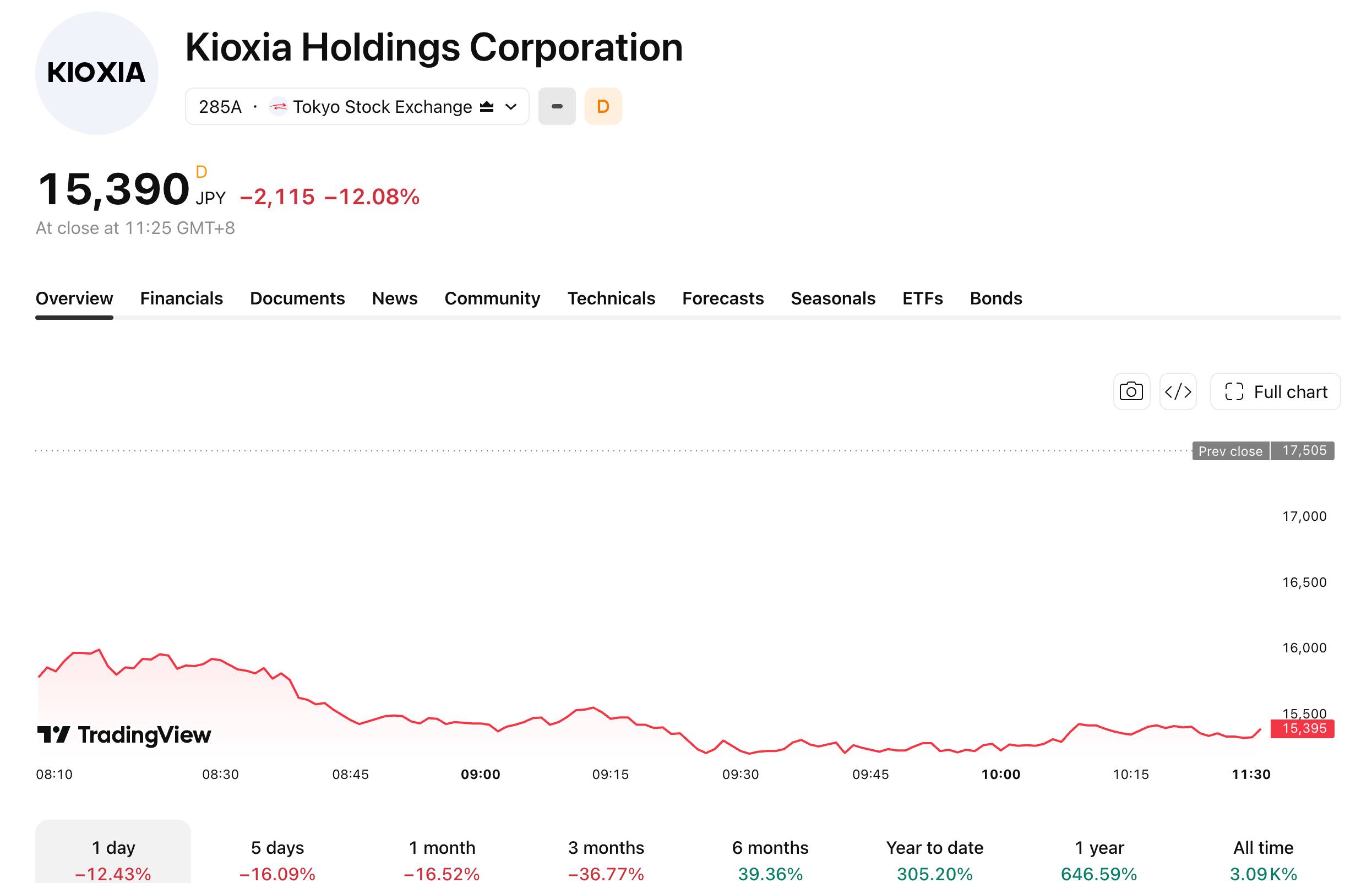
[Source: TradingView]
Can CXMT’s 4F² Technology Reshape DRAM Competition?
Currently, mainstream DRAM mostly adopts a 6F² memory cell architecture. By shrinking the footprint of individual memory cells, 4F² increases storage density per wafer, theoretically helping to lower the cost per unit of capacity.
ChangXin Memory Technologies (CXMT) disclosed that its 4F² architecture combines vertical channel transistors with hybrid bonding technology, with plans to first apply it to server DDR5 RDIMMs. The relevant products remain in the pre-launch stage, and specific specifications, mass production scale, and customer lists have not yet been disclosed.
Server memory places high requirements on stability, power consumption, reliability, and long-term supply capability. For CXMT to convert 4F² technology into commercial products, it still needs to complete pilot production, yield improvement, module testing, and customer qualification. Therefore, at this stage, the actual impact on the competitive landscape of the industry cannot be judged solely by the technology roadmap.
According to Counterpoint estimates, in the second quarter of 2026, Samsung Electronics held a global DRAM market share of approximately 38%, ranking first; SK Hynix held about 25%, ranking second; and CXMT held about 10%.
Meanwhile, Kioxia mainly focuses on NAND flash memory and solid-state drives and is not a major DRAM supplier. Data from TrendForce shows that in the second quarter of 2026, Kioxia's NAND revenue was approximately $10.72 billion, with a revenue share of about 13.6%, ranking fourth.
Market | Company | Q2 2026 Share or Ranking |
DRAM | Samsung Electronics | Approx. 38% share, ranked first |
DRAM | SK Hynix | Approx. 25% share, ranked second |
DRAM | CXMT | Approx. 10% share, industry estimate |
NAND | Samsung Electronics | Revenue share of approx. 29.3%, ranked first |
NAND | Kioxia | Revenue share of approx. 13.6%, ranked fourth |
Samsung and SK Hynix: Short-Term Impact Focused on Legacy DRAM
If CXMT completes DDR5 server memory qualification and expands shipments, the competitive impact may first be reflected in supply choices and price negotiations within the Chinese market. Only if its products further pass qualification by overseas server customers might Samsung and SK Hynix face more noticeable pressure on orders and pricing.
According to currently disclosed product plans, CXMT's 4F² technology is primarily aimed at DDR5 DRAM, exerting limited direct impact on the HBM businesses of Samsung and SK Hynix. Samsung has announced that it has begun mass production of HBM4 and started shipping to customers; its subsequent performance will still depend on HBM shipment scale, customer adoption, and product pricing.
Whether CXMT can enter the global server supply chain also depends on product qualification, supply stability, mass production yield rates, and relevant trade policies. At this stage, CXMT is more appropriately viewed as a potential competitor in the conventional DRAM market and cannot yet be seen as a direct substitute for high-end HBM products from Samsung and SK Hynix.
Kioxia: Impact Mainly Comes From Server Storage Budgets
CXMT's current product plans focus on DRAM and do not directly compete with Kioxia's NAND flash and enterprise SSDs for now. Even if CXMT expands its supply of DDR5 server memory, there is currently no evidence that it will directly lead to a reduction in Kioxia's NAND or SSD orders.
The potential impact lies mainly in server hardware procurement structures and supplier negotiations. If DRAM prices, supply, or procurement shares change, cloud service providers may adjust their server budgets, but demand for enterprise SSDs will not necessarily decline as a result.
If DRAM costs decrease, the saved budget could also be used to expand storage capacity or procure other data center equipment. Kioxia's future performance will still depend primarily on NAND prices, enterprise SSD orders, product mix, and data center investments.
How Big a Threat Is CXMT?
CXMT's 4F² technology progress has heightened competitive expectations in the DRAM market, but it is currently insufficient to prove that Samsung and SK Hynix's high-end HBM businesses will face a significant impact.
CXMT's actual impact still hinges on four key developments: whether products can be launched on schedule, whether mass-production yield rates meet targets, whether server customer qualifications can be completed, and whether shipment volumes can continue to expand.
Based on current product positioning, if CXMT achieves stable mass production, the impact will likely first manifest in China's DDR5 market, increasing regional competitive pressure through price negotiations and supply options. Only after securing qualifications from more overseas server customers and expanding shipments could the competitive impact extend further to the global market.
If progress in mass production, qualification, or shipments falls below expectations, the market impact will remain largely at the level of expectations. Samsung and SK Hynix need to monitor changes in conventional DRAM prices, orders, and market share. Meanwhile, Kioxia faces no direct product competition from CXMT, and its primary focus will remain on NAND prices, enterprise SSD orders, and data center investments.
Recommended Articles


