


The S&P 500's Safety Net Is Disappearing. History Says Investors Shouldn't Ignore It.
Key Points
Long-term Treasury yields are at multidecade highs.
But that's not necessarily a bad thing for the S&P 500.
Here's why corporate earnings growth can do the heavy lifting instead.
- These 10 stocks could mint the next wave of millionaires ›
For the vast majority of 2009 to 2022, U.S. stocks had a powerful tailwind at their back: ultra-low interest rates.
Lower rates made bonds less competitive. They reduced the discount rate applied to future corporate earnings. They helped support higher stock valuations.
Missed AI’s "Act 1"? Act 2 Could Be 15x Bigger. Most investors think they missed the AI boat because they didn't buy Nvidia in 2005. But according to our analysts, we’re only at the end of "Act 1"—the R&D phase. "Act 2" is the global rollout. Continue »
All of these factors were broadly positive for equities, including the Vanguard S&P 500 ETF (NYSEMKT: VOO) and the Vanguard Total Stock Market ETF (NYSEMKT: VTI).
But those same conditions aren't around today.
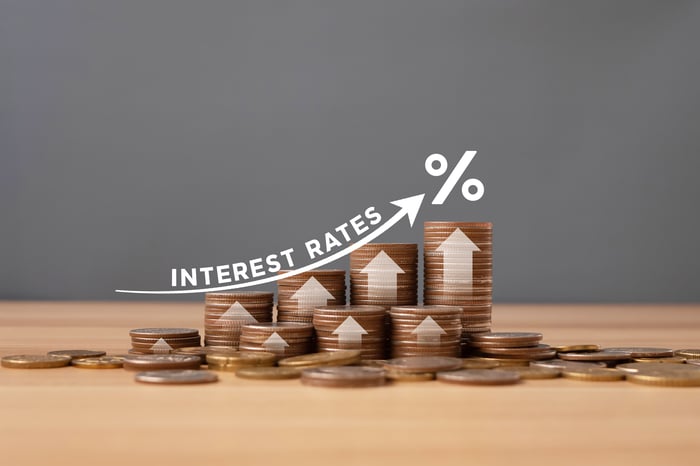
Image source: Getty Images.
Both the 10-year and 30-year Treasury yields are near two-decade highs (5.32% and 5.70%, respectively). With both rates well above 5%, it makes it more challenging to justify high stock valuations. The artificial intelligence (AI) boom is helping to generate the strong earnings growth necessary to keep stock prices and the S&P 500 (SNPINDEX: ^GSPC) high. But the margin for error now is getting thinner.
High rates aren't necessarily the big problem
Most investors believe that high interest rates are a negative for stocks. In isolation, that's probably true. But history says that it's more complicated than that.
In reality, rates can rise for different reasons. In high inflation environments, yields often move higher. On the other hand, they can also rise because economic growth is strong and corporate earnings growth is accelerating.
We're seeing a little bit of both of those factors in today's economy. The revenue and earnings growth from the AI boom is offsetting some of the current pressure from inflation and Federal Reserve rate hikes. That's a big reason we're seeing the bond market tank while the S&P 500 holds near all-time highs. That's not holding across the board, though, from what we've seen in September sector returns. But the major indexes are sustaining for now.
In short, stocks don't need falling rates to move higher. Fundamentals and earnings do a lot of the work, too.
Here's what I'd do with VOO and VTI today
A lot of people have been forecasting an economic downturn and a stock correction for months, based on the rising rates narrative. Anybody remaining invested in the Vanguard S&P 500 ETF and the Vanguard Total Stock Market ETF, however, has been rewarded for ignoring the doomer narratives and staying the course.
In other words, we have no idea what's going to happen at any point in the future. That's why long-term buy-and-hold is usually the best path. Ignore the short-term noise and focus on the long-term goals.
I think that's the right approach to take today. If corporate earnings grow as expected in 2026 and 2027, fundamentals could support a continuation of the current rally. Even if rates keep rising, give the story time to play out.
Where to invest $1,000 right now
When our analyst team has a stock tip, it can pay to listen. After all, Stock Advisor’s total average return is 955%* — a market-crushing outperformance compared to 215% for the S&P 500.
They just revealed what they believe are the 10 best stocks for investors to buy right now, available when you join Stock Advisor.
See the stocks »
*Stock Advisor returns as of October 9, 2026.
David Dierking has positions in Vanguard Morningstar Total Stock Market ETF. The Motley Fool has positions in and recommends Vanguard S&P 500 ETF. The Motley Fool has a disclosure policy.
Recommended Articles


