


How Much Would You Need to Invest in These 4 High-Yield Stocks to Earn $1,000 a Month?
Key Points
Many consider dividend yields in the 3% to 5% range very attractive.
There are even some companies with dividend yields of 15% or higher.
Real estate investment trusts often pay high dividends.
- 10 stocks we like better than Realty Income ›
Most investors would agree that sitting back each month and collecting $1,000 in passive income would be pretty sweet. But there are no free lunches. Even when investing in dividend stocks, it's important to conduct due diligence on a company's operating business to ensure it can support the dividend.
When a dividend yield looks too good to be true, it usually is. That said, astute investors who do the work can find attractive dividend stocks. Here's how much you would need to invest in these four high-yield dividend stocks to earn $1,000 per month in passive income.
Missed AI’s "Act 1"? Act 2 Could Be 15x Bigger. Most investors think they missed the AI boat because they didn't buy Nvidia in 2005. But according to our analysts, we’re only at the end of "Act 1"—the R&D phase. "Act 2" is the global rollout. Continue »

Image source: Getty Images.
REITs typically pay higher dividend yields by design
One area to look for strong-paying dividends is real estate investment trusts (REITs). REITs operate under a special corporate structure in which they can avoid paying corporate taxes if they distribute 90% of their taxable income to shareholders.
They also tend to pay dividends monthly, unlike most companies, which pay them quarterly. However, as the name implies, REITs must follow other guidelines, including investing at least 75% of their capital in real estate.
Four REITs that pay high yields are AGNC Investment Corp. (NASDAQ: AGNC), Annaly Capital Management (NYSE: NLY), Realty Income (NYSE: O), and Vici Properties (NYSE: VICI).
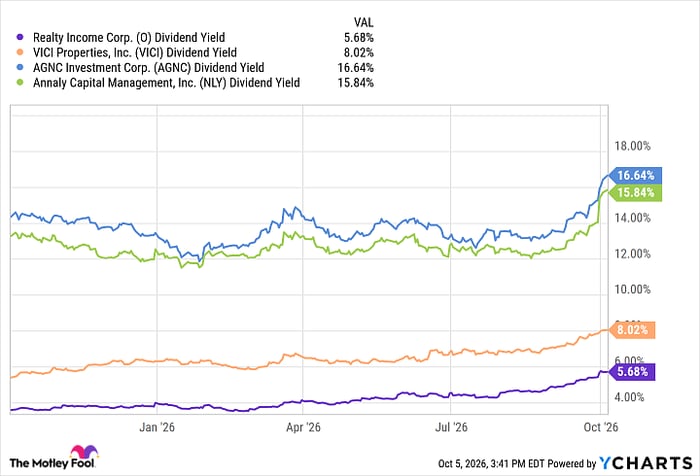
Data by YCharts.
As you can see, some dividend yields, such as those on AGNC and Annaly, are simply unheard of. Investors should understand that there is often an underlying reason that explains a high dividend yield, and often that reason is problematic. This is why a thorough financial analysis is required.
AGNC and Annaly are mortgage REITs, meaning they invest most of their capital in agency mortgage-backed securities (MBS), which receive cash flows from a pool of mortgages. Agency mortgages are also guaranteed by the government, meaning the government will cover any credit losses.
The main risk for AGNC and Annaly is interest rate risk. Rising rates make older MBS with lower fixed rates less valuable than newly issued ones, so their prices fall. They also have significant leverage, so swings in the fair value of their MBS can significantly lower book value. Higher rates also increase borrowing costs.
As a result, AGNC and Annaly do their best to hedge their balance sheets to protect against wild swings in interest rates, as we've seen in recent years. But it's obviously easier said than done. AGNC cut its dividend in 2020, although it has since maintained a $0.12 monthly dividend per share.
So, while AGNC and Annaly's dividends are attractive, they are by no means a guarantee, and Wall Street analysts are always worried about their long-term sustainability. Mortgage REITs tend to perform best when interest rates are steadier, and the yield curve is normal, with short-term bonds yielding less than long-term ones.
Companies like Realty Income and VICI actually buy physical real estate. Both work as triple-net lease operators, in which they lease properties to large clients, who are then responsible for property taxes, maintenance, and other costs such as insurance. In return, tenants get more control over the spaces they operate in and may be able to negotiate longer-term leases at better rates.
In my opinion, the dividends on these types of REITs, known as equity REITs, are easier to evaluate. For instance, VICI's second-quarter dividend was $0.45 per share, while the company's adjusted funds from operations (AFFO), which is like free cash flow for a REIT, was $0.62 per share.
There are other concerns investors need to monitor. For instance, VICI leases properties to large casinos like Caesars Entertainment. Some analysts worry that VICI may eventually have to lower Caesars' rent, which could reduce AFFO. However, VICI recently disclosed that Caesars remains current on rent.
Since it began paying a dividend in 2018, VICI has raised its annual dividend each year. Realty Income has increased its annual dividend for 31 straight years.
How to make $1,000 in monthly dividends
Assuming you are OK with the risks presented in some of these stocks, if you want to make $1,000 per month in dividends by investing in these four high-yield stocks, that means you need to make $12,000 per year in dividends.
These four stocks have an average annual dividend yield (based on their trailing yields above) of 11.55%, meaning one would need to invest $103,941 to earn $12,000 in passive income per year, or $1,000 per month. Split evenly, that's investing $25,985 in each stock.
Should you buy stock in Realty Income right now?
Before you buy stock in Realty Income, consider this:
The Motley Fool Stock Advisor analyst team just identified what they believe are the 10 best stocks for investors to buy now… and Realty Income wasn’t one of them. The 10 stocks that made the cut could produce monster returns in the coming years.
Consider when Netflix made this list on December 17, 2004... if you invested $1,000 at the time of our recommendation, you’d have $375,887!* Or when Nvidia made this list on April 15, 2005... if you invested $1,000 at the time of our recommendation, you’d have $1,459,146!*
Now, it’s worth noting Stock Advisor’s total average return is 955% — a market-crushing outperformance compared to 215% for the S&P 500. Don't miss the latest top 10 list, available with Stock Advisor, and join an investing community built by individual investors for individual investors.
See the 10 stocks »
*Stock Advisor returns as of October 9, 2026.
Bram Berkowitz has no position in any of the stocks mentioned. The Motley Fool has positions in and recommends Realty Income. The Motley Fool recommends Vici Properties. The Motley Fool has a disclosure policy.
Recommended Articles


