


If I Had $5,000 to Invest Today, Here's the Trillion-Dollar Stock I'd Buy Instead of SpaceX
Key Points
Space Exploration Technologies (SpaceX) stock recently peaked at $225, but it has since lost 29% of its value.
SpaceX has plenty of potential, but its stock is trading at a sky-high valuation which could open the door to more downside in the near term.
Microsoft might be a better investment because of its growing dominance in enterprise artificial intelligence, and its relatively cheap stock.
- 10 stocks we like better than Microsoft ›
Elon Musk's Space Exploration Technologies (NASDAQ: SPCX) went public in June, and it received a positive reception from investors who quickly sent its stock soaring to a peak of $225. However, the initial enthusiasm faded, and the stock has since declined by 29% to $158.96 (as of the market close last Friday, Oct. 2).
Valuation might be the reason why. SpaceX still has a market capitalization of $2.1 trillion, so based on the company's trailing 12-month revenue of $23 billion, its stock trades at a hefty price-to-sales (P/S) ratio of 94, making it 14 times as expensive as the technology-heavy Nasdaq-100 index.
Missed AI’s "Act 1"? Act 2 Could Be 15x Bigger. Most investors think they missed the AI boat because they didn't buy Nvidia in 2005. But according to our analysts, we’re only at the end of "Act 1"—the R&D phase. "Act 2" is the global rollout. Continue »
Therefore, although management is predicting significant revenue growth over the next few years, more downside might be ahead for SpaceX stock in the near term. Value investors might want to look elsewhere for positive returns, and if I had $5,000 to deploy into one stock today, here's why I'd buy Microsoft (NASDAQ: MSFT) instead.

Image source: Getty Images.
Microsoft wants to dominate enterprise artificial intelligence
Artificial intelligence (AI) has the potential to significantly increase productivity in the enterprise. It can rapidly analyze high volumes of data, instantly generate text and images, and even automate repetitive tasks entirely so employees can focus on more important things. Microsoft is helping businesses unlock the power of AI primarily through its Copilot virtual assistant and its Azure cloud platform.
Copilot is embedded in legacy software products like Windows, Bing, and Edge for free. But enterprises can also add it to the 365 productivity suite (which includes Word, Excel, PowerPoint, and Outlook) for an additional monthly subscription fee. As of June 30, companies all over the world were paying for 30 million Copilot licenses for 365, a whopping 50% increase from just three months earlier. But that's a mere fraction of Microsoft's opportunity, because companies pay for over 400 million 365 licenses for their employees, and all of them are candidates for the Copilot upgrade.
The Azure cloud platform offers all the tools enterprises need to develop and deploy AI software, including computing capacity from state-of-the-art data centers, foundation models from labs like OpenAI, and the Foundry platform where they can manage AI agents. As of June 30, Microsoft had a staggering $678 billion order backlog from customers who were waiting for more data centers to come online.
Microsoft built 88 new data centers during its 2026 fiscal year as part of a two-year plan to double its global infrastructure footprint. This will help the company convert that enormous backlog into revenue. On that note, Azure's annual revenue topped $100 billion for the first time during fiscal 2026, and the platform ended the year with an accelerating growth rate that hit 43% in the fourth quarter. In other words, Azure has a ton of momentum right now.
Microsoft looks like a bargain compared to SpaceX
Microsoft stock is trading at a P/S ratio of 11.6, so it's more expensive than the Nasdaq-100 which has a P/S ratio of 6.5. However, it's significantly cheaper than SpaceX by that valuation metric.
Plus, Microsoft is highly profitable, so we can also value its stock using the more traditional price-to-earnings (P/E) ratio. Based on the company's fiscal 2026 earnings of $17.95 per share, its stock is trading at a P/E ratio of 28.8, which is below its five-year average of 32. It's also cheaper than the Nasdaq-100 by this particular metric, because the index has a P/E ratio of 34.7.
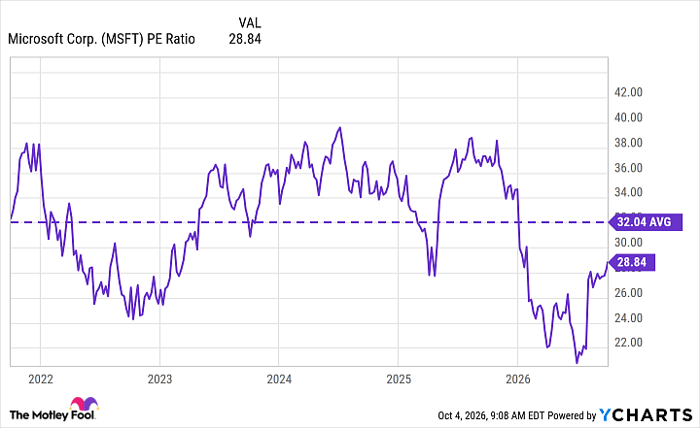
MSFT PE Ratio data by YCharts
Looking ahead, Microsoft has a significant advantage over AI companies like OpenAI and Anthropic in the race to dominate enterprise AI, because its legacy software products have so many existing users. As I highlighted earlier, organizations around the world already pay for over 400 million 365 licenses, but the Windows operating system is also used on a whopping 1.6 billion monthly active devices.
Therefore, while OpenAI and Anthropic have to build an enterprise customer base from scratch -- which can be very expensive -- Microsoft can sell AI products like Copilot to hundreds of millions of potential users with virtually no customer acquisition costs.
Combined with the incredible growth in the Azure cloud platform and the company's attractive valuation, I think Microsoft stock has significantly more upside potential from here than SpaceX stock.
Should you buy stock in Microsoft right now?
Before you buy stock in Microsoft, consider this:
The Motley Fool Stock Advisor analyst team just identified what they believe are the 10 best stocks for investors to buy now… and Microsoft wasn’t one of them. The 10 stocks that made the cut could produce monster returns in the coming years.
Consider when Netflix made this list on December 17, 2004... if you invested $1,000 at the time of our recommendation, you’d have $364,023!* Or when Nvidia made this list on April 15, 2005... if you invested $1,000 at the time of our recommendation, you’d have $1,467,933!*
Now, it’s worth noting Stock Advisor’s total average return is 948% — a market-crushing outperformance compared to 214% for the S&P 500. Don't miss the latest top 10 list, available with Stock Advisor, and join an investing community built by individual investors for individual investors.
See the 10 stocks »
*Stock Advisor returns as of October 7, 2026.
Anthony Di Pizio has no position in any of the stocks mentioned. The Motley Fool has positions in and recommends Microsoft. The Motley Fool has a disclosure policy.
Recommended Articles


