


Dell Technologies Stock Forecast: $95 Billion AI Backlog Keeps Growth Accelerating
Dell Technologies (NYSE: DELL) is trading near recent highs as the AI infrastructure boom propels the computer company to new heights. DELL closed at $562.52 on October 2, 2026, up 3.84% from the previous day, putting shares at a 5.5% deficit from the September 18, 2026 52-week high of $595.51. The company’s newest earnings report sparked interest as the demand for AI servers, traditional infrastructure, storage and commercial PCs helped fuel the company’s growth.
What’s most interesting is the breadth of this acceleration. Dell has a $95 billion backlog for AI servers, while traditional servers and networking are both growing at triple-digit rates and storage is also growing once again. Commercial PCs are also helping to drive growth. The question isn’t if there is demand for Dell’s products, it is if the company can convert the backlog to revenue while protecting the stronger margins.
Japan AI Project Adds Another Growth Avenue
On October 1, Dell, JERA, and RHAELM signed a memorandum of understanding to build hyperscale AI infrastructure in Japan. The first project is to build a 400 MW hyperscale data center in Chiba, Japan. The total cost of the project is expected to be over 15 billion dollars. The investment will be for land, building, and power and AI compute infrastructure. Apollo Global Management will participate as a strategic financing partner for RHAELM.
Dell will provide standardized rack-scale AI infrastructure, JERA will provide the site and power capacity, and RHAELM will lead development, construction, operations and financing. Phased operations are expected to begin around 2028, with full capacity targeted for 2029. The parties expect additional deployments at other JERA sites in the 2030s. The 15 billion dollar price tag is not Dell revenue because no Dell contract value has been disclosed. The agreement shows that Dell is positioning itself to provide large scale AI compute racks for sovereign and hyperscale AI projects.
AI-Server Backlog Reaches $95 Billion
Dell’s Q2 2027 results have Investors even more excited, after recording $60.9B in orders for AI Servers in the quarter, recognizing $16.4B in revenue from AI optimized servers, and leaving Q2 with a record $95B backlog of AI Server orders. They also stated they have recorded over $130B of AI server orders in the last 12 months.
The backlog improves revenue predictability, and management increased their outlook for AI server revenue from $60B to $74B for the full year. For me, the major issue is execution, as Dell now must quickly source GPUs, memory and networking components without giving back the margin gains from Q2.
Q2 Revenue and Earnings Accelerated Sharply
Dell's fiscal second quarter results included record revenue of $47.0 billion, up 58% year over year, and records for both GAAP and non-GAAP diluted EPS. Cash flow from operations was $2.2 billion. Management characterized the quarter as another step-up in scale and profitability.
Revenue in the Infrastructure Solutions Group (ISG) soared 89% to $31.8 billion. Within ISG, revenues from AI-optimized servers doubled to $16.4 billion, traditional servers and networking products more than doubled to $10.5 billion, and storage increased 26% to $4.9 billion. Operating income for ISG increased 225% to about $4.8 billion.
What's important to note in Dell's quarter was the improved operating margins in the Infrastructure Solutions Group. For years, Wall Street analysts expressed concerns about Dell's AI Hardware margins, and rightfully so. Given the nature of the AI Hardware and the components used (e.g. GPUs), margins get crushed even if revenue increases. Quarter 2 results showed that Dell was able to create stronger absolute profits and improve segment margins with AI Hardware volume.
PC Growth Is Contributing Again
Dell’s Client Solutions Group (CSG) also made good progress. CSG revenue came to $15.0 billion, up 20% versus last year, with commercial-client revenue up 22% to $13.2 billion, a new high. Consumer revenue improved 7% to $1.84 billion and CSG operating income improved 42% to approximately $1.1 billion.
This is good because the replacement cycle for commercial PCs is another growth opportunity for Dell separate from the AI server business. Additionally, Dell’s storage, and server sales, along with the PC business, create a balanced mix.
Gross Margin Improvement Changes the Debate
Dell’s GAAP gross margin improved to 20.9% from 18.3% last year, and non-GAAP gross margin improved to 21.1%. This was the case even with AI servers being a larger part of the overall revenue mix. Prior to this, there was concern about how the server mix would impact the overall business. Operating leverage also improved as expenses grew much slower than revenue.
There is still risk around AI systems. Management has acknowledged that certain infrastructure components remain scarce, but based on the results to this point, Dell is improving its ability to use scale, pricing discipline and operating efficiency to manage the effect of AI systems on its business.
FY2027 Guidance Was Raised Aggressively
Full-year fiscal 2027 revenue guidance was increased by $25 billion to $192 billion, representing ~69% growth at the mid-point from last year. Additionally, management increased their AI-optimized server revenue guidance to $74 billion from $60 billion, roughly 3x year over year. Further, management increased their GAAP diluted EPS to $24.37 and non-GAAP EPS to $25.50.
For fiscal Q3, management expects ~$49 billion in revenue and non-GAAP EPS of $6.50.
Dell’s size makes the revisions especially notable. The stock has already re-rated significantly, so next move higher will depend on Dell meeting or beating revised guidance. I will focus most on AI orders, backlog conversion, component supply and ISG margins.
Cash Generation Supports Shareholder Returns
Dell Technologies (Dell) reported $2.2 billion in operating cash flow for Q2. The company returned $4.3 billion to its shareholders via dividends and share repurchases. The Dell board of directors also recently approved a quarterly dividend of $0.63. Dell has continued to reduce its share count through share repurchases. Reduced share counts mean less shares participate in the earnings of the company.
Dell has reported a record backlog of $95 billion. To meet this backlog, Dell needs to address working capital issues and effectively manage its supply chain. For Dell, the case for the strongest shareholder returns is made when cash returns to shareholders is funded by cash generated by the business rather than through cutting the capacity to invest in the business.
The Next Test Is Backlog Conversion
Dell has had a strong year. At the end of fiscal 2026, the company had a $43 billion AI-server backlog, which rose to $51.3 billion after Q1 and $95 billion after Q2 of fiscal 2027. In the last year, the backlog has accelerated along with earnings. Demand for Dell's PCs and storage products has increased along with traditional infrastructure. Dell also has better margins and a strong partnership with JERA to build AI infrastructure. The JERA project shows that Dell is moving away from one-off server sales and getting involved in larger projects.
Dell still has operational risks. In 2026, Dell has faced supply constraints, including memory and other infrastructure components. There is a risk that with an increase in AI orders, Dell would be unable to secure the components to meet demand, while also maintaining discipline on pricing. Dell has not officially announced its fiscal Q3 earnings date, but market calendars suggest it will be in late November.
Valuation Reflects High Expectations
On October 2, Dell's market capitalization was about $357.7 billion. At that time, the stock had a trailing price to earnings (P/E) ratio of 32.8 and a forward P/E ratio of about 20. Before the AI infrastructure cycle, Dell traded at a P/E ratio in the mid-to-low single digits. The market is betting strongly that strong earnings and backlog conversions will continue.
I agree with the market that the strong conversions and earnings will continue; however, a dip in AI orders or component shortages could lead to a greater drop in the stock price than previously expected since the market is already pricing in significant success.
Dell Technologies Technical Analysis: DELL Tests $566.96 Resistance as Bullish Momentum Rebuilds
Dell closed at $562.52 on October 2 after rebounding from $529.53 to $531.32. What is important here is the clean defense of the rising trendline and the 100-period moving average, followed by a recovery of the 50-period average at $547.25. As a result, the bullish structure is intact, and DELL is again testing a new breakout.
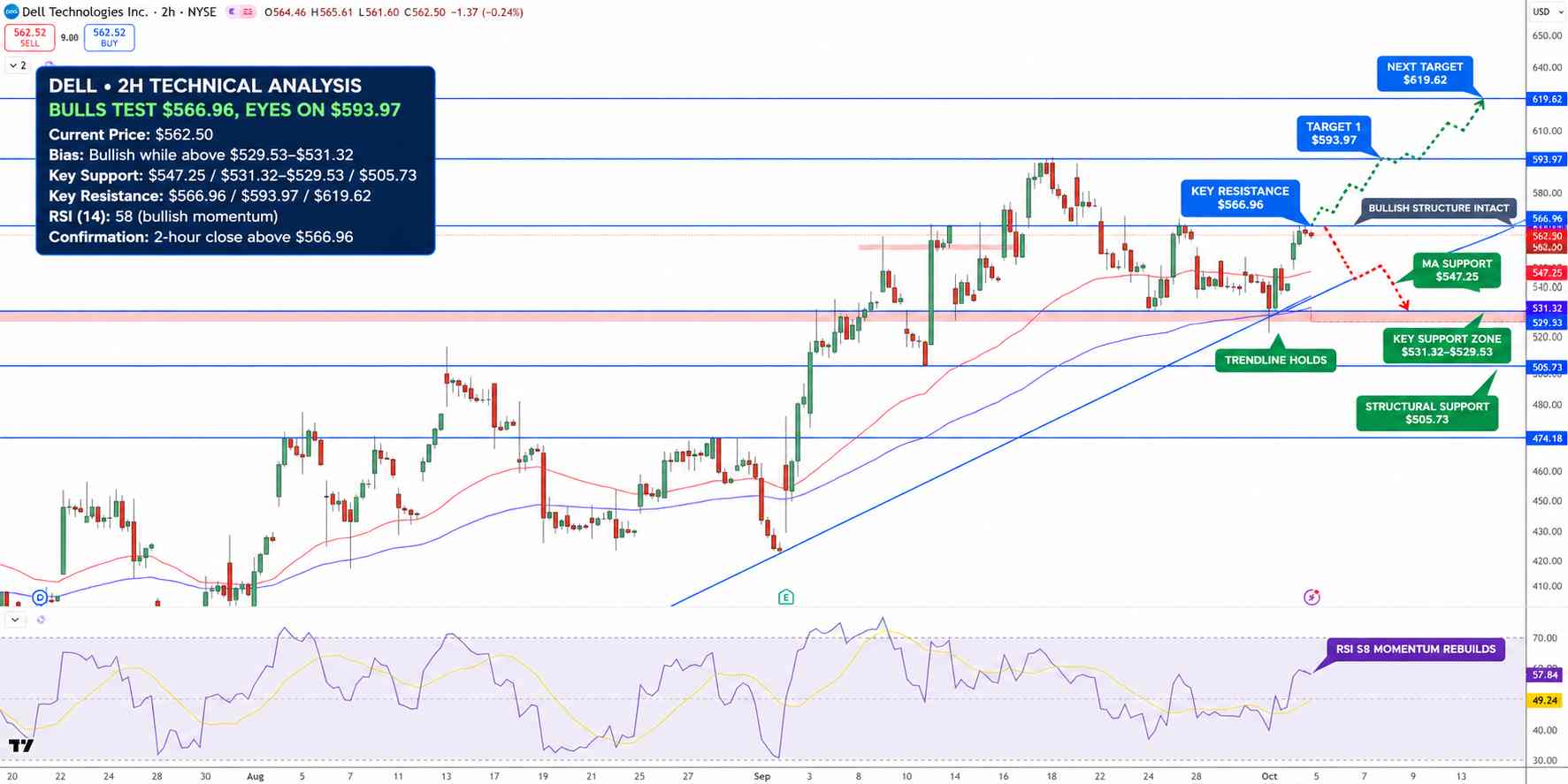
Dell Technologies Price Chart - Source: Tradingview
RSI is around 58, and therefore is above its signal line of 49 and the neutral 50 line. As a result, the momentum is bullish, and there are no overbought conditions. The next resistance level is at $566.96, and if the bulls close above it in the next two hours, it would give a positive signal to the breakout trade.
In the case of a clean break above $566.96, the next resistance level would be at $593.97, and beyond that at $619.62. Support would come at $547.25 and then at $531.32 to $529.53, where a rising trendline and a longer-term moving average come together. As long as Dell holds above the $529.53 to $531.32 support zone, my bullish bias would remain intact.
Key Levels
- Latest close: $562.52
- Major support levels: $547.25, $531.32 to $529.53, then $505.73
- Major resistance levels: $566.96, $593.97, then $619.62
- RSI: approximately 58, bullish
- Breakout target: $593.97 above a confirmed $566.96 break
Why is Dell stock in focus now?
Dell is receiving attention due to record revenues in fiscal Q2, a $95 billion backlog for AI Servers, and much higher profitability at the Infrastructure Solutions Group (ISG). As a result, Dell is guiding much higher for the full year. The October 1 partnership with JERA adds another opportunity in the rapidly developing area of AI infrastructure, and while the project investment is expected to exceed $15 billion, that amount should not be treated as Dell revenue.
What level confirms a stronger DELL breakout?
A sustained 2-hour close above $566.96 would confirm a stronger breakout and increase the likelihood of a move to $593.97. A break of the $529.53 to $531.32 support would negate the bullish case and increase the likelihood of a move to $505.73.
Bottom Line
Dell heads into the week with one of the largest AI infrastructure backlogs, and continues to gain AI server order share as evidenced by record Q2 revenues. While order share is increasing for AI Servers, it is also increasing for Commercial PCs, Storage, and Traditional Infrastructure. Margin improvements make the earnings case more compelling. Execution in this case would mainly focus on supply and pricing, and has increased the focus on ensuring inventory is available to fulfill orders.
Dell remains bullish as long as it trades above $529.53, and increased likelihood for a move to $593.97 is seen on a break above $566.96. Improving the case for high margin, sustained earnings and cash flow is the next major focus for the company.
Recommended Articles


