


Want Reliable Dividend Income? These 2 Industrial Stocks Deliver.
Key Points
Caterpillar is seeing increased business from data center operators seeking secure power sources.
Waste Management, or WM, has a massive network of landfills, transfer stations, and recycling facilities.
- 10 stocks we like better than Caterpillar ›
With the economy facing plenty of issues these days -- higher prices, rising interest rates, elevated gas prices -- and other challenges that make it harder to make ends meet, investors with sizable portfolios could consider shifting their holdings into industrial stocks to get some extra reliable income.
Companies in the industrial sector can be particularly well suited for dividend investors because many operate mature businesses that generate reliable cash flow. This allows management to return some of that cash to investors. And because these companies often operate in businesses that are essential to the broader economy, investors can benefit from demand even if the overall economy deteriorates.
Missed AI’s "Act 1"? Act 2 Could Be 15x Bigger. Most investors think they missed the AI boat because they didn't buy Nvidia in 2005. But according to our analysts, we’re only at the end of "Act 1"—the R&D phase. "Act 2" is the global rollout. Continue »
Two of my favorite companies in this space are Caterpillar (NYSE: CAT) and Waste Management (NYSE: WM). Both seem poised to continue paying their dividends well into the future.
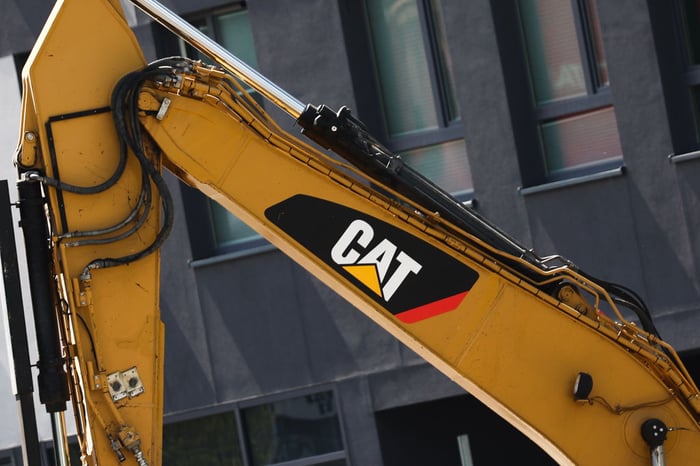
Image source: Getty Images.
Industrial dividend stock No. 1: Caterpillar
You may best know Caterpillar for its big yellow machines commonly seen at construction sites and mines; the company's equipment is so well known that its toy trucks are still popular with kids everywhere.
But Caterpillar has also become an important company supporting the growth of artificial intelligence. It makes fast-response natural gas generators that can provide reliable power for AI data centers -- providing an interesting growth opportunity to Caterpillar's legacy construction business.
Revenue in the second quarter was $20.5 billion, up 24% from a year ago. Profits were $7.77 per share, with an operating profit margin of 20.9% -- an improvement from $4.62 and 17.3% in Q2 2025. The company's power generation business was particularly strong, up 72% from a year ago.
Caterpillar returned $2.2 billion to shareholders in the quarter, including $700 million in dividends. Caterpillar stock is up 43% this year, and pays a dividend of $6.52 per share, with a yield of 0.8%. While that is a relatively small yield, I'm more interested in the growth and consistency; Caterpillar has increased its dividend for 32 consecutive years, and the dividend itself has grown nearly 47% over just the last five years.
Industrial dividend stock No. 2: Waste Management
Waste Management, or WM, is the biggest garbage collector in North America, with more than 19,000 daily routes. But really, its role is much more than just emptying garbage cans. Waste Management operates a huge network of landfills, transfer stations, and recycling facilities, handling everything from medical and hazardous waste to residential and commercial refuse.
And the company sees a huge opportunity in the recycling market in the U.S. and Canada. Waste Management currently has the largest percentage of the business, at $25.2 billion, but sees a total market opportunity of $130 billion in the two countries.
Revenue in the second quarter was $6.68 billion, up from $6.43 billion a year ago. Net income was $785 million and $1.95 per share, versus $726 million and $1.80 per share in the second quarter of 2025. That profitability helped WM return $1.04 billion to shareholders in the quarter, including $379 million in dividends.
Waste Management stock is down 6% this year, but the company's dividend yield of $3.78 per share (with a dividend yield of 1.8%) appears secure, particularly since the company has increased its dividend annually for 23 consecutive years. And its dividend has grown even faster than Caterpillar, charting a 64% increase in the last five years.
These stocks are built for the long haul
While Caterpillar and WM don't have the highest yields, those yields don't tell the full story. Industrial companies aren't immune to recessions, but companies such as Caterpillar and WM, with their strong, competitive positions and healthy balance sheets, can provide consistent, reliable income to investors. Both have shown a commitment to increasing their payouts, making them appealing choices for income investors.
Should you buy stock in Caterpillar right now?
Before you buy stock in Caterpillar, consider this:
The Motley Fool Stock Advisor analyst team just identified what they believe are the 10 best stocks for investors to buy now… and Caterpillar wasn’t one of them. The 10 stocks that made the cut could produce monster returns in the coming years.
Consider when Netflix made this list on December 17, 2004... if you invested $1,000 at the time of our recommendation, you’d have $375,240!* Or when Nvidia made this list on April 15, 2005... if you invested $1,000 at the time of our recommendation, you’d have $1,403,292!*
Now, it’s worth noting Stock Advisor’s total average return is 933% — a market-crushing outperformance compared to 211% for the S&P 500. Don't miss the latest top 10 list, available with Stock Advisor, and join an investing community built by individual investors for individual investors.
See the 10 stocks »
*Stock Advisor returns as of October 1, 2026.
Patrick Sanders has no position in any of the stocks mentioned. The Motley Fool has positions in and recommends Caterpillar. The Motley Fool recommends WM. The Motley Fool has a disclosure policy.
Recommended Articles


