


Here's Where Wall Street Analysts See Eli Lilly's Share Price Going
Key Points
Wall Street analysts are modestly bullish on the stock.
However, the expanding GLP-1 market and Lilly's strong patents suggest it can regain momentum.
- 10 stocks we like better than Eli Lilly ›
Eli Lilly (NYSE: LLY) has had an impressive run over the past few years. The stock is up 410% over the last five years and 58% over the past 52 weeks. Its performance this year, however, has been a bit more modest, up just 10.1%. So, it's underperforming the broader market, as measured by the S&P 500 (SNPINDEX: ^GSPC), which gained around 12.5% so far in 2026.
I think the deceleration in the stock's climb this year is probably due to its run-up over the past few years, which has made it expensive. Lilly currently trades at about 40 times trailing earnings.
Missed Nvidia in 2009? This Rare Signal Is Flashing Again. In 2009, a "Double Down" signal flashed for a little-known chipmaker called Nvidia. For the first time in years, that same "Total Conviction" signal is flashing for a company 1/100th the size of Nvidia. Continue »
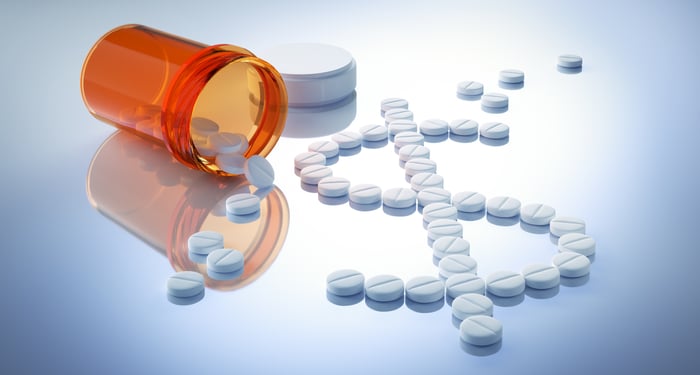
Image source: Getty Images.
But remember, Eli Lilly makes the world's best-selling drug. In the third quarter of 2025, the company's tirzepatide, a GLP-1 dual receptor agonist, overtook Merck's blockbuster cancer drug Keytruda as the top seller worldwide. Tirzepatide is sold as Mounjaro to treat type 2 diabetes and Zepbound for weight loss.
And the market for GLP-1 drugs is projected to soar. Morgan Stanley sees it hitting $190 billion by 2045, more than double the 2025 level. The investment bank recently increased its forecast by $40 billion due to the launch of oral therapies and the expansion of Medicare coverage in the U.S.
Wall Street is moderately bullish on Eli Lilly
So where does the stock go from here? Well, I checked the latest data on price targets for Lilly shares, which are Wall Street analysts' official predictions of where the stock will be in 12 to 18 months, based on historical and projected earnings. All in all, analysts covering the stock are bullish, though not overly so.
The average price target for Lilly is $1,325, which is about 11% above the current price of $1,193. And of the 30 major analysts that cover Eli Lilly, 25 recommend a "buy" or "strong buy." Citigroup is the most bullish on the drugmaker, with a "buy" recommendation and a price target of $1,600. HSBC is the most bearish, with a target of $940 and a rating of "reduce."
Some of these analysts are probably concerned that Lilly's current dominance in the GLP-1 market won't last. Lilly's main competitor in the GLP-1 space, Novo Nordisk (NYSE: NVO), has developed its own oral GLP-1 weight loss drug called Wegovy. And other companies are looking to do the same. But Lilly's tirzepatide has patents that extend into the late 2030s, and the company has several follow-on patents for delivery devices, formulations, and treatment methods.
So yes, Lilly is an expensive stock. But the outlook for the GLP-1 market, coupled with Lilly's strong patents, makes me a bit more bullish on the stock than the average analyst.
Should you buy stock in Eli Lilly right now?
Before you buy stock in Eli Lilly, consider this:
The Motley Fool Stock Advisor analyst team just identified what they believe are the 10 best stocks for investors to buy now… and Eli Lilly wasn’t one of them. The 10 stocks that made the cut could produce monster returns in the coming years.
Consider when Netflix made this list on December 17, 2004... if you invested $1,000 at the time of our recommendation, you’d have $383,680!* Or when Nvidia made this list on April 15, 2005... if you invested $1,000 at the time of our recommendation, you’d have $1,382,954!*
Now, it’s worth noting Stock Advisor’s total average return is 937% — a market-crushing outperformance compared to 214% for the S&P 500. Don't miss the latest top 10 list, available with Stock Advisor, and join an investing community built by individual investors for individual investors.
See the 10 stocks »
*Stock Advisor returns as of September 26, 2026.
Citigroup is an advertising partner of Motley Fool Money. HSBC Holdings is an advertising partner of Motley Fool Money. Matthew Benjamin has positions in Novo Nordisk. The Motley Fool has positions in and recommends Eli Lilly and Novo Nordisk. The Motley Fool recommends HSBC Holdings. The Motley Fool has a disclosure policy.
Recommended Articles


