


The 3 "Magnificent Seven" Stocks That I'm Buying Now
Key Points
Nvidia's stock could double over the next year if it just meets expectations.
Amazon and Alphabet are two leaders in the cloud computing world.
- 10 stocks we like better than Nvidia ›
The "Magnificent Seven" is a popular grouping of stocks that includes some of the largest companies in the world. In fact, every company in the Magnificent Seven is among the 10 largest U.S.-listed stocks. It consists of:
- Nvidia (NASDAQ: NVDA)
- Apple (NASDAQ: AAPL)
- Alphabet (NASDAQ: GOOG) (NASDAQ: GOOGL)
- Microsoft (NASDAQ: MSFT)
- Amazon (NASDAQ: AMZN)
- Meta Platforms (NASDAQ: META)
- Tesla (NASDAQ: TSLA)
Those seven companies have been long-term success stories, but the reality is that not every one on that list is a great buy. The three that I think make for the best buys are Nvidia, Alphabet, and Amazon. While the other four may have some investing merits, these are the three that I think will provide the best returns moving forward, and it's where I'm focusing.
Missed AI’s "Act 1"? Act 2 Could Be 15x Bigger. Most investors think they missed the AI boat because they didn't buy Nvidia in 2005. But according to our analysts, we’re only at the end of "Act 1"—the R&D phase. "Act 2" is the global rollout. Continue »

Image source: Getty Images.
Nvidia
Nvidia is the largest company in the world at about a $5.4 trillion market capitalization. But there's one thing: I think it's grossly undervalued. While that may fly in the face of common assessment, the reality is that the AI arms race is only intensifying, and Nvidia estimates that the big five AI hyperscalers will spend $1.3 trillion on data center capital expenditures in 2027, up from nearly $800 billion in 2026. With Nvidia being the primary AI computing unit supplier, this bodes well for it, which is why it issued 70% revenue growth guidance for 2027. That's faster than any other company in the Magnificent Seven by far.
Also, none of that is baked into the stock price. Currently, Nvidia trades for a mere 14.4 times next year's earnings.
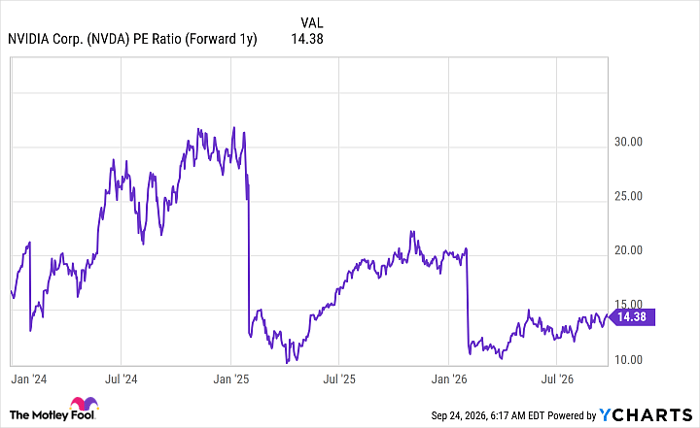
NVDA PE Ratio (Forward 1y) data by YCharts
Right now, its trailing price-to-earnings ratio is 29. If Nvidia hits analysts' estimates and it maintains its 29-times-earnings valuation, that indicates the stock will double between now and the end of Nvidia's next fiscal year (ending in January 2028). That's major upside for the stock, and no other stock in the Magnificent Seven can match it.
As a result, it's my top buy in this group.
Alphabet and Amazon
Alphabet and Amazon are two companies that are spending a ton on AI data centers, but for good reason. Each of them operates a leading cloud computing provider, which requires an incredible amount of computing power to satisfy client demand. Now is the time to capture market share, so each isn't afraid to spend big. This year, Amazon and Alphabet are spending $220 billion and $200 billion, respectively, on data center capital expenditures. While Nvidia doesn't call out who the big five AI hyperscalers are, Amazon and Alphabet easily fall into this classification.
That means each of these companies will be ramping up their spending again in 2027, which may be a red flag for some investors. However, the investments are paying off.
Google Cloud's revenue rose a jaw-dropping 82% in Q2 and is operating at a 36% operating margin. With more investments going into this division, the growth rate will continue to accelerate and stay rapid for many quarters. Amazon Web Services (AWS) isn't seeing as rapid growth, only rising 37% in Q2. Still, that figure will likely accelerate over the next few years as more capacity comes online, which will be a significant boost to Amazon's business as a whole.
With each company heavily invested in cloud computing and seeing the trends they desire, I'm bullish on the outlook for these two stocks. While they won't likely provide the upside of Nvidia, the business they are capturing from AI clients now will not go away, which makes this a recurring revenue stream. That's a huge advantage for these two companies.
Should you buy stock in Nvidia right now?
Before you buy stock in Nvidia, consider this:
The Motley Fool Stock Advisor analyst team just identified what they believe are the 10 best stocks for investors to buy now… and Nvidia wasn’t one of them. The 10 stocks that made the cut could produce monster returns in the coming years.
Consider when Netflix made this list on December 17, 2004... if you invested $1,000 at the time of our recommendation, you’d have $383,680!* Or when Nvidia made this list on April 15, 2005... if you invested $1,000 at the time of our recommendation, you’d have $1,382,954!*
Now, it’s worth noting Stock Advisor’s total average return is 937% — a market-crushing outperformance compared to 214% for the S&P 500. Don't miss the latest top 10 list, available with Stock Advisor, and join an investing community built by individual investors for individual investors.
See the 10 stocks »
*Stock Advisor returns as of September 26, 2026.
Keithen Drury has positions in Alphabet, Amazon, Meta Platforms, Microsoft, Nvidia, and Tesla. The Motley Fool has positions in and recommends Alphabet, Amazon, Apple, Meta Platforms, Microsoft, Nvidia, and Tesla. The Motley Fool has a disclosure policy.
Recommended Articles


