


Prediction: Robotics Will Be the Biggest Opportunity Within the AI Supercycle. 1 Dividend Growth Stock to Own.
Key Points
Artificial intelligence is likely to change the world in many ways, enabling computers to perform complex tasks.
Robotics is a vital way in which AI will interact with the real world.
Robots need more than AI brains to function, and Texas Instruments makes the boring chips that help control the rest of a robot.
- 10 stocks we like better than Texas Instruments ›
Nvidia (NASDAQ: NVDA) is the poster child for artificial intelligence (AI) stocks. That makes sense, given that it makes the high-powered chips that allow these highly complex computer programs to function. But brains are just the start of the AI supercycle, with robotics likely to be the way AI will really touch the world. This is why the boring chips that Texas Instruments (NASDAQ: TXN) makes will likely be in huge demand when robotics takes off.
Artificial intelligence leads directly to robotics
Artificial intelligence is developing rapidly. The news is filled with the achievements AI has made (both good and bad) as it gets closer and closer to mimicking how the human brain operates. While Luddites like myself question why normal human intelligence isn't enough, the direction is very clear: AI is likely to change how the world operates.
Missed Nvidia in 2009? This Rare Signal Is Flashing Again. In 2009, a "Double Down" signal flashed for a little-known chipmaker called Nvidia. For the first time in years, that same "Total Conviction" signal is flashing for a company 1/100th the size of Nvidia. Continue »
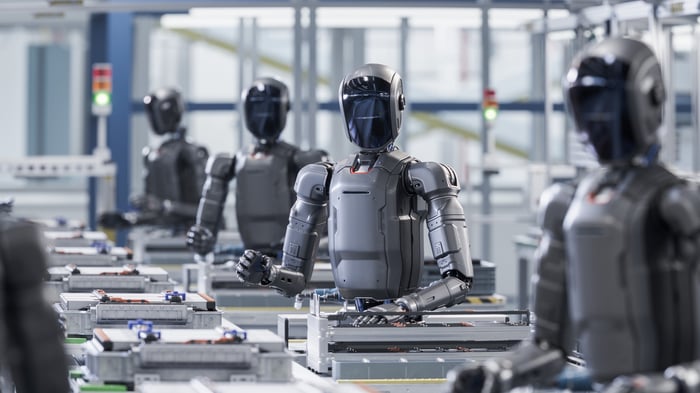
Image source: Getty Images.
In reality, this isn't much different from previous technological breakthroughs. From the internet to trains, technology has pushed the world forward in once unimaginable ways. But one thing I can easy imagine is how AI makes robots far more useful. Instead of simply performing a single repetitive task in an automated factory, robots will be able to perform many jobs across many fields and under uncontrolled, varying conditions. This is basically the dream that Elon Musk has as he pushes Tesla (NASDAQ: TSLA) into the robotics space with the humanoid Optimus robot.
Robots need more than just AI brains
When you look at a picture of an Optimus robot, you probably don't think about what goes into making it work. I'm awed by its capabilities and just accept that it exists without considering more deeply what actually allows such robots to function. A key part of the picture is the AI brain, but boring analog chips are used throughout a robot. We've had analog chips for a very long time; they go into everything from cellphones to, well, robots.
A key part of what an analog chip does is to turn a real-world stimulus into digital signals. Since a robot is essentially the way AI interacts with the physical world, analog chips are likely to see huge demand as AI-powered robots take off. Which is why I'm happy I own Texas Instruments, one of the world's largest and most respected analog chipmakers.
The best part of the story for dividend lovers like me is that Texas Instruments is a technology stock with an attractive yield. The yield is currently around 2.2%, which is roughly twice what you'd get from the S&P 500 index (SNPINDEX: ^GSPC). It is also more than four times the miserly 0.4% yield you'd collect from the average tech stock.
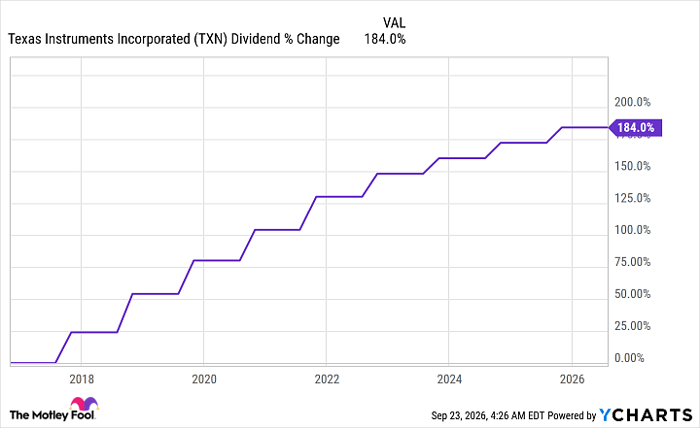
Moreover, Texas Instruments has increased its dividend annually for 23 years. The annualized rate of increase over the past decade is over 10%, though recent years have been slower due to a slump in the analog chip market (the industry tends to be a bit cyclical, so this happens from time to time). Still, even during an industry-weak patch, the most recent dividend increase was a robust 7%.
TXN Dividend data by YCharts
With a 7% dividend growth rate, the dividend will double in roughly 10 years. Over the past 10 years, Texas Instruments' dividend has increased by 184%. The one caveat is that Texas Instruments is in the middle of an investment cycle as it builds out production capacity. That's pressured profitability and cash flow, and left the payout ratio at a fairly lofty 85%. But leverage appears manageable with a debt-to-equity ratio of around 0.8x, and interest expenses covered 13x over.
Not just for dividend growth fans
Texas Instruments is clearly going to be attractive to dividend growth lovers, but given its well-above-market yield, even yield seekers may want to take a look. It is a good way to add some technology exposure to a portfolio that might otherwise be light on the sector. And, as AI drives advances in robotics, I'm confident that Texas Instruments will play a big role in the process.
Should you buy stock in Texas Instruments right now?
Before you buy stock in Texas Instruments, consider this:
The Motley Fool Stock Advisor analyst team just identified what they believe are the 10 best stocks for investors to buy now… and Texas Instruments wasn’t one of them. The 10 stocks that made the cut could produce monster returns in the coming years.
Consider when Netflix made this list on December 17, 2004... if you invested $1,000 at the time of our recommendation, you’d have $383,680!* Or when Nvidia made this list on April 15, 2005... if you invested $1,000 at the time of our recommendation, you’d have $1,382,954!*
Now, it’s worth noting Stock Advisor’s total average return is 937% — a market-crushing outperformance compared to 214% for the S&P 500. Don't miss the latest top 10 list, available with Stock Advisor, and join an investing community built by individual investors for individual investors.
See the 10 stocks »
*Stock Advisor returns as of September 26, 2026.
Reuben Gregg Brewer has positions in Texas Instruments. The Motley Fool has positions in and recommends Nvidia, Tesla, and Texas Instruments. The Motley Fool has a disclosure policy.
Recommended Articles


