


Nvidia Trades Near Its 52-Week High at Its Cheapest Valuation in a Decade. History Says This Is What $1,000 Invested Could Be Worth by 2030.
Key Points
Nvidia is trading at its cheapest valuation in a decade based on forward price-to-earnings (P/E) multiples.
Nvidia stock looks poised for a breakout given the amount of catalysts the company has in its pipeline.
Significant gains could be on the horizon for Nvidia investors who exercise patience as the AI infrastructure era plays out.
- 10 stocks we like better than Nvidia ›
One of the more curious semiconductor stocks so far in 2026 is Nvidia (NASDAQ: NVDA). As of this writing (Sept. 25), shares are up about 20% on the year. On the surface, this looks respectable considering Nvidia is handily outperforming both the S&P 500 and the Nasdaq Composite.
However, these gains look modest when compared to the monster years that have defined the artificial intelligence (AI) revolution. In 2023, Nvidia stock more than tripled. In 2024, it nearly doubled again. Even last year, Nvidia delivered nearly a 40% gain. The slowdown has investors asking an obvious question: Is the party winding down?
Missed Nvidia in 2009? This Rare Signal Is Flashing Again. In 2009, a "Double Down" signal flashed for a little-known chipmaker called Nvidia. For the first time in years, that same "Total Conviction" signal is flashing for a company 1/100th the size of Nvidia. Continue »
A mix of worries is at play here. For starters, some investors are susceptible to AI fatigue -- the sense that the first wave of hype is already priced in. Meanwhile, others are torn on whether the big cloud companies can continue spending on capital expenditures (capex) at their current pace without choking their balance sheets. Finally, there is real competition emerging from Advanced Micro Devices and Broadcom. But these factors aren't fatal to Nvidia's future.

Image source: Getty Images.
Nvidia is trading at its cheapest valuation in a decade
Wall Street analysts currently forecast $15.68 in earnings per share (EPS) for Nvidia in fiscal 2028. At today's price of roughly $225, that works out to a forward price-to-earnings (P/E) ratio of roughly 14.3. This is the lowest forward P/E Nvidia stock has carried on a multiyear estimate in 10 years.
The last time Nvidia's multiple compressed this dramatically, history was generous. Between late 2018 and early 2019, Nvidia's graphics processing units (GPUs) were primarily used for crypto mining and gaming. Both of those markets cooled off, and the stock de-rated in the low-20s range on a forward earnings basis. But after 2022, the generative AI explosion became a new catalyst for Nvidia's data center business, sending shares up more than tenfold in just three years.
When growth reaccelerates from a low starting point, valuation multiples can expand while earnings compound. This is precisely what happened with Nvidia. Even a move from 15 times earnings to 25 times on the same $15.68 EPS estimate implies a stock price near $390 before any further earnings growth. That is the setup smart investors should be looking for.
Nvidia looks poised for a breakout
The main reason Nvidia's valuation has room to expand is that the company is no longer a pure-play GPU shop. Nvidia is quietly layering new businesses on top of its core data center franchise.
For starters, the new Vera Rubin CPU is already in production and designed specifically for AI agents. Management told investors that early adopters of the platform include every major hyperscaler. On the software side, the company's $12.9 billion acquisition of Hugging Face gives it a leading open-source hub that keeps Nvidia at the center of how models get discovered and deployed.
Strategic stakes and partnerships with Marvell Technology, Coherent, and Nokia are giving Nvidia access to the technology that will support the next wave of AI traffic, including AI-RAN for 6G and custom silicon in its server racks.
Meanwhile, Nvidia is also pushing hard into three longer-cycle markets. In space exploration, its Jetson modules are already in lunar orbit with Firefly Aerospace, and SpaceX plans to launch Vera Rubin systems into orbit next year. In physical AI, Nvidia's full stack -- Omniverse, Cosmos, Isaac, and Jetson -- is being deployed by Amazon for warehouse robots. Another emerging opportunity on this front is autonomous vehicles, including the integration of Nvidia's Hyperion and DRIVE suite with robotaxis.
None of these developments contribute meaningful revenue to Nvidia right now. Each represents an incremental tailwind that sits on top of the company's data center business, which is still growing at 117% year over year. That combination is exactly what lets a compressed multiple rerate higher.
Where could Nvidia stock trade by 2030?
Given the trends below, I think it's reasonable to forecast EPS of at least $26 by fiscal 2030. If Nvidia's forward P/E simply expands from 15 back to 22, the stock would reach about $572. That is a 154% gain from today's price point, turning $1,000 into $2,540.
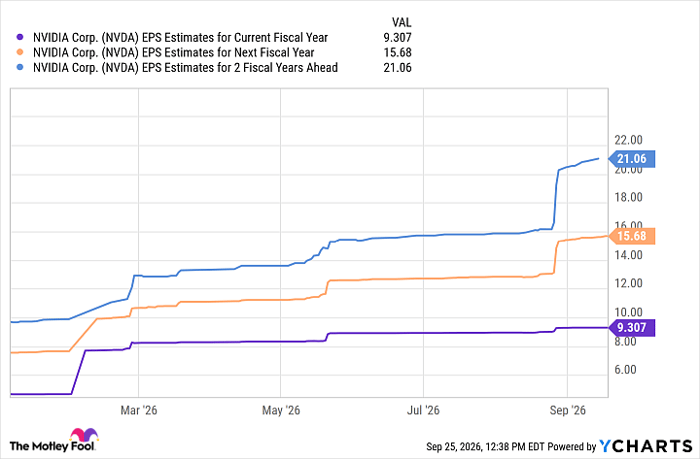
NVDA EPS Estimates for Current Fiscal Year data by YCharts
I do not think these are heroic assumptions. It is similar to the recoveries that followed prior cycles when Nvidia fell into a valuation trough. In my eyes, Nvidia looks like a growth stock trading more like a value opportunity. Against this backdrop, I see Nvidia as an obvious choice to buy and hold as the AI infrastructure era pushes on.
Should you buy stock in Nvidia right now?
Before you buy stock in Nvidia, consider this:
The Motley Fool Stock Advisor analyst team just identified what they believe are the 10 best stocks for investors to buy now… and Nvidia wasn’t one of them. The 10 stocks that made the cut could produce monster returns in the coming years.
Consider when Netflix made this list on December 17, 2004... if you invested $1,000 at the time of our recommendation, you’d have $386,781!* Or when Nvidia made this list on April 15, 2005... if you invested $1,000 at the time of our recommendation, you’d have $1,379,943!*
Now, it’s worth noting Stock Advisor’s total average return is 936% — a market-crushing outperformance compared to 213% for the S&P 500. Don't miss the latest top 10 list, available with Stock Advisor, and join an investing community built by individual investors for individual investors.
See the 10 stocks »
*Stock Advisor returns as of September 26, 2026.
Adam Spatacco has positions in Amazon and Nvidia. The Motley Fool has positions in and recommends Advanced Micro Devices, Amazon, Broadcom, Coherent, Marvell Technology, and Nvidia. The Motley Fool has a disclosure policy.
Recommended Articles


