


Amazon Is Spending $220 Billion on Data Centers. Here's Why That Makes The Stock an Incredible Buy
Key Points
AWS is seeing significant growth from its investments in data centers.
Data center capital expenditures have consumed all of Amazon's cash flows.
- 10 stocks we like better than Amazon ›
When a company announces that it's spending nearly all of its available cash flows on capital expenditures, investors have the right to question those decisions. When the figure is as large as $220 billion, like Amazon (NASDAQ: AMZN) is spending, it really should have investors questioning what's going on.
After digging in and investigating where the money is going, I think Amazon is doing just fine, and investors should be cheering on these investments in future growth. The implications for the company are incredible. After the dust settles in the artificial intelligence (AI) build-out, investors will be happy that Amazon made the tough choice to spend hundreds of billions of dollars on computing power.
Missed Nvidia in 2009? This Rare Signal Is Flashing Again. In 2009, a "Double Down" signal flashed for a little-known chipmaker called Nvidia. For the first time in years, that same "Total Conviction" signal is flashing for a company 1/100th the size of Nvidia. Continue »

Image source: The Motley Fool.
AWS's investments are already paying off
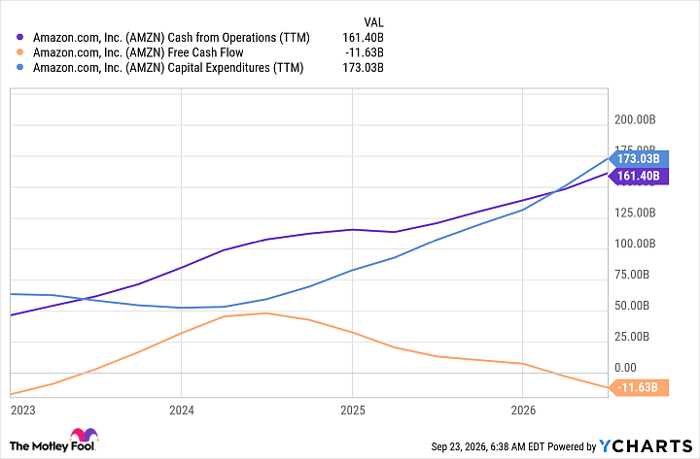
Amazon has been spending big on AI data centers over the past few years, but it's only now starting to maximize its spending. The graph below illustrates Amazon's operating cash flow and free cash flow. Free cash flow is cash from operations minus capital expenditures, and you can see that it has been on a negative trend for a long time due to rising capital expenditures, while Amazon's cash from operations continues to rise.
Data by YCharts.
Capital expenditures have overtaken cash from operations, which indicates that Amazon is either dipping into its cash reserves or taking on debt to fund the build-out. It's doing both, but if Amazon is to continue down this path of rising capital expenditures, it will need to generate much more cash.
Fortunately for investors, it's doing just that.
The primary beneficiary of these massive capital expenditures is Amazon Web Services (AWS). AWS is a cloud computing firm that rents computing power to clients who need it, and Amazon has many clients who fit this description. Demand for cloud computing is off the charts, and Amazon CEO Andy Jassy noted that they do not have enough computing power to meet demand in 2026 and likely in 2027, so demand for 2028 is already appearing. Its backlog reached $496 billion, growing at a triple-digit pace in Q2.
That showcases that there's huge demand for AI computing power and justifies Amazon's spending. These are long-term market share gains, as its clients are unlikely to leave AWS in the future due to deep partnerships and ties to the ecosystem. It's critical that Amazon maximizes its spending now, and even takes on some debt, as this market share it captures early on could lead to even greater growth down the road if AI workloads ramp up considerably.
All of this spending appears to be paying off, because AWS's revenue growth is accelerating.
AWS is seeing monster growth
During Q2, AWS's revenue rose 37% year over year. That's a notable acceleration from Q1's 28% revenue growth. Additionally, Amazon's operating income from AWS rose 64% year over year, helping fund these data center build-outs.
As the computing power from this year's $220 billion investments comes online, that will help fuel AWS's growth and perhaps even accelerate it. Additionally, a large share of spending over the past few years has gone toward acquiring land and building facilities. Once that initial investment is made, Amazon can focus on adding more computing units, which will have an even bigger boost to AWS's revenue total and growth rate.
We haven't seen that part of the AI build-out occur yet, although it's coming in the next few years. As a result, I think Amazon is one of the top stocks to buy now, as there is a lot of growth in the pipeline that the market doesn't see. Amazon is a top AI stock to buy, and even though it's spending big to achieve it, it will be worth it in the end.
Should you buy stock in Amazon right now?
Before you buy stock in Amazon, consider this:
The Motley Fool Stock Advisor analyst team just identified what they believe are the 10 best stocks for investors to buy now… and Amazon wasn’t one of them. The 10 stocks that made the cut could produce monster returns in the coming years.
Consider when Netflix made this list on December 17, 2004... if you invested $1,000 at the time of our recommendation, you’d have $386,781!* Or when Nvidia made this list on April 15, 2005... if you invested $1,000 at the time of our recommendation, you’d have $1,379,943!*
Now, it’s worth noting Stock Advisor’s total average return is 936% — a market-crushing outperformance compared to 213% for the S&P 500. Don't miss the latest top 10 list, available with Stock Advisor, and join an investing community built by individual investors for individual investors.
See the 10 stocks »
*Stock Advisor returns as of September 26, 2026.
Keithen Drury has positions in Amazon. The Motley Fool has positions in and recommends Amazon. The Motley Fool has a disclosure policy.
Recommended Articles


