


Carnival Stock Forecast: Can Record Cruise Demand Deliver Another Earnings Beat?
TradingKey - Carnival Corporation (NYSE: CCL) will release its third quarter results on September 29. As of September 23, its latest completed close was at $21.80. Carnival’s latest reported customer deposits were the highest on record, the company was 93% booked for 2026, and the remaining second-half position was ahead of the prior year at historically high prices. The question is, will increased fuel costs and inflation (potentially decreasing demand for travel) be offset by increased prices and other passenger revenue? While higher passenger prices may help offset increased costs for the quarter, will it impact travel demand for the year?
Record Deposits Keep the Demand Story Intact
Carnival recorded over $6.7 billion in revenue during its second quarter. Its adjusted EPS and EBITDA for the quarter were $0.41 and $1.6 billion, respectively.
Its record customer deposits for the quarter totaled $9 billion.
Carnival noted that approximately 93% of its 2026 sailings were booked, with the remaining second-half position ahead of the prior year at historically high prices.
Bookings and prices for 2027 sailings were outperforming the same period last year.
While there is a strong booking position for future cruises, demand is probably not the major constraint on third quarter results. The more important constraint is the fixed capacity available to monetize that demand. Ultimately, the number of bookings is the driver of cruise company bottom lines.
Fuel Costs Are the Main Margin Counterweight
Rising fuel costs negatively impacted Carnival’s margins during Q2. Carnival reduced fuel consumption per available lower berth day by 5.6%, but fuel prices were nearly 30% higher, so the efficiency gains only partially offset the cost increase. For Q3, fuel costs will likely impact Carnival’s bottom line.
Fuel costs are so unpredictable that Carnival’s own analysis shows a 10% change in fuel costs for Q3 would change the company’s adjusted net income by $56 million.
Rising fuel costs are out of Carnival’s control, and improving fuel efficiency only partially mitigates the negative impact on profits.
Q3 Guidance Sets a High but Achievable Bar
Management expects fiscal Q3 adjusted EPS to be around $1.35. They expect fiscal Q3 Adjusted EBITDA to be approximately $2.88 billion. They have projected net yields to increase approximately 1.2% in constant currency. They expect cruise costs to increase about 2.8% excluding fuel. For the fiscal year, they expect adjusted EPS to be about $2.22. The expectations and forecasts were disclosed in June.
Management's expectations are roughly in line with the market's expectations, so it is possible that the quality of the beat might be more important than the beat itself. It is likely that management expects to see more favorable yield and/or margin trends to positively impact the stock price.
Onboard Spending and Late Bookings Could Decide the Upside
Recent william Blair analysis suggested stronger-than-expected net yields and onboard spending may improve Q3 results. Rising customer spending, and the bookings Mix, will help yields and margins (potentially offsetting higher ticket prices).
Improving yields would also alleviate any concerns related to record customer bookings.
Potentially, extremely high customer bookings, with very little pricing power, would indicate high customer demand, but may not be beneficial in the long-run.
Jefferies Highlights the Fuel and Pricing Risk
This week, there has been a mixed view on Carnival. Jefferies lowered its 2026 and 2027 earnings estimates and cut its price target from $35 to $33. They keep a Buy rating on the stock. Fuel prices and weak pricing were the reasons given for the negative outlook. In a vacuum, this wouldn't impact Carnival's outlook, but it illustrates where there is dissent among the investing community. The question is whether pricing can be maintained or if deeper discounts would need to be given.
Mediterranean Demand Remains a Geographic Risk
There are effects from the conflict in the Middle East on Carnival's bookings, particularly for cruises that depart from and travel through the Mediterranean.
Prioritizing higher pricing and net yields over filling cruises (occupancy) may work out in the end for Carnival, but it could also leave unfavorable low occupancy, last-minute booking cruises.
Improving bookings could support the thesis that the geo-political tensions will ultimately be temporary.
Debt Reduction Still Depends on Cash Generation
Improvements in Carnival’s net debt/adjusted EBITDA ratio have been reflected in their latest report. At June, this ratio was at 3.1 times.
Improving the ratio is a positive sign, but a more material improvement in cash flows would allow Carnival to further decrease its financial leverage.
Strong bookings no doubt improves Carnival’s near term cash flows and provides an added measure of safety; however, customer deposits are cash inflows that support liquidity but are recorded as liabilities until the cruise or related services are provided, so they are not current profit. Record bookings can support future revenue and additional cash generation as sailings occur.
In the near term, the cash flows in excess of cash outflows would enable the company to reduce financial leverage. Improved cash flows would also positively impact cash yields.
What Would Strengthen the Bull Case
In general, I see positive momentum for Carnival and, therefore, am Bullish to a certain extent.
I would take on a more Bullish outlook should the constant currency net yields improve beyond the 1.2% goal for the quarter, and EPS come in at or above the $1.35 target, with the company maintaining or improving their guidance.
I would become Bearish should the company improve EPS but maintain or reduce their guidance.
I believe demand for Carnival's cruises is high, and the company is releasing positive earnings, therefore, the final report for this quarter will be the most telling.
Carnival Technical Analysis: CCL Stays Bearish Below $22.01 as $21.53 Support Comes Under Pressure
CCL’s latest confirmed closed price is $21.80. The 1 hour chart is trapped in a clear bearish channel, having bounced from the channel top at $23.34. The channel has contained the price action, with the recent decline taking price below the $22.69 and $22.01 levels. The RSI is at 41, having recently been in bullish territory.
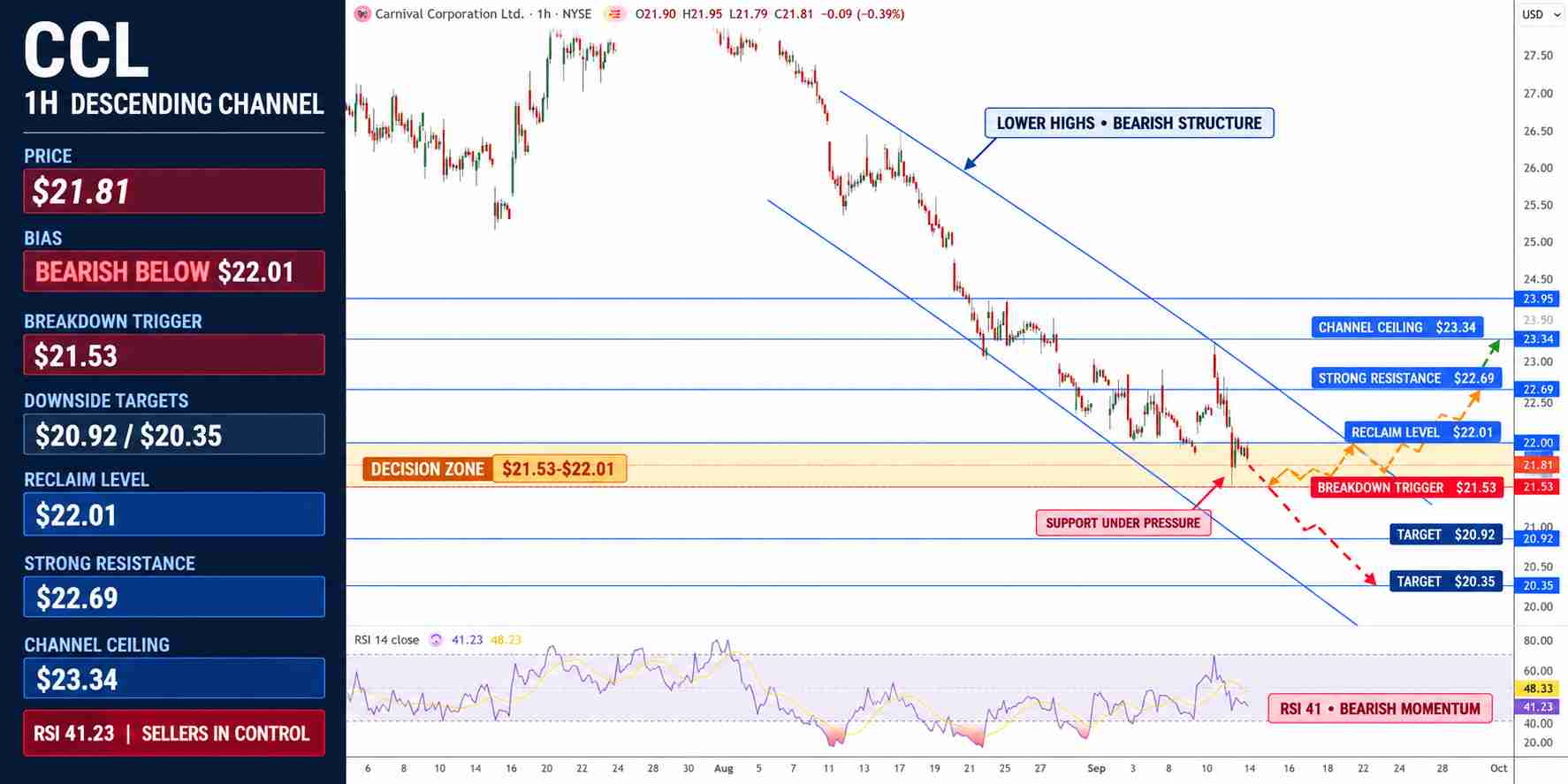
Carnival Stock Price Chart - Source: Tradingview
Support is at $21.53. A breakdown below $21.53 would bring the next bearish target at $20.92 into focus.
To reach the channel bottom, currently at $20.35, CCL would have to continue its bearish price action. For CCL bulls, the first target is the resistance at $22.01, followed by $22.69, with the descending channel top near $23.34 as the stronger resistance. I currently see a bearish bias below $22.01, with $21.53 as the next support level.
Important Price Levels
• Latest verified completed close at $21.80
• Important Support Levels: $21.53, $20.92, $20.35
• Important Resistance Levels: $22.01, $22.69, $23.34
• RSI: 41
• Bearish target: $20.92 (A break below $21.53)
Why is Carnival stock in focus now?
Carnival will release its fiscal Q3 results on September 29. Investors will look at net yields, passenger spending, fuel costs, and Q3 EPS. A strong Q3 could lead the company to update its guidance. The company entered the quarter with a record booked future, and a heavily booked 2026.
What level confirms a stronger CCL recovery?
Given the current price action, a move back above $22.69 would begin to weaken the bearish thesis. A clear breakdown and daily close below $21.53 would be bearish, targeting $20.92. A break above $23.34 would confirm a larger reversal.
Bottom Line
Carnival enters the weekend with strong demand supported by record deposits and high booking levels. Rising oil prices and fuel costs are making it more difficult for lines to be profitable. The street will be looking for signs that management can continue to navigate higher fuel costs. There will be a focus on overall pricing and passenger spend.
Carnival remains bearish while below $22.01. A move below $21.53 would bring $20.92 into play. A move above $22.69 would begin to improve the setup and bring the $23.34 level into play.
Recommended Articles


