


Prediction: A Stock Market Crash Is Coming. Here's What Investors Should Do Based on Warren Buffett's Time-Tested Advice.
Key Points
The S&P 500 stock market index is trading at the second-highest valuation in its history, behind only the dot-com internet bubble peak in 2000.
Surging oil prices, rising inflation, interest rate hikes, and a slowdown in artificial intelligence development could upend the current bull market.
During his career at Berkshire Hathaway, Warren Buffett offered a wealth of advice for navigating stock market downturns.
- 10 stocks we like better than S&P 500 Index ›
Stocks typically trend higher over the long term, but a growing combination of risks could place the current bull market under threat. For example, oil prices are soaring due to the ongoing geopolitical conflict in the Middle East, causing a spike in inflation that triggered an interest rate hike by the Federal Reserve last week.
Moreover, artificial intelligence (AI) labs such as Anthropic, OpenAI, and xAI are discussing slowing the pace of development to mitigate potential risks to humanity. This could spark a slowdown in data center investments, hurting many of the semiconductor stocks that have propped up the broader market over the last few years.
Missed Nvidia in 2009? This Rare Signal Is Flashing Again. In 2009, a "Double Down" signal flashed for a little-known chipmaker called Nvidia. For the first time in years, that same "Total Conviction" signal is flashing for a company 1/100th the size of Nvidia. Continue »
These risks are mounting as the S&P 500 (SNPINDEX: ^GSPC) trades at the second-highest valuation in its history, behind only the peak of the dot-com internet bubble in the year 2000. In my opinion, this leaves the market extremely vulnerable to a crash, but legendary investor Warren Buffett has some time-tested advice on how to navigate that very situation.

Warren Buffett. Image source: Getty Images.
Rising interest rates could derail the bull market
The ongoing geopolitical conflict between the U.S. and Iran continues to put upward pressure on oil prices. A single barrel of West Texas Intermediate crude traded for around $57 at the beginning of 2026, but it has exploded higher to $92 as of Sept. 24. Iran has effectively closed the Strait of Hormuz, through which 25% of the world's seaborne oil transits every day, so energy prices are unlikely to cool anytime soon.
The average price of diesel is now above $6 per gallon across the U.S., driving up the cost of every product that travels across the country by truck. Therefore, consumers are paying higher prices not only at the gas station but also at the grocery store and the mall. This is stoking inflation; the Consumer Price Index (CPI) rose at an annualized rate of 3.4% in August, well above the Fed's 2% target.
As a result, the Fed raised the federal funds rate (overnight interest rate) by 25 basis points at its recent September meeting, and hinted that at least one more hike might be coming. The central bank's last cycle of rate hikes spanned from March 2022 and August 2023, and it sparked a decline of more than 20% in the S&P 500, constituting a technical bear market.
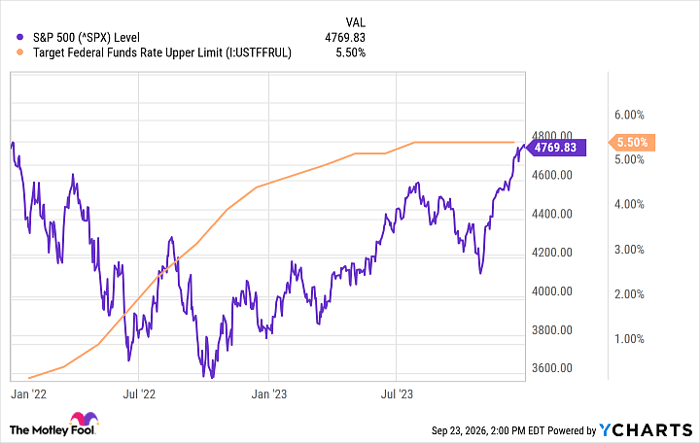
^SPX data by YCharts
Rising interest rates are bad for the stock market for several reasons. First, they increase interest costs on corporate debt, which directly impacts earnings. Second, companies simply can't borrow as much money when rates are high, limiting their ability to invest in growth.
Third, rising rates force consumers to allocate more of their household budgets to debt repayments, leaving less money for discretionary spending. This is another headwind for corporate earnings.
Rising interest rates could also derail the AI infrastructure spending boom, because many of America's tech giants are relying on billions of dollars in debt financing to buy chips and build data centers. Therefore, the pace of AI development among labs like Anthropic and OpenAI certainly matters for the performance of leading chip stocks like Nvidia, Advanced Micro Devices, and Micron Technology, but interest rates might be just as important.
Here's what investors should do, according to Warren Buffett
Warren Buffett served as the CEO of the Berkshire Hathaway holding company from 1965 to 2025. Berkshire stock returned an average of 19.7% per year during his tenure, enough to have turned an investment of $1,000 into a whopping $48.5 million. The same investment in the S&P 500 would have grown to just $399,702 over the same period, so Buffett knew a thing or two about the stock market.
In his 1986 annual letter to Berkshire's shareholders, Buffett said, "We simply attempt to be fearful when others are greedy, and to be greedy only when others are fearful." In other words, he viewed stock market downturns as opportunities, and it worked out well because every crash throughout history was eventually followed by a recovery to new highs.
Buffett offered a wealth of other advice during his long career. He regularly implored investors to remember that stocks represent real businesses with real fundamentals. A person wouldn't sell their house when its value moves up and down throughout the year, so selling a stock for the same reason makes little sense. If the fundamentals of the underlying business remain solid, a decline in its stock price should be viewed as an opportunity to buy more.
But most importantly, Buffett always stressed the importance of focusing on the long term. Berkshire has owned stocks like American Express and Coca-Cola for decades, and the underlying businesses have thrived despite countless sell-offs in the broader market.
The S&P 500 currently has a Shiller cyclically adjusted price-to-earnings (CAPE) ratio of 41.6, a shade below its all-time high of 44.2 from the peak of the dot-com internet bubble in 2000. I think its elevated valuation significantly increases the odds of a crash in light of the headwinds I highlighted earlier, but if that does happen, investors should remember Buffett's advice before making any rash decisions.
Should you buy stock in S&P 500 Index right now?
Before you buy stock in S&P 500 Index, consider this:
The Motley Fool Stock Advisor analyst team just identified what they believe are the 10 best stocks for investors to buy now… and S&P 500 Index wasn’t one of them. The 10 stocks that made the cut could produce monster returns in the coming years.
Consider when Netflix made this list on December 17, 2004... if you invested $1,000 at the time of our recommendation, you’d have $386,781!* Or when Nvidia made this list on April 15, 2005... if you invested $1,000 at the time of our recommendation, you’d have $1,379,943!*
Now, it’s worth noting Stock Advisor’s total average return is 936% — a market-crushing outperformance compared to 213% for the S&P 500. Don't miss the latest top 10 list, available with Stock Advisor, and join an investing community built by individual investors for individual investors.
See the 10 stocks »
*Stock Advisor returns as of September 25, 2026.
American Express is an advertising partner of Motley Fool Money. Anthony Di Pizio has no position in any of the stocks mentioned. The Motley Fool has positions in and recommends Advanced Micro Devices, American Express, Berkshire Hathaway, Micron Technology, and Nvidia. The Motley Fool has a disclosure policy.
Recommended Articles


