


The Stock Market Is Triggering a Warning Seen Only Once Before, and Warren Buffett Has a Stark Warning for Investors
Key Points
Valuations are climbing, and that could spell trouble for the market.
Warren Buffett warns that some investors may be taking on unnecessary risk.
History still has promising news for long-term investors.
- 10 stocks we like better than S&P 500 Index ›
The last few years have been lucrative for the stock market, with the S&P 500 (SNPINDEX: ^GSPC), Nasdaq Composite (NASDAQINDEX: ^IXIC), and Dow Jones Industrial Average (DJINDICES: ^DJI) all notching multiple record highs in 2026.
AI stocks have fueled much of this growth. Within the S&P 500, the tech sector alone has soared by nearly 155% over the last three years. Meanwhile, all other sectors combined have earned total returns of just over 60% in that time.
Missed Nvidia in 2009? This Rare Signal Is Flashing Again. In 2009, a "Double Down" signal flashed for a little-known chipmaker called Nvidia. For the first time in years, that same "Total Conviction" signal is flashing for a company 1/100th the size of Nvidia. Continue »
Concerns about an AI bubble have been looming for years, and, for the most part, Wall Street has shrugged them off. However, the market recently signaled a new warning sign that has only been seen ahead of the dot-com bubble in the early 2000s -- and Warren Buffett has a warning for investors.
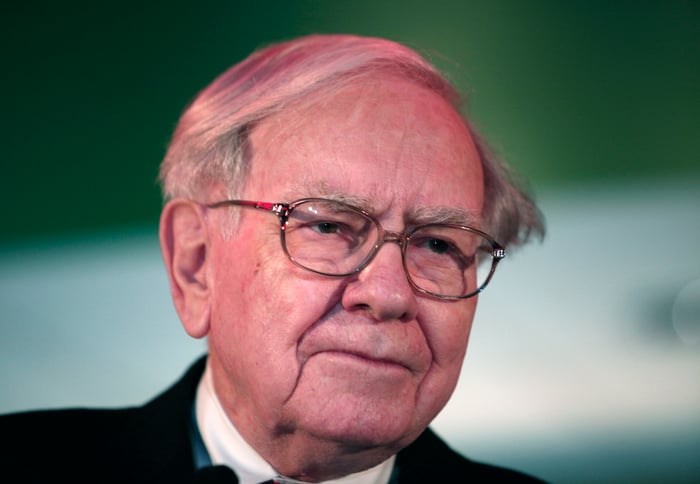
Image source: Getty Images.
Valuations are entering bubble territory
While no stock market indicator can predict the market's short-term movements, they can provide a snapshot of how current market conditions compare to previous downturns.
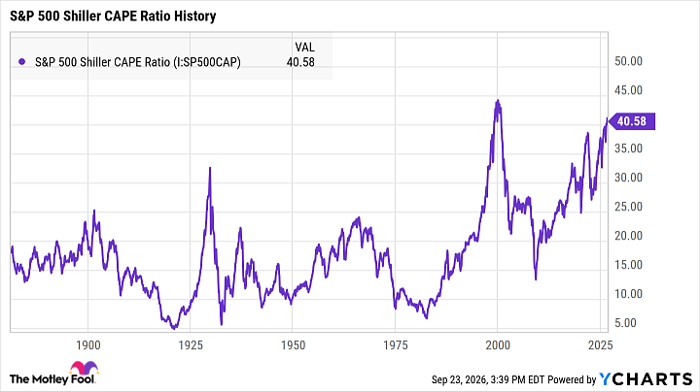
The S&P 500 Shiller CAPE Ratio is a metric that measures the S&P 500's 10-year inflation-adjusted earnings. A higher ratio suggests the S&P 500 is more likely to be overvalued, and historically, stock prices tend to fall in the years after this metric peaks.
Dating back to 1871, this ratio has averaged out to around 17. It experienced its first major spike in 1929 ahead of the Great Depression, and it surged again in the late 1990s as tech stocks ballooned in value.
S&P 500 Shiller CAPE Ratio data by YCharts
In January 1999, this metric surpassed 40 for the first time in history. It stayed above that level for another year before the dot-com bubble officially burst in March 2000 -- leading to a bear market that would last over two years.
Today, it's repeating a similar pattern. The CAPE Ratio surpassed 40 again in May of this year and has remained above 40 ever since. This is only the second time in history that this ratio has stayed above 40 for months at a time.
Warren Buffett is issuing a warning for investors
Earlier this year, in an interview with CNBC at Berkshire Hathaway's annual meeting, Warren Buffett offered his advice on investing in this historically expensive market.
Buffett reminded investors that he often compares the market to a church with a casino attached. One represents slow-and-steady long-term investing, while the other symbolizes short-term risk-taking.
"[W]e've never had people in a more gambling mood than now," Buffett warned, adding that this type of short-term buying is "not investing, it's not speculating, it's gambling. Just totally."
He added, however, that "that doesn't mean that investing is terrible. It does mean that prices for an awful lot of things will look very silly."
History says Buffett is right
Right now is not a bad time to invest in the stock market -- as long as you're investing in the right places. As valuations climb, it's more likely that some stocks are overvalued.
Overvalued stocks are particularly risky right now, even if they don't seem like it. Weak stocks can earn lucrative returns in the near term if they're fueled by hype, but the market tends to correct itself eventually. Over time, these stocks tend to experience severe downturns and underperform the market.
^IXIC data by YCharts
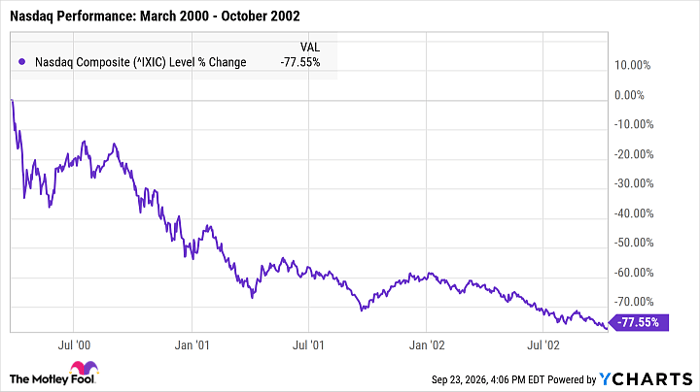
The dot-com bubble is a shining example of the risk of buying overvalued stocks. Despite record-breaking initial public offerings (IPOs) and monumental valuations, hundreds of tech stocks crashed and never recovered when the bubble popped.
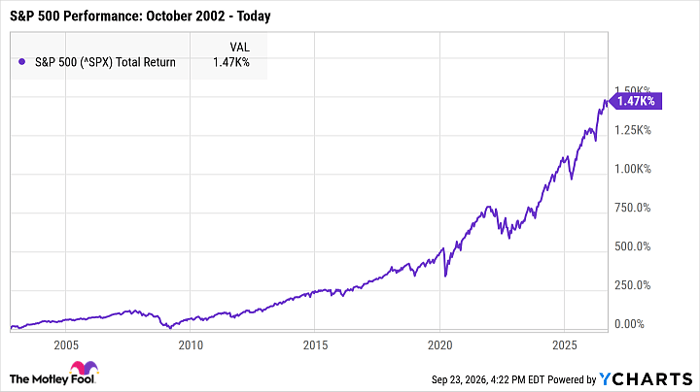
The good news, though, is that strong stocks have historically survived even the worst bear markets and recessions. For example, while the S&P 500 lost nearly half of its value throughout the dot-com bear market, the index has earned total returns of nearly 1,500% since it bottomed out in October 2002.
^SPX data by YCharts
While no one can predict exactly when a bear market will arrive, it's wise to prepare early. The stocks most likely to survive a recession are those of strong companies with healthy underlying business fundamentals.
Even the best stocks can experience short-term volatility, but by holding them for the long haul, you can set yourself up for lucrative returns over time.
Should you buy stock in S&P 500 Index right now?
Before you buy stock in S&P 500 Index, consider this:
The Motley Fool Stock Advisor analyst team just identified what they believe are the 10 best stocks for investors to buy now… and S&P 500 Index wasn’t one of them. The 10 stocks that made the cut could produce monster returns in the coming years.
Consider when Netflix made this list on December 17, 2004... if you invested $1,000 at the time of our recommendation, you’d have $384,839!* Or when Nvidia made this list on April 15, 2005... if you invested $1,000 at the time of our recommendation, you’d have $1,385,657!*
Now, it’s worth noting Stock Advisor’s total average return is 936% — a market-crushing outperformance compared to 213% for the S&P 500. Don't miss the latest top 10 list, available with Stock Advisor, and join an investing community built by individual investors for individual investors.
See the 10 stocks »
*Stock Advisor returns as of September 25, 2026.
Katie Brockman has no position in any of the stocks mentioned. The Motley Fool has positions in and recommends Berkshire Hathaway. The Motley Fool has a disclosure policy.
Recommended Articles


