


Alphabet Trades for 17 Times Earnings. The S&P 500 Trades for 25 Times Earnings. Is This the Best Stock to Buy in the Market?
Key Points
One-time effects skew Alphabet's valuation.
The stock is still a great one to invest in, but it's not the bargain its valuation portrays.
- 10 stocks we like better than Alphabet ›
Sometimes the market values fantastic stocks at low prices, just like it appears to be doing with Alphabet (NASDAQ: GOOG) (NASDAQ: GOOGL) right now.
Recently, Alphabet traded for just 17 times earnings, while the S&P 500 (SNPINDEX: ^GSPC) trades for 25 times earnings. That's an incredible mismatch, and it may convince investors that they need to load up on every Alphabet share they can get their hands on, especially with how well the business is doing.
Missed AI’s "Act 1"? Act 2 Could Be 15x Bigger. Most investors think they missed the AI boat because they didn't buy Nvidia in 2005. But according to our analysts, we’re only at the end of "Act 1"—the R&D phase. "Act 2" is the global rollout. Continue »
But as is the case with a lot of things, there's more to this story, and investors need to be aware before scooping up shares just because one metric says it looks far cheaper than the broader market.
Image source: The Motley Fool.
There is an asterisk next to Alphabet's valuation figure
The price-to-earnings (P/E) ratio is the most commonly quoted valuation metric, and for good reason. It's a great measure of how expensive a stock is or isn't, as long as everything is optimized. However, that's not always the case, and that's exactly what's going on with Alphabet's stock right now.
One line item that can add to a company's earnings-per-share (EPS) metric is gains on investments, even if the company just held on to its investment. For example, if Alphabet invested in a stock that rose from $100 to $200 per share in the quarter, it is required to report that $100 gain on investments as earnings, even if the company didn't sell its shares. This quirk can cause any stock's valuation measure to be skewed, and that's exactly what's going on with Alphabet.
Alphabet took a significant stake in Space Exploration Technologies (NASDAQ: SPCX) a decade ago, so when it went public in the second quarter, Alphabet had to report a major gain on its initial investment. However, it has lost value since then, so its SpaceX investment will have a negative effect on third quarter earnings, although it won't be to the same degree that SpaceX was a benefit in Q2. Over the next year, this one-time effect will become a non-factor in Alphabet's earnings, but that's not Alphabet's only investment.
Another one of Alphabet's major investments is the AI firm Anthropic. Anthropic is expected to go public before 2026 is over at a valuation of around $2 trillion. That will be another huge boost for Alphabet and will make its stock look even cheaper, as Alphabet will have to report a massive gain on the investment there as well.
In short, Alphabet's price-to-earnings ratio cannot be trusted right now, but that's not the only way to value the stock.
Alphabet's other valuation measures paint a different picture
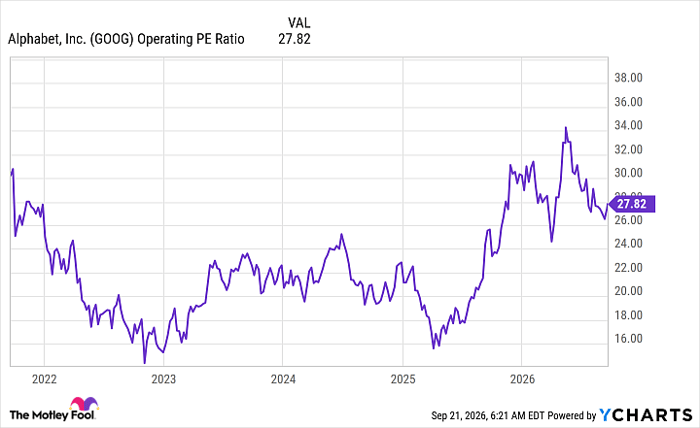
There are several other ways to value a stock besides earnings. One method I've been using is valuing the stock based on its operating income, as that excludes any effect from investment gains. From this perspective, Alphabet is the most expensive it has been over the past five years, but down significantly from its peak valuation.
GOOG Operating PE Ratio data by YCharts
I think this perfectly encapsulates Alphabet's stock. Its business prospects have improved a lot over the past five years, so it deserves a higher premium. At the same time, it's well off from its peak valuation. With Alphabet's business growing at a solid pace (revenue was up 24% in Q2), I think it's an excellent stock to consider buying right now.
While it may not have the sky-high upside of other AI stocks, Alphabet will be one of the long-term winners of the AI race, and it makes for a solid stock pick right now as a result.
Should you buy stock in Alphabet right now?
Before you buy stock in Alphabet, consider this:
The Motley Fool Stock Advisor analyst team just identified what they believe are the 10 best stocks for investors to buy now… and Alphabet wasn’t one of them. The 10 stocks that made the cut could produce monster returns in the coming years.
Consider when Netflix made this list on December 17, 2004... if you invested $1,000 at the time of our recommendation, you’d have $384,839!* Or when Nvidia made this list on April 15, 2005... if you invested $1,000 at the time of our recommendation, you’d have $1,385,657!*
Now, it’s worth noting Stock Advisor’s total average return is 936% — a market-crushing outperformance compared to 213% for the S&P 500. Don't miss the latest top 10 list, available with Stock Advisor, and join an investing community built by individual investors for individual investors.
See the 10 stocks »
*Stock Advisor returns as of September 25, 2026.
Keithen Drury has positions in Alphabet. The Motley Fool has positions in and recommends Alphabet. The Motley Fool has a disclosure policy.
Recommended Articles


