


Michael Burry Just Bought Sprouts Farmers Market, Making It a "Full Position." Should You Follow?
Key Points
Famous investor Michael Burry just bought Sprouts Farmers Market stock after a 63% decline.
Difficult comps and inflation are weighing on this year's results.
The stock looks very cheap... provided Sprouts maintains its above-normal margins.
- 10 stocks we like better than Sprouts Farmers Market ›
Investor Michael Burry is famous for his epic shorting of the housing market leading up to the great financial crisis of 2008, and today is still an active short-seller.
However, Burry also invests on the long side, displaying adherence to the value-investing ethos of Warren Buffett.
Missed AI’s "Act 1"? Act 2 Could Be 15x Bigger. Most investors think they missed the AI boat because they didn't buy Nvidia in 2005. But according to our analysts, we’re only at the end of "Act 1"—the R&D phase. "Act 2" is the global rollout. Continue »
In his most recent September portfolio update, Burry increased his long position in Sprouts Farmers Market (NASDAQ: SFM) to what he described as a "full position," after initiating it earlier in 2026.
Around $66 per share as of this writing, investors can buy Sprouts stock at a lower price than Burry did, as the stock has retreated in recent days. So, should you follow?
Sprouts is a "luxury" grocery store name
As a business model, Sprouts is akin to Whole Foods, which Amazon purchased in 2017. The grocery store caters to a higher-end clientele, with "better for you" food and organic offerings. As you can see, catering to higher-end customers enables Sprouts to earn a much higher operating margin than its generic grocery store chain peers:
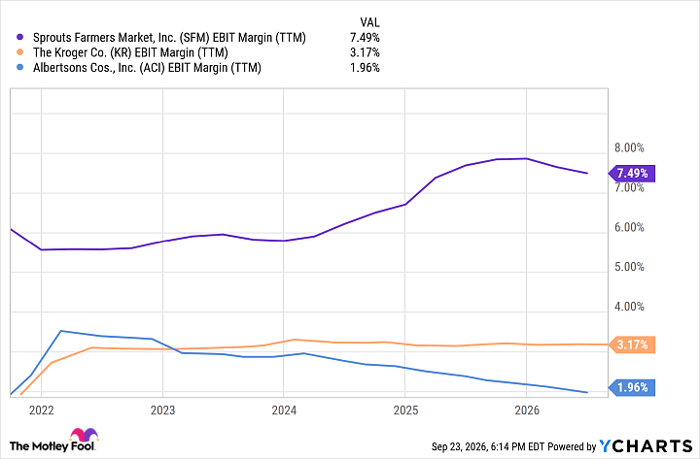
SFM EBIT Margin (TTM) data by YCharts
Thus, Sprouts can be thought of almost as a luxury goods stock. What makes luxury goods stocks attractive to many investors is that well-off consumers are better insulated from economic downturns and financial stress, leading to more resilient earnings and pricing power.
But Sprouts has withered
After hitting an all-time high of $182 per share in early 2025, Sprouts' stock has fallen a stunning 62.3% today. It currently trades at just 12 times this year's earnings estimates and 11.2 times 2027 estimates.
The decline is due to several factors. Virtually all retail stocks are judged heavily on same-store sales growth, defined as growth at each store relative to last year. Last quarter, Sprouts saw same-store sales dip 1%, a stark reversal from the 10.2% same-store sales growth in the year-ago quarter.
Retail stocks need to generate same-store sales growth at least in line with inflation, or margins will decline. As you can see above, although Sprouts has higher margins than its more generic competitors, its margins have been subtly declining this year.
Investors may have been anticipating continued robust same-store sales growth on top of unit growth in early 2025, when Sprouts traded at nearly 50 times earnings. The abrupt change has thus caused a violent rerating of the stock.

Image source: Getty Images.
Management's explanation
Management has provided some reasonable explanations for the decline in same-store sales. First, Sprouts has difficult comparisons with the prior year this year. In early 2025, disruptions in the organic and natural food supply chain drove more customers to Sprouts from other natural grocers. So, Sprouts is lapping that comparison.
Of note, the "two-year stack" of comps, going up 10.2% and then falling 1%, still yields a two-year compound same-store sales growth rate of 4.4%, which is not bad at all. Obviously, there are questions about whether same-store sales will rebound to those "normalized" levels, but it could be that the comparisons are skewing the data in a one-off fashion.
Additionally, the war with Iran has sparked a bout of inflation this year, not only in the food category, but also in other consumer spending categories, especially gasoline. That has put pressure on even Sprouts' higher-end customers, who management said have been more "thoughtful" about their spending on natural and organic foods. Chief Operating Officer Nick Konat noted on the second-quarter conference call with analysts, "On the price and promotion piece ... It's been a little tougher to move the customer in this environment."
Short-term vs. long-term
Even Burry, in his note on Sprouts, acknowledged that this year would be a difficult one, saying, "I appreciate the model and believe there is a long runway ahead. This year will not be a good one, but long-term, I believe in the business."
This aligns with the Warren Buffett quote: "The best thing that happens to us is when a great company gets into temporary trouble. ... We want to buy them when they're on the operating table."
The big question is: Is Sprouts actually a wonderful business? The grocery store industry generally operates on low margins and is often fiercely competitive. So Sprouts' higher-than-normal margins could fall further if competition encroaches. Nevertheless, Sprouts isn't a "new" company. It was founded in 1943 and has been a public company since 2013.
There also appears to be lots of room to open new stores. Sprouts has 490 stores open as of the end of the second quarter, with 110 more approved leases and 155 new stores approved overall. The approvals would amount to over 30% growth from here. Even after that, Spouts would still have less than one-fourth as many stores as Kroger, which has over 2,700 stores today.
A premium, niche grocer might not ever become as large as a general grocery store like Kroger. However, there appears to be room for good unit growth ahead.
If Sprouts can fend off competition and maintain above-normal margins, the stock certainly looks undervalued today. However, whether Sprouts can maintain margins materially above those of its more mainstream peers over the long term remains to be seen.
Should you buy stock in Sprouts Farmers Market right now?
Before you buy stock in Sprouts Farmers Market, consider this:
The Motley Fool Stock Advisor analyst team just identified what they believe are the 10 best stocks for investors to buy now… and Sprouts Farmers Market wasn’t one of them. The 10 stocks that made the cut could produce monster returns in the coming years.
Consider when Netflix made this list on December 17, 2004... if you invested $1,000 at the time of our recommendation, you’d have $384,839!* Or when Nvidia made this list on April 15, 2005... if you invested $1,000 at the time of our recommendation, you’d have $1,385,657!*
Now, it’s worth noting Stock Advisor’s total average return is 936% — a market-crushing outperformance compared to 213% for the S&P 500. Don't miss the latest top 10 list, available with Stock Advisor, and join an investing community built by individual investors for individual investors.
See the 10 stocks »
*Stock Advisor returns as of September 25, 2026.
Billy Duberstein and/or his clients have positions in Amazon. The Motley Fool has positions in and recommends Amazon and Sprouts Farmers Market. The Motley Fool recommends Kroger and recommends the following options: long January 2028 $75 calls on Sprouts Farmers Market and short January 2028 $85 calls on Sprouts Farmers Market. The Motley Fool has a disclosure policy.
Recommended Articles


