


Nvidia Raised Its Dividend 2,400%, but a $10,000 Investment Still Pays Just $44 a Year
Key Points
Nvidia has paid about $6.2 billion in dividends so far this year.
The majority of the company's capital-return program is allocated toward share buybacks, which have totaled nearly $40 billion this year.
While raising its dividend was a nice feature, Nvidia's yield is still only 0.44%.
- 10 stocks we like better than Nvidia ›
Nvidia (NASDAQ: NVDA) stock's run throughout the artificial intelligence (AI) revolution is the kind of story people talk about like folklore. If you invested in Nvidia on Nov. 30, 2022 -- the day OpenAI released ChatGPT to the public -- shares closed around $16.87 on a split-adjusted basis. Given their current level around $225, that's roughly a 1,230% gain. This would make a $10,000 investment at that time worth more than $132,000 today. That is not a typo.
The problem is Nvidia stock doesn't feel like that multibagger trade anymore. The easy valuation expansion is gone because investors are hunting the next AI breakout candidate. That shift helps explain another headline: back in May, Nvidia raised its quarterly dividend from $0.01 to $0.25 a share -- a 2,400% increase.
Missed AI’s "Act 1"? Act 2 Could Be 15x Bigger. Most investors think they missed the AI boat because they didn't buy Nvidia in 2005. But according to our analysts, we’re only at the end of "Act 1"—the R&D phase. "Act 2" is the global rollout. Continue »
While the old dividend payout was a courtesy, the new one looks like an attempt to appeal to a broader shareholder base: pensions, passive income investors, or anyone else who needs a reason to stick around after the initial moonshot rally.

Image source: Getty Images.
Nvidia's massive dividend raise is still a small check overall
During Nvidia's fiscal first-quarter earnings report, the company announced that its board of directors approved a dividend increase, making the first $0.25 payment on June 26 to holders of record as of June 4. Another $0.25 went ex-dividend on Sept. 10, payable Oct. 1.
Here's the breakdown of cash that has actually left the building throughout Nvidia's fiscal 2027. During the first quarter, the company was still on the penny dividend, paying about $243 million. After the raise, Nvidia's dividend payout jumped to $6.0 billion in the second quarter. That is a real number in isolation, but next to the rest of the company's capital-return program it is just a side dish.
Nvidia spent about $19 billion in Q1 and about $20 billion in Q2 on share buybacks. Management has said it wants to return 50% or more of free cash flow to shareholders, net of strategic uses. After adding an $80 billion repurchase authorization in May, roughly $99 billion was still available at the end of the second quarter.
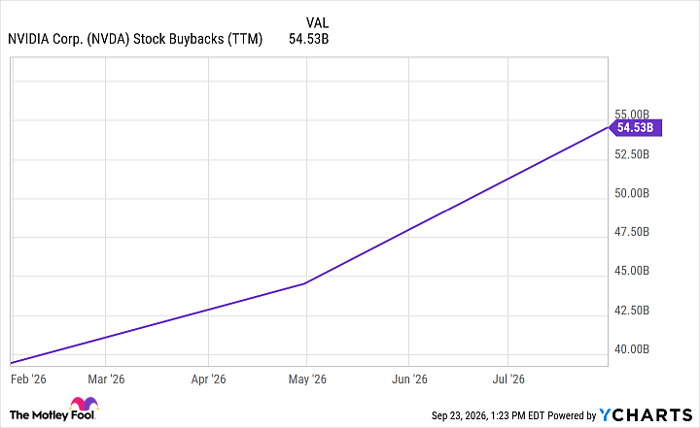
NVDA Stock Buybacks (TTM) data by YCharts
So yes, Nvidia's dividend got 25 times bigger. But for now, the company is using buybacks as the main driver of shareholder rewards.
What a $10,000 investment in Nvidia actually pays you
The math below illustrates the magnitude of the 2,400% headline. At about $225 a share, $10,000 buys roughly 44 shares of Nvidia. The new annual dividend payout is $1.00 a share, or $0.25 each quarter. This equates to:
- Annual passive income: $44
- Quarterly check: $11
- Monthly: $3.70
Before the raise, these same 44 shares only paid $0.04 a year, or less than $2 in aggregate. This is all to show that Nvidia's dividend increase looks enormous on a percentage basis simply because the starting point was so small. In reality, the dollar increase is the equivalent of a couple of streaming subscriptions.
Nvidia isn't a dividend stock just yet
Calling Nvidia a dividend stock is a little misleading. A 0.44% dividend yield does not compete with those seen in utilities, REITs, or business development companies (BDCs). Nobody is going to fund their retirement with $44 on a $10,000 sum.
The more prudent interpretation is that Nvidia is a growth company that suddenly has more cash than it can comfortably spend on chips, software, and strategic investments. Stock buybacks will continue to shrink the company's share count and juice earnings per share (EPS). Meanwhile, a higher dividend is the more visible aspect you can see in your brokerage account.
Both programs can keep rising if free cash flow continues to compound, but that does not turn Nvidia into Realty Income overnight. The takeaway here is investors should still own Nvidia for the core business and its upside in the AI infrastructure era. While the 2,400% dividend raise is real, and more hikes would not be shocking, it does not make Nvidia a lucrative passive-income generator.
Should you buy stock in Nvidia right now?
Before you buy stock in Nvidia, consider this:
The Motley Fool Stock Advisor analyst team just identified what they believe are the 10 best stocks for investors to buy now… and Nvidia wasn’t one of them. The 10 stocks that made the cut could produce monster returns in the coming years.
Consider when Netflix made this list on December 17, 2004... if you invested $1,000 at the time of our recommendation, you’d have $384,839!* Or when Nvidia made this list on April 15, 2005... if you invested $1,000 at the time of our recommendation, you’d have $1,385,657!*
Now, it’s worth noting Stock Advisor’s total average return is 936% — a market-crushing outperformance compared to 213% for the S&P 500. Don't miss the latest top 10 list, available with Stock Advisor, and join an investing community built by individual investors for individual investors.
See the 10 stocks »
*Stock Advisor returns as of September 25, 2026.
Adam Spatacco has positions in Nvidia. The Motley Fool has positions in and recommends Nvidia and Realty Income. The Motley Fool has a disclosure policy.
Recommended Articles


