


Tesla's Roadster Reveal Is Oct. 1. The Real Story Is Optimus.
Key Points
The Roadster sports car launch may be high profile, but it's not a revenue driver.
Optimus development is Tesla's key operational focus for 2026.
- These 10 stocks could mint the next wave of millionaires ›
Tesla (NASDAQ: TSLA) investors are counting down the days until the launch of the new Roadster electric sports car, an event CEO Elon Musk believes could be one of the most "exciting product unveils ever."
However, as Musk noted in April, the new Roadster is unlikely to move the needle on revenue, and, for a variety of reasons, investors should focus more on hardware developments for the Optimus robot. That's likely to be the key development for Tesla investors to focus on through 2026. Here's why.
Missed AI’s "Act 1"? Act 2 Could Be 15x Bigger. Most investors think they missed the AI boat because they didn't buy Nvidia in 2005. But according to our analysts, we’re only at the end of "Act 1"—the R&D phase. "Act 2" is the global rollout. Continue »
The Roadster isn't a game changer
The new Roadster is widely expected to sell for between $200,000 and $250,000, depending on the model. It's a figure that aligns with Wall Street analyst estimates (according to market intelligence company, Visible Alpha) for the average revenue per unit (ARPU) of $180,000 in 2027. The latter tends to be lower than the former, but in the same ballpark.
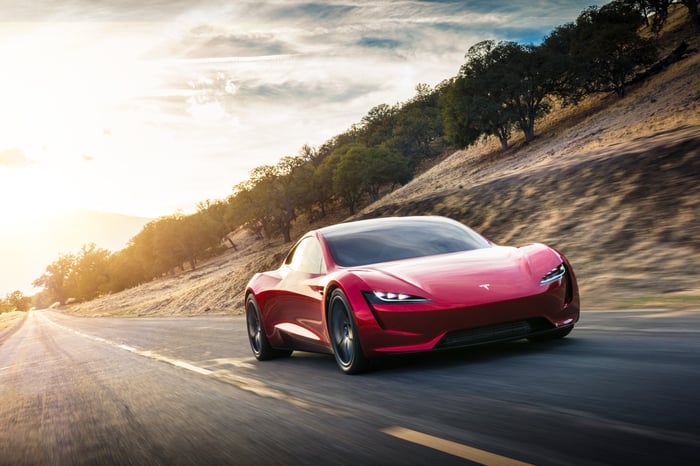
Image source: Tesla.
Given these estimates, it's unlikely that such an expensive vehicle will generate the mass-market sales needed to meaningfully change Tesla's sales trajectory. Indeed, many analysts expect no more than a few thousand Roadster units to be sold in 2027.
The last manually driven car developed by Tesla?
Musk raised this prospect when asked about the company's car lineup on the earnings call in April. He noted that the vast majority of Tesla's future production would be for the Cybercab. Moreover, Musk said Tesla's future lineup is "going to be almost entirely autonomous. In fact, long-term, the only manually driven car will be the new Tesla Roadster."
These comments imply, but don't confirm, that there won't be a new low-cost or family Tesla, at least not a manually driven one. All of which throws the emphasis on electric vehicle (EV) development onto the dedicated robotaxi EV, Cybercab.
However, the Cybercab (robotaxi) rollout depends on a variety of factors, including the development of the next version of full self-driving (FSD), v15, regulatory approvals, and modifications to Federal Motor Vehicle Safety Standards (FMVSS). All of this, plus a wide-scale Cybercab (robotaxi) rollout, will take time, not least as Musk doesn't expect v15 to be validated and released before late 2026 or early 2027.
Why Optimus development is the real hardware story
While Cybercab (robotaxi) is obviously the most important near-term catalyst, many of the key factors in its development are, unfortunately, outside management's control. These include how fast and comprehensively FMVSS are modified, state-by-state approvals, the result of National Highway Traffic Safety Administration (NHTSA) investigations, and legal and liability considerations.
So if the Roadster isn't a game changer, and many of the key considerations around Cybercab aren't in management's hands, what should investors focus on in terms of management's operations in 2026? The answer is Optimus.
Back on the earnings call in July, Musk said Tesla would "soon start production with Optimus." He's on record as saying that 80% of the company's value would come from Optimus in the future. That's an impressive claim given the expectations for Cybercab (robotaxi) to generate multibillions in recurring revenue over time as Tesla builds out its transportation-as-a-service (TaaS) business. While much of the attention, naturally, falls on Optimus's future use in the home, the reality is its initial use is highly likely to be concentrated in industries that already extensively use robots and automation, such as logistics/warehousing and automotive manufacturing.
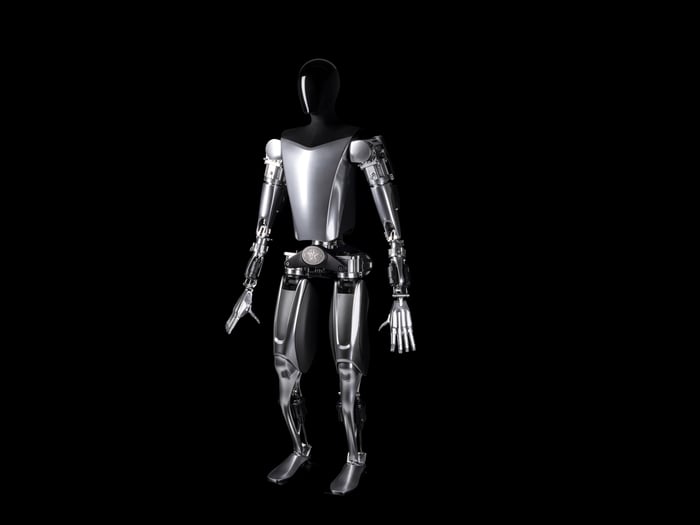
Image source: Tesla.
Optimus has a big future, but scaling its production won't be easy, not least as Musk noted, "with Optimus, there is no supply chain. So we've had to build up a supply chain in its entirety or in-house production." This is distinct from automotive manufacturing, where a manufacturer can approach myriad established suppliers to source components. Indeed, Musk described Optimus as "the hardest product to scale manufacturing that we've ever made at Tesla because everything on the robot is new."
As such, Tesla needs to build out its supply chain and refine production to scale in the future.
Roadster is coming soon
The Roadster launch will showcase the best of Tesla's technology and provide the company with a so-called "halo car" (a car designed to showcase an automaker's highest level of engineering, performance, or design). However, as with most such cars, it's not going to drive the company's performance, and with Cybercab development ongoing (the hardware is already in use) and largely dependent on factors outside Tesla's control, the real operational focus for investors in 2026 should be Optimus.
Don’t miss this second chance at a potentially lucrative opportunity
Ever feel like you missed the boat in buying the most successful stocks? Then you’ll want to hear this.
On rare occasions, our expert team of analysts issues a “Double Down” stock recommendation for companies that they think are about to pop. If you’re worried you’ve already missed your chance to invest, now is the best time to buy before it’s too late. And the numbers speak for themselves:
- Nvidia: if you invested $1,000 when we doubled down in 2009, you’d have $586,280!*
- Apple: if you invested $1,000 when we doubled down in 2008, you’d have $64,289!*
- Netflix: if you invested $1,000 when we doubled down in 2004, you’d have $384,839!*
Right now, we’re issuing “Double Down” alerts for three incredible companies, available when you join Stock Advisor, and there may not be another chance like this anytime soon.
See the 3 stocks »
*Stock Advisor returns as of September 24, 2026.
Lee Samaha has no position in any of the stocks mentioned. The Motley Fool has positions in and recommends Tesla. The Motley Fool has a disclosure policy.
Recommended Articles


