


Warren Buffett Has a Stark Warning for Investors as the Market Repeats a Pattern Seen Only Twice in 155 Years
Key Points
Generative AI is helping power a legendary stock market rally.
But it is also raising fears of another bubble.
What can Buffett teach us about investing in times like this?
- 10 stocks we like better than S&P 500 Index ›
Warren Buffett has retired from his position as the chairman of his holding company, Berkshire Hathaway. But as one of the most successful investors in history, it can still pay (literally) to listen to what he has to say about the market -- especially in this increasingly uncertain climate.
Let's dig deeper into Buffett's stark warning about investing right now, and explore what the repeat of a pattern not seen since the dot-com bubble could mean for the future of the S&P 500.
Missed AI’s "Act 1"? Act 2 Could Be 15x Bigger. Most investors think they missed the AI boat because they didn't buy Nvidia in 2005. But according to our analysts, we’re only at the end of "Act 1"—the R&D phase. "Act 2" is the global rollout. Continue »
An alarming trend has emerged in the market
Nobel Prize-winning economist Robert Shiller created the cyclically adjusted price-to-earnings (CAPE) ratio to highlight periods of unusually high market valuations. It works by dividing the current price of the S&P 500 by its average inflation-adjusted earnings over the past decade. The long time period helps smooth out short-term fluctuations to provide a clearer perspective on the index's valuation compared with historical norms.
Spikes in the CAPE ratio have had a remarkable correlation with stock market bubbles. Over the past 155 years, it has peaked at 32.6 in 1929, shortly before the stock market crash that triggered the Great Depression, and again at 44.2 in 1999 before the collapse of the dot-com bubble. Right now, the metric stands at 41.6, just below its all-time high.
The surge in stock prices is mainly due to optimism about generative artificial intelligence (AI), which has added an eye-watering $19 trillion in market value across global markets. But while the technology is already changing the way people live and do business, many financial professionals fear that excitement has begun to outpace fundamentals. And industry leaders such as OpenAI continue to burn through money, with a projected cash burn of $280 billion by 2030, as reported by the Financial Times.
The market faces additional headwinds, such as rising Federal Reserve interest rates (which now stand at 3.75% to 4%) and rising Treasury bond yields (with the yield of the 10-year Treasury bond at just under 5%). Both of these factors can cause stocks to underperform because they increase the cost of capital in the real economy and change investor risk tolerance.
Buffett sends out a stark warning
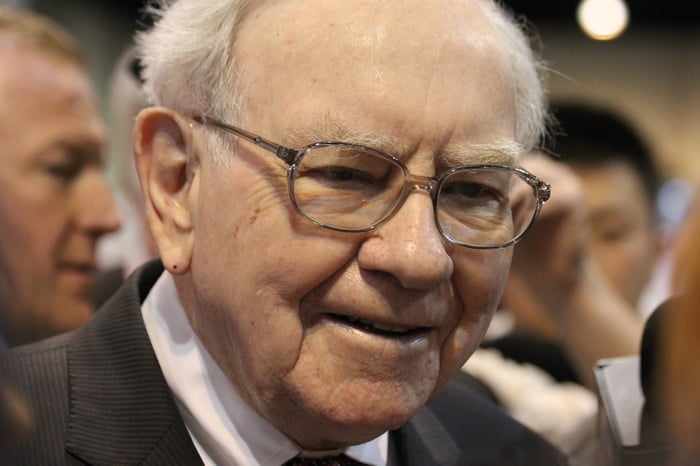
Image source: Getty Images.
Buffett doesn't seem to have much confidence in this market. And in a recent interview with CNBC, he stated, "It's tough to find values when everybody is preferring gambling." This follows earlier remarks in which he called the current market "a church with a casino attached," likely referencing investors' increasing disconnect from company fundamentals.
AI bulls will push back by pointing out that the valuations of many leading AI companies remain quite reasonable compared with their earnings and growth. For example, leading chipmaker Nvidia trades for a forward price-to-earnings (P/E) multiple of just 25, which is quite fair for a company that saw its second-quarter earnings soar 128% year over year.
However, the seemingly low price tags may be a bit deceiving, considering they are being driven by arguably unsustainable levels of capital spending elsewhere in the economy. If hyperscalers decide they are no longer willing to spend hundreds of billions on Nvidia's AI hardware, the chipmaker's operational boom could quickly shift to reverse. A similar trend occurred when the crypto mining boom stalled in the early 2020s.
How can investors win?
Instead of chasing the latest trends, Buffett's investment strategy has focused on selecting long-term winners. And this involves betting on companies with reasonable valuations and sustainable economic moats that can withstand future competition and changing market sentiment.
When you follow this philosophy, potential downturns become a lot less scary because you know your portfolio will have what it takes to bounce back when the dust settles.
Should you buy stock in S&P 500 Index right now?
Before you buy stock in S&P 500 Index, consider this:
The Motley Fool Stock Advisor analyst team just identified what they believe are the 10 best stocks for investors to buy now… and S&P 500 Index wasn’t one of them. The 10 stocks that made the cut could produce monster returns in the coming years.
Consider when Netflix made this list on December 17, 2004... if you invested $1,000 at the time of our recommendation, you’d have $384,839!* Or when Nvidia made this list on April 15, 2005... if you invested $1,000 at the time of our recommendation, you’d have $1,385,657!*
Now, it’s worth noting Stock Advisor’s total average return is 936% — a market-crushing outperformance compared to 213% for the S&P 500. Don't miss the latest top 10 list, available with Stock Advisor, and join an investing community built by individual investors for individual investors.
See the 10 stocks »
*Stock Advisor returns as of September 24, 2026.
Will Ebiefung has no position in any of the stocks mentioned. The Motley Fool has positions in and recommends Berkshire Hathaway and Nvidia. The Motley Fool has a disclosure policy.
Recommended Articles


