


Warren Buffett Says "Father Time Always Wins." History Says Investors Who Do This 1 Thing Will Win Out Anyway.
Key Points
Warren Buffett has stepped down as Chairman of Berkshire Hathaway and will be succeeded by his son, Howard.
He has given investors a number of time-tested strategies that prove anyone can make money in the market.
Whether you buy individual stocks or passive index funds, holding for the long run always wins out.
- 10 stocks we like better than S&P 500 Index ›
Warren Buffett just published his farewell letter to Berkshire Hathaway (NYSE: BRKA) (NYSE: BRKB) investors as the Oracle of Omaha steps down as Chairman and becomes Chairman Emeritus. Near the end of his letter, the 96-year-old wrote a sobering line: "Father Time always wins." Buffett added, "He has, however, been generous with me."
That generosity shows up in Berkshire's track record. Between 1965 and 2025, Berkshire's per-share market value compounded at 19.7% a year, turning a modest $100 investment into roughly $6.1 million. The S&P 500 (SNPINDEX: ^GSPC), with dividends included, compounded closer to 10.5%, and turned that same $100 into about $46,000.
Missed AI’s "Act 1"? Act 2 Could Be 15x Bigger. Most investors think they missed the AI boat because they didn't buy Nvidia in 2005. But according to our analysts, we’re only at the end of "Act 1"—the R&D phase. "Act 2" is the global rollout. Continue »
Berkshire's transition is now complete. Greg Abel took over as CEO on Jan. 1, while Buffett's son, Howard, became Chairman on Sept. 18. While this feels like the end of an era, reviewing Buffett's investment philosophy is a great reminder of how anyone can win in the stock market, no matter what Father Time has planned.
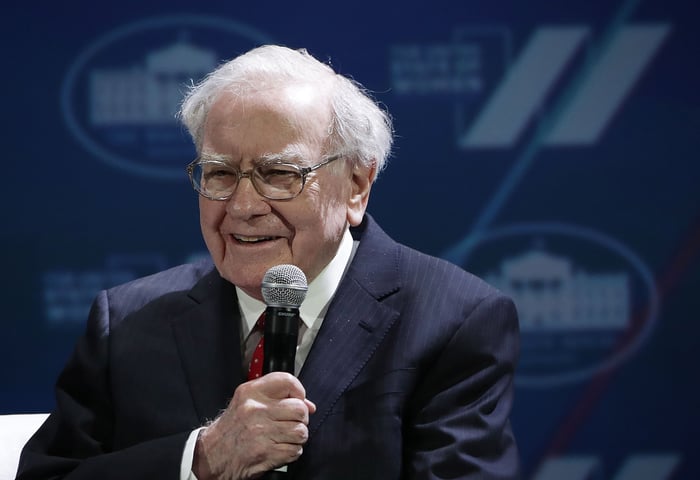
Image source: Getty Images.
Buffett wasn't a stock-picking sage -- he was a disciplined holder
Buffett did not become a billionaire because every stock he picked was a multibagger. During his tenure, Berkshire invested in plenty of stocks that didn't pan out. Buffett himself has repeatedly spoken about deciding to sit on the sidelines during certain hot streaks, selling some stocks too early, or holding for too long.
What he did, again and again, was refuse to treat the stock market like a casino. In his 1996 letter, he wrote a famous line that investors love to quote but that almost nobody truly lives: "If you aren't willing to own a stock for ten years, don't even think about owning it for ten minutes." His other version of that same idea was even blunter: "Our favorite holding period is forever."
Just look at the names that actually made Buffett rich. Berkshire has owned Coca-Cola since 1988 -- nearly four decades of cash flow and rising dividends. The firm has owned American Express continuously since 1991. Although Apple arrived much later, in 2016, it still became Berkshire's largest position because the business value appreciated over time. Berkshire used its profits to buy back stock.
None of these was a 10-minute trade. Instead, they were all decades-long calculations made on businesses that stayed profitable, kept their brand moats, and compounded while headlines came and went.
Image source: Getty Images.
Blue chips or the broader index: same rules, different homework
Investors can try to copy Buffett's strategy. Look for durable economic moats, household brands, or companies trading below intrinsic value that also use excess cash to repurchase shares or pay dividends. That is the Buffett shopping list in summarized form. Alternatively, you can skip the due diligence and opt for a vehicle Buffett has said most retail investors should prioritize: owning the S&P 500.
In his 2013 shareholder letter, Buffett wrote that the cash left over for his wife should be allocated like this: "Put 10% of the cash in short-term government bonds and 90% in a very low-cost S&P 500 index fund." The idea here is that the average person cannot pick winning stocks and beat the market consistently.
Buffett himself has even put some of Berkshire's money into S&P 500 exchange-traded funds in the past. The point is not that stock-picking is pure luck -- it's that spending time in the market across a diversified set of blue chip companies ultimately does more work for you than almost any single ticker can do.
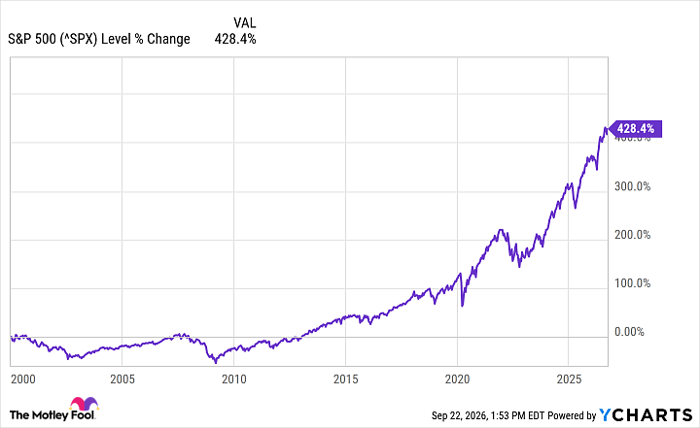
While the S&P 500 will fall into bear markets or look overextended during rallies, the index has a history of moving higher over time because the underlying components earn more, buy back shares, and reward shareholders. Dollar-cost averaging -- investing fixed sums on a consistent basis during both booms and busts -- is how everyday investors can actually capture the grind higher.
^SPX data by YCharts.
Father Time might win, but so does this investing strategy
No one can outrun the calendar. But what Buffett did for 60 years was prove that generational wealth does not require omniscience. It requires consistency: owning quality businesses or the S&P 500 index, continuing to buy through volatility, and letting compounding do the quiet work of turning ordinary deposits into something your kids can appreciate later on.
While none of us can beat Father Time, anyone can still win on his watch. The one thing history always rewards is staying invested for the long haul, even after the farewell letters are filed away.
Should you buy stock in S&P 500 Index right now?
Before you buy stock in S&P 500 Index, consider this:
The Motley Fool Stock Advisor analyst team just identified what they believe are the 10 best stocks for investors to buy now… and S&P 500 Index wasn’t one of them. The 10 stocks that made the cut could produce monster returns in the coming years.
Consider when Netflix made this list on December 17, 2004... if you invested $1,000 at the time of our recommendation, you’d have $384,839!* Or when Nvidia made this list on April 15, 2005... if you invested $1,000 at the time of our recommendation, you’d have $1,385,657!*
Now, it’s worth noting Stock Advisor’s total average return is 936% — a market-crushing outperformance compared to 213% for the S&P 500. Don't miss the latest top 10 list, available with Stock Advisor, and join an investing community built by individual investors for individual investors.
See the 10 stocks »
*Stock Advisor returns as of September 24, 2026.
American Express is an advertising partner of Motley Fool Money. Adam Spatacco has no position in any of the stocks mentioned. The Motley Fool has positions in and recommends American Express, Apple, and Berkshire Hathaway. The Motley Fool has a disclosure policy.
Recommended Articles


