


SpaceX Stock: Bull vs. Bear Scenarios
Key Points
Analysts are split on what will happen to SpaceX stock in the years ahead.
Investors must understand the key factors affecting SpaceX's valuation.
- 10 stocks we like better than Space Exploration Technologies ›
Take a look at Wall Street's projections for Space Exploration Technologies (NASDAQ: SPCX) stock, and you might be a little confused about what to expect. One analyst, for example, has an $800 price target on shares. Another analyst has a price target of just $75.
Of course, both analysts have good reasons for their price targets. And for the most part, they're digesting the same information available to every other investor. The difference of opinion doesn't necessarily stem from the facts on hand, but rather from expectations about the company's ability to execute its growth initiatives.
Missed AI’s "Act 1"? Act 2 Could Be 15x Bigger. Most investors think they missed the AI boat because they didn't buy Nvidia in 2005. But according to our analysts, we’re only at the end of "Act 1"—the R&D phase. "Act 2" is the global rollout. Continue »
If you're a SpaceX investor or own any other space stocks or rocket stocks, you'll want to understand the key drivers for SpaceX's valuation.
This is why Wall Street disagrees on SpaceX stock
To understand why Wall Street is split on SpaceX stock, it's important to first identify where most of SpaceX's growth opportunity lies. Then, we can get a better idea of which growth initiatives are actually meaningful in valuing the stock. "We believe we have identified the largest actionable total addressable market in human history," SpaceX claims in its IPO prospectus. "We estimate that our quantifiable TAM is $28.5 trillion."
Right away, we can start to understand why analysts disagree about the stock. Some believe SpaceX will be successful in targeting its large claimed growth runway. Others are more skeptical.
When we break down SpaceX's total growth opportunity in more detail, it becomes clear that one segment reigns supreme in generating long-term value. Of its total claimed $28.5 trillion addressable market, just $370 billion stems from "space-based solutions," a category that largely consists of its rocket launch business. Another $1.6 trillion of value stems from "connectivity," which mostly includes SpaceX's Starlink satellite network.
A whopping $26.5 trillion, however, deals exclusively with one segment: AI. According to SpaceX, that sum breaks down into $2.4 trillion for AI infrastructure, $760 billion for consumer subscriptions, $600 billion for digital advertising, and $22.7 trillion for enterprise applications. So-called "enterprise applications," therefore, are the key driver to SpaceX's long-term growth plans.
According to HyperFrame Research, "That enterprise figure is not a software market estimate; it is the Digital Cooperation Organization's projected size of the entire global digital economy (blended across several estimates)." In other words, HyperFrame Research believes that this figure "relies on the premise that AI agents displace white-collar labor."
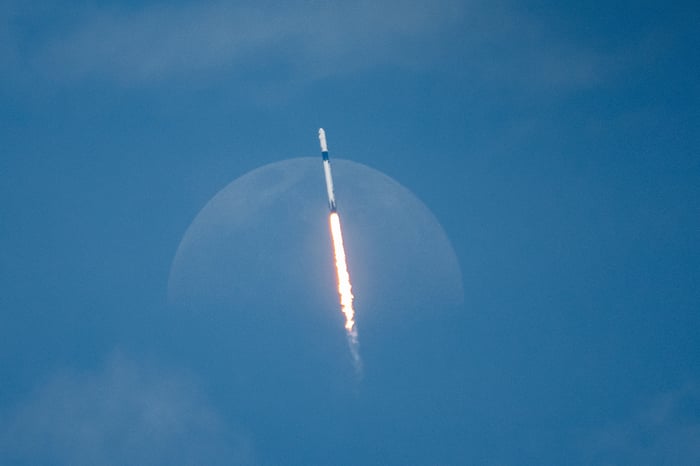
Image source: Getty Images.
Wall Street may disagree on many points regarding SpaceX stock. Some analysts believe orbital data centers are feasible. Others do not. Some analysts forecast a Starlink monopoly for years to come. Others see mounting competition. Some analysts fully expect SpaceX to establish a manufacturing base on the moon. Others remain skeptical.
Regardless of those disagreements, one thing is clear: SpaceX is relying on AI to replace a large share of global human labor to justify its valuation. If that fails to occur -- or even if it occurs on a much longer timeline than experts think -- it will have a disproportionate impact on the company's long-term stock price.
Should you buy stock in Space Exploration Technologies right now?
Before you buy stock in Space Exploration Technologies, consider this:
The Motley Fool Stock Advisor analyst team just identified what they believe are the 10 best stocks for investors to buy now… and Space Exploration Technologies wasn’t one of them. The 10 stocks that made the cut could produce monster returns in the coming years.
Consider when Netflix made this list on December 17, 2004... if you invested $1,000 at the time of our recommendation, you’d have $384,839!* Or when Nvidia made this list on April 15, 2005... if you invested $1,000 at the time of our recommendation, you’d have $1,385,657!*
Now, it’s worth noting Stock Advisor’s total average return is 936% — a market-crushing outperformance compared to 213% for the S&P 500. Don't miss the latest top 10 list, available with Stock Advisor, and join an investing community built by individual investors for individual investors.
See the 10 stocks »
*Stock Advisor returns as of September 24, 2026.
Ryan Vanzo has no position in any of the stocks mentioned. The Motley Fool has no position in any of the stocks mentioned. The Motley Fool has a disclosure policy.
Recommended Articles


