


Prediction: This Will Be Palantir Technologies’ Stock Price by the End of 2028
Key Points
Palantir is growing faster than the generative AI software market.
The company can easily outperform consensus earnings expectations over the next couple of years.
Palantir stock can rise substantially from current levels due to its fast-growing customer base and sizable backlog.
- 10 stocks we like better than Palantir Technologies ›
Palantir Technologies (NASDAQ:PLTR) has turned in a disappointing performance on the stock market so far in 2026, with shares of the software specialist rising just 4% compared to the 17% appreciation in the Nasdaq Composite index.
However, the artificial intelligence (AI) software specialist has seen a sharp rise in its stock price recently. Palantir stock is up by 50% since the beginning of August. The good part is that Wall Street expects Palantir to jump higher over the coming year. But can Palantir sustain its newfound momentum beyond that and deliver healthy gains to investors by the end of 2028?
Missed AI’s "Act 1"? Act 2 Could Be 15x Bigger. Most investors think they missed the AI boat because they didn't buy Nvidia in 2005. But according to our analysts, we’re only at the end of "Act 1"—the R&D phase. "Act 2" is the global rollout. Continue »
Let's find out.

Image source: The Motley Fool.
Improving confidence in software stocks has powered Palantir's surge
Palantir's poor returns in 2026 can be attributed to a lack of confidence in software stocks. Wall Street was concerned that the growing proliferation of AI would render the software industry redundant, but the sector has bounced back lately. In fact, software stocks have been outperforming semiconductor stocks.
The iShares Expanded Tech-Software Sector ETF has gained 22% over the past three months, while the iShares Semiconductor Sector ETF is down 12% over the same period. Palantir has benefited from this rebound, and quite rightly so.
After all, the company has been growing at an incredible pace amid the booming demand for generative AI software by enterprises and governments.
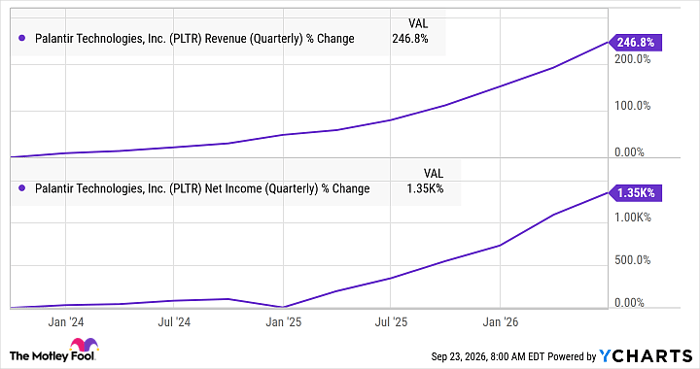
PLTR Revenue (Quarterly) data by YCharts
Palantir reported a 93% year-over-year increase in revenue in the second quarter to $1.94 billion. Its non-GAAP earnings per share increased by a whopping 156% year over year to $0.41. The company now expects to end 2026 with an 82% increase in revenue to just over $8.15 billion. However, I won't be surprised to see Palantir finishing the year with a bigger revenue increase.
That's because the company has been adding new customers at a nice clip, and those customers tend to spend more on its AI software tools over time. For instance, Palantir management noted on last month's earnings call that a tech company that deployed its solutions in the fourth quarter of 2025 has now entered into a three-year, $370 million deal.
Similarly, many other companies that enter into contracts with Palantir expand their scope of work due to the productivity gains delivered by its AI software platform. This explains why businesses have been giving Palantir sizable contracts. The company's total contract value (TCV) in the U.S. commercial business was up by a stunning 2.5x year over year in Q2 to $2.13 billion, well above the 49% year-over-year jump in the overall TCV to $3.37 billion.
Given that Palantir added 200 new customers on a year-over-year basis last quarter, its long-term revenue pipeline could increase nicely once they start spending more on its platform. Investors will do well to note that Palantir's remaining deal value (RDV), which is the value of unfulfilled contracts, increased 83% from the prior-year period in Q2 to $13.1 billion.
This robust pipeline, coupled with the secular growth of the AI software platforms market, can help Palantir crush Wall Street's expectations and deliver stronger-than-expected gains.
Here's why Palantir can soar past Wall Street's expectations
Palantir's 12-month median price target of $210, according to 36 analysts covering the stock, points to a potential jump of 13% from current levels. However, the company's ability to outperform expectations could lead to much stronger upside by the end of 2028.
Palantir's earnings per share could jump by 114% in 2026 to $1.61, according to Yahoo! Finance consensus estimates. However, analysts are expecting its earnings growth rate to settle in the mid-40% range over the next couple of years.
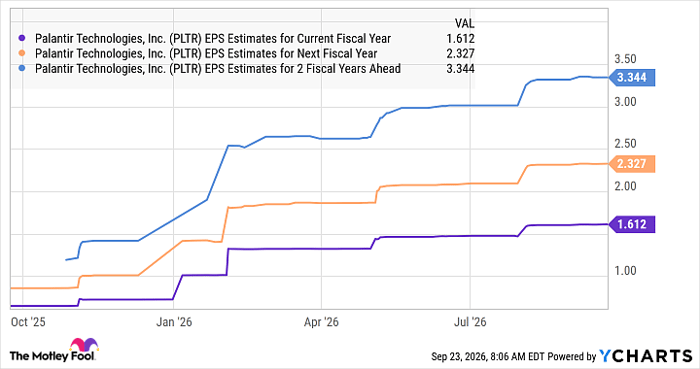
PLTR EPS Estimates for Current Fiscal Year data by YCharts
We have already seen ample reasons why Palantir can clock a significantly higher growth rate. Gartner expects a 60% increase in AI software revenue in 2026 to $461.6 billion, followed by another 42% increase next year to $656 billion. Palantir is growing faster than the market, suggesting it can capture a larger share of the multibillion-dollar AI software opportunity.
Assuming Palantir can double its bottom line over the next two years, its earnings per share could increase to $6.44 in 2028 (based on the $1.61 earnings per share estimate for 2026). If this AI stock trades at even 50 times earnings at that time, a significant discount to its forward earnings multiple of 77, its price will reach $322.
That's 74% higher than Palantir's stock price right now. So, investors looking to buy a growth stock would do well to take a closer look at Palantir as it can sustain its recent momentum and jump significantly over the next couple of years.
Should you buy stock in Palantir Technologies right now?
Before you buy stock in Palantir Technologies, consider this:
The Motley Fool Stock Advisor analyst team just identified what they believe are the 10 best stocks for investors to buy now… and Palantir Technologies wasn’t one of them. The 10 stocks that made the cut could produce monster returns in the coming years.
Consider when Netflix made this list on December 17, 2004... if you invested $1,000 at the time of our recommendation, you’d have $389,154!* Or when Nvidia made this list on April 15, 2005... if you invested $1,000 at the time of our recommendation, you’d have $1,406,303!*
Now, it’s worth noting Stock Advisor’s total average return is 949% — a market-crushing outperformance compared to 214% for the S&P 500. Don't miss the latest top 10 list, available with Stock Advisor, and join an investing community built by individual investors for individual investors.
See the 10 stocks »
*Stock Advisor returns as of September 24, 2026.
Harsh Chauhan has no position in any of the stocks mentioned. The Motley Fool has positions in and recommends Palantir Technologies and iShares Trust - iShares Semiconductor ETF. The Motley Fool recommends Gartner. The Motley Fool has a disclosure policy.
Recommended Articles


