


Qualcomm Stock Price Forecast: On-Device AI Agents and Linux Ecosystem Expansion, Can QCOM Break $200?
TradingKey - On September 23 Eastern Time, Qualcomm (QCOM) fell 0.51% to close at $197.24, hitting an intraday high of $199.50 and once again nearing the $200 mark. Snapdragon on-device AI applications, Linux device support, and mobile chip business performance are key factors to watch for QCOM's future trends.
During Snapdragon Summit 2026, AI startup Liquid AI announced that Liquid Context has been optimized for Snapdragon processors and Hexagon NPUs; Qualcomm, meanwhile, introduced an early developer preview of Linux for the Snapdragon X2 series. These two developments expand Snapdragon's coverage in on-device AI applications and PC operating systems, respectively.
Can On-Device AI and Linux Support Expand the Snapdragon Market?
With user authorization, Liquid Context can build personal context through device signals for access by locally, cloud-, or hybrid-deployed AI agents. Liquid AI has optimized the system for Snapdragon processors and Hexagon NPUs, and completed adaptation of the LFM2.5-2.6B model, enabling certain processing to run on-device.
Device manufacturers can evaluate Liquid Agents based on this model, but neither party has announced pre-installed models or commercial contracts.
Qualcomm also introduced an early Linux developer preview for Snapdragon X2 laptops and is pushing drivers for the Hexagon NPU, Adreno GPU, power management, and other components into the mainline Linux kernel. Ubuntu certification is targeted for the first half of 2027, with HP, Asus, and HUMAIN planning to launch related devices in 2027.
Currently, Snapdragon PCs have entered over 12,300 stores, with more than 13,000 enterprises completing testing or deployment, and over 7,300 adapted applications. Whether Linux support can drive revenue growth remains dependent on device launches and actual sales.
When Will Smartphone Chip Revenue Stabilize?
Qualcomm's revenue for the third quarter of fiscal 2026 fell 4% year-over-year to $9.947 billion, and Non-GAAP EPS dropped 20% to $2.21. QCT handset chip revenue declined 20% to $5.086 billion, while automotive and IoT revenues grew 61% and 9%, respectively, partially offsetting the decline in the handset business.
For the fiscal fourth quarter, the company expects revenue of $9.7 billion to $10.5 billion and Non-GAAP EPS of $2.05 to $2.25. Handset chips remain QCT's largest revenue source, and shifts in demand will continue to impact Qualcomm's near-term performance.
The Snapdragon X2's on-device AI capabilities and Linux support have expanded Qualcomm's product reach in the PC market. The company has not yet separately disclosed Snapdragon PC sales volume and revenue; future contributions will depend on OEM models, device shipments, and the scale of enterprise deployment.
Can QCOM Break Through $200?
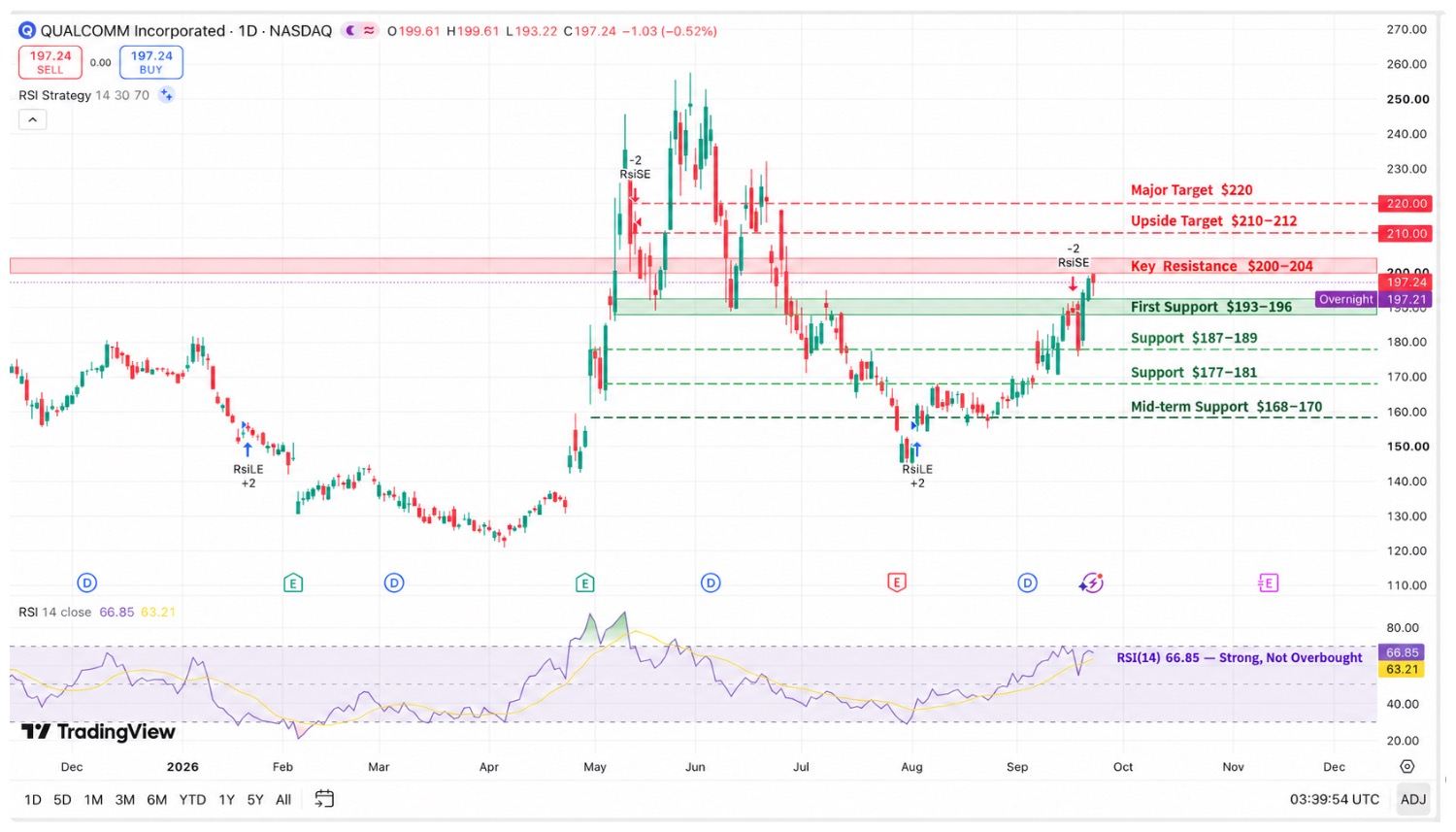 [Source: TradingView]
As of the close on September 23, QCOM stood at $197.24, sitting above its 10-day, 20-day, 50-day, and 200-day moving averages. The 14-day RSI in the chart is 66.85, indicating relatively strong price momentum, though it has not yet entered the traditional overbought zone above 70.
On the upside, $200–$204 is the main resistance zone. If the stock price closes firmly above $204, the next observation range will be $210–$212; a further breakthrough could test the resistance level at $220.
On the downside, $193–$196 is the primary support zone. If breached, the next support levels are sequentially located at $187–$189 and $177–$181. Both the 50-day and 200-day simple moving averages are near $169, with $168–$170 forming medium-term support.
Liquid Context is being adapted for the Hexagon NPU, and Snapdragon X2 has also begun offering a Linux developer preview, though related progress has not yet generated separately quantifiable revenue.
Whether QCOM can break through $200–$204 in the short term largely depends on market momentum; its medium-term performance hinges on AI PC shipments, device maker adoption scale, and whether smartphone chip revenue can stabilize.
Recommended Articles


