

I Speculated That Stanley Druckenmiller's Tesla Buy Was About FSD. Billionaire Investor Ron Baron Just Confirmed My Thesis.
Key Points
Most Tesla bulls are fixated on the company's AI projects: Robotaxi and Optimus.
Tesla's most measurable progress is being made in its self-driving software platform, not AI.
Billionaire investor Ron Baron just said the time to buy Tesla stock is now, and he says the adoption of Full Self-Driving (FSD) is why.
- These 10 stocks could mint the next wave of millionaires ›
Last month, I made a simple assertion: Stanley Druckenmiller's decision to buy call options in Tesla (NASDAQ: TSLA) was less of a bet on its artificial intelligence (AI) efforts and more likely a wager on the value of Full Self-Driving (FSD). The company's Robotaxi platform and its Optimus humanoid robots are projects that still live mostly in the future. By contrast, FSD already boasts paying users, a rising attach rate, and the kind of recurring revenue Wall Street pays a premium for.
Just last week, mutual fund investor Ron Baron -- a longtime Elon Musk supporter -- went on CNBC and walked through almost the exact same idea. Baron boldly claimed that the time to buy Tesla stock is now, and he put FSD right at the center of his thesis.
Missed AI’s "Act 1"? Act 2 Could Be 15x Bigger. Most investors think they missed the AI boat because they didn't buy Nvidia in 2005. But according to our analysts, we’re only at the end of "Act 1"—the R&D phase. "Act 2" is the global rollout. Continue »
While that does not explicitly show that Druckenmiller bought Tesla calls under the same thesis, it does show how two very different billionaires are circling the same opportunity, and the premise attracting them to it doesn't seem to revolve around robots illustrated in a PowerPoint.
Image source: Tesla.
Baron points to FSD, not robotics
Baron did not spend much time lingering on the idea of humanoid robots. When asked how much of his Tesla thesis rests on cars versus robots, he simply replied that he's "not giving a lot to the robots," and went so far as to call them "dystopian." It's a rare instance of Baron appearing to have a different view from his longtime friend Musk, who has gone on the record saying Optimus could become "Tesla's biggest product ever."
During the second quarter, Tesla reported 1.48 million active FSD subscriptions, up 56% year over year. The company also said that it is seeing "elevated interest" in markets with FSD approval, with more than 55% of new deliveries in North America now coming with the subscription feature activated. These trends suggest that self-driving is no longer an add-on for Tesla enthusiasts. Instead, the technology is quietly becoming the default choice.
This is why I leaned so hard into FSD when I wrote about Druckenmiller's investment in Tesla. While Robotaxi and Optimus get the headlines, there are harsh realities that need to be accepted about both of these businesses.
For starters, Robotaxi's paid miles are still small. Moreover, some vehicles operating in Tesla's Cybercab fleet still have a human involved in the loop as regulatory and safety standards are addressed. Regarding robotics, Optimus is not a commercial product. And given Elon Musk's history of not meeting the timelines he sets, I'm not holding my breath in terms of Optimus scaling into a meaningful business anytime soon.
FSD is actually a legitimate business for Tesla at this point. Subscriptions are captured as services revenue, a category that grew 50% year over year to $4.6 billion during the second quarter. The margin profile on services revenue is compelling because it acts more like software, in contrast to capital-intensive hardware or labor-intensive energy system installations.
FSD can become even more lucrative because incremental user feeds Tesla more data about real-world miles driven, which is a data advantage that bulls like Baron and Ark Invest boss Cathie Wood have been talking about for years.
If autonomous services are the future, FSD's installed base is the real asset in Tesla's ecosystem. But even if you do not fully buy into Musk's vision around autonomous abundance, you can still recognize that FSD is a high-margin subscription business attached to a car people are already buying. So either way, it is much easier to underwrite FSD than the idea of a billion humanoid robots operating in society alongside humans sometime in the future.
Tesla stock is still expensive
On a vehicles-only scorecard, Tesla stock is a stretch compared to General Motors, Ford, or other EV names on both a price-to-earnings (P/E) and price-to-sales (P/S) basis. If you value the company purely based on vehicles delivered, you will never feel comfortable investing in Tesla.
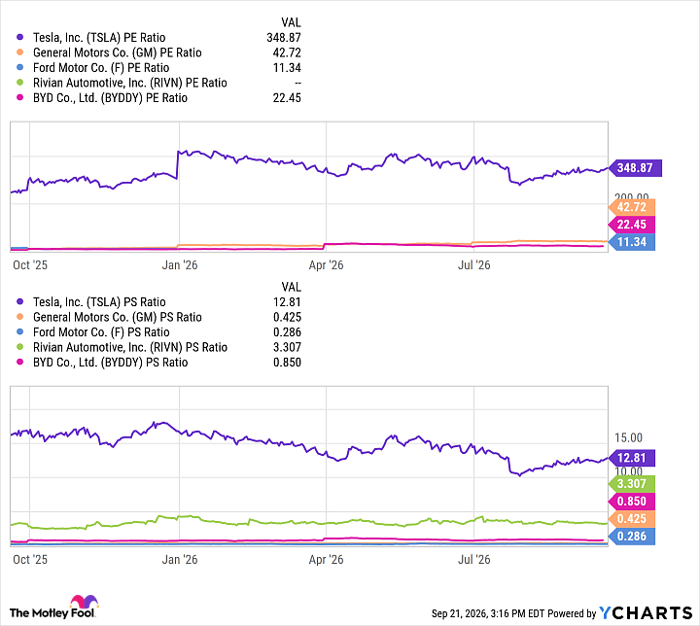
TSLA PE Ratio data by YCharts.
The buy thesis around Tesla argues that traditional valuation metrics measure the wrong business. FSD's attach rate on new cars shows how the auto manufacturer is starting to look like a platform business. Moreover, Robotaxi does not need to "work" next quarter for that recurring software revenue to matter. All that should be required is for adoption to continue compounding.
Even so, none of that makes Tesla stock cheap, per se. Baron himself even said that his nearly $30 billion in Musk-related exposure through Tesla (a stake worth about $4.7 billion) and Space Exploration Technologies is "enough," which is a polite way of saying he is not pounding the table with fresh capital at the moment.
Still, the interesting part is the overlap between my Druckenmiller call and Baron's core thesis. I argued Druckenmiller's Tesla position made a lot more sense if you ignored the sci-fi side of the business and dialed into FSD's progression. Baron just told the world to buy Tesla stock for that very reason. If you decide that Tesla stock is a buy at its current share price, it won't be because the company's P/E looks reasonable. It will be because its self-driving software is finally starting to scale with the automotive business.
Don’t miss this second chance at a potentially lucrative opportunity
Ever feel like you missed the boat in buying the most successful stocks? Then you’ll want to hear this.
On rare occasions, our expert team of analysts issues a “Double Down” stock recommendation for companies that they think are about to pop. If you’re worried you’ve already missed your chance to invest, now is the best time to buy before it’s too late. And the numbers speak for themselves:
- Nvidia: if you invested $1,000 when we doubled down in 2009, you’d have $595,015!*
- Apple: if you invested $1,000 when we doubled down in 2008, you’d have $64,810!*
- Netflix: if you invested $1,000 when we doubled down in 2004, you’d have $389,154!*
Right now, we’re issuing “Double Down” alerts for three incredible companies, available when you join Stock Advisor, and there may not be another chance like this anytime soon.
See the 3 stocks »
*Stock Advisor returns as of September 23, 2026.
Adam Spatacco has positions in Tesla. The Motley Fool has positions in and recommends Tesla. The Motley Fool recommends BYD Company and General Motors. The Motley Fool has a disclosure policy.
Recommended Articles


