


Silver Stocks Are Turning High Margins Into Dividends for Shareholders. 1 Precious Metals Stock to Buy Right Now.
Key Points
Wheaton Precious Metals raised its dividend by 18% earlier this year and has room to grow further.
The company locks in low purchase costs, limiting inflation exposure compared with traditional miners.
Elevated gold and silver prices have boosted margins, grown cash flow, and supported shareholder returns.
- 10 stocks we like better than Wheaton Precious Metals ›
Gold and silver prices surged into 2026, then pulled back sharply. That said, precious metals remain in focus amid rising fiscal debt and geopolitical tensions, and prices remain elevated.
Higher metals prices can translate into wider margins, and precious metals streaming company Wheaton Precious Metals (NYSE: WPM) is turning that tailwind into something investors can really appreciate: cold, hard cash. After raising its dividend by 18% earlier this year, Wheaton still has plenty of room to reward shareholders.
Missed AI’s "Act 1"? Act 2 Could Be 15x Bigger. Most investors think they missed the AI boat because they didn't buy Nvidia in 2005. But according to our analysts, we’re only at the end of "Act 1"—the R&D phase. "Act 2" is the global rollout. Continue »
Here's what investors need to know.
Here's why Wheaton stands out among precious metals stocks
Traditional miners dig ore out of the ground and sell their gold, silver, or other metals at prevailing spot market prices. Rising prices boost revenue and margins -- that is, if costs don't rise in tandem.
Running a physical mine involves high operational costs, including heavy-duty equipment, diesel fuel, and labor. Rising diesel and fuel costs have eroded mining operating margins, eating into the windfall cash flows operators would otherwise realize during precious metal rallies.
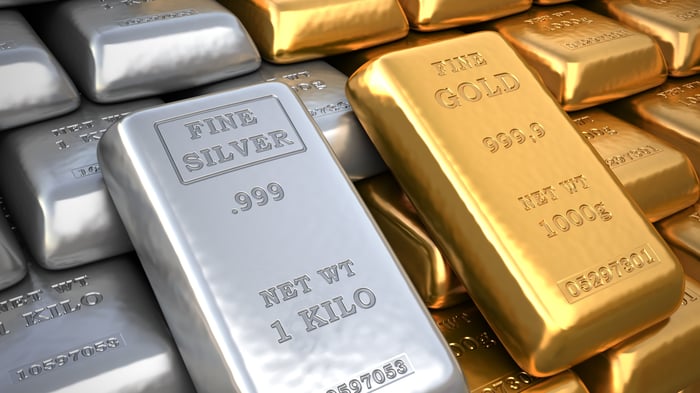
Image source: Getty Images.
This is where Wheaton Precious Metals' business stands out. The company operates a precious metals streaming business model. The company provides funds to mining companies to build or expand operations. In return, it secures long-term agreements that allow it to purchase a fixed percentage of future silver and gold production at low, predetermined contractual cash costs.
Profit margins are soaring
This structure helps shield Wheaton from inflation and boosts cash flow. During the second quarter, Wheaton paid an average contractual price of $9.57 per ounce of silver and $543 per ounce of gold. It sold that silver and gold for $73.41 and $4,452 per ounce, respectively, during the period.
Fixed purchase costs plus elevated spot prices have boosted Wheaton's profit margins. Through the first half of this year, its cash operating margin for silver jumped 139% to $66.96 per ounce, while its cash operating margin for gold jumped 56% to $4,099 per ounce. In other words, nearly every extra dollar from rising metal prices flows straight into cash flow.
Wheaton has further room for growth
During the first quarter, Wheaton raised its quarterly dividend to $0.195 per share, an 18% year-over-year increase. Its payout ratio is a modest 16% of net earnings per share, leaving plenty of room to grow the dividend again next year.
For investors seeking exposure to precious metals that benefit from rising prices and are less affected by inflation, Wheaton Precious Metals is a solid stock to buy.
Should you buy stock in Wheaton Precious Metals right now?
Before you buy stock in Wheaton Precious Metals, consider this:
The Motley Fool Stock Advisor analyst team just identified what they believe are the 10 best stocks for investors to buy now… and Wheaton Precious Metals wasn’t one of them. The 10 stocks that made the cut could produce monster returns in the coming years.
Consider when Netflix made this list on December 17, 2004... if you invested $1,000 at the time of our recommendation, you’d have $389,154!* Or when Nvidia made this list on April 15, 2005... if you invested $1,000 at the time of our recommendation, you’d have $1,406,303!*
Now, it’s worth noting Stock Advisor’s total average return is 949% — a market-crushing outperformance compared to 214% for the S&P 500. Don't miss the latest top 10 list, available with Stock Advisor, and join an investing community built by individual investors for individual investors.
See the 10 stocks »
*Stock Advisor returns as of September 23, 2026.
Courtney Carlsen has positions in Wheaton Precious Metals. The Motley Fool has no position in any of the stocks mentioned. The Motley Fool has a disclosure policy.
Recommended Articles


