


Pfizer, Kraft, and UPS All Yield More Than 6%. Which of These Dividend Stocks Is the Safest Option Today?
Key Points
Pfizer, UPS, and Kraft are all high-yielding stocks that come with varying levels of risk.
They're all generating positive free cash flow, but their payout ratios don't look good.
- 10 stocks we like better than Pfizer ›
Chasing high-yielding stocks can be risky. Dividend payments are, after all, never a guarantee. If a company runs into a situation where it needs to divert more cash to growth initiatives or simply can no longer afford to pay the dividend, it may have little choice but to cut or possibly even suspend its payout.
Three popular dividend stocks that are paying more than 6% right now include Pfizer (NYSE:PFE), United Parcel Service (NYSE:UPS), and Kraft Heinz (NYSE:KHC). Which one of these stocks looks to be the safest option for dividend investors right now? Let's take a closer look and analyze their respective payout ratios, cash flows, and long-term risks.
Missed AI’s "Act 1"? Act 2 Could Be 15x Bigger. Most investors think they missed the AI boat because they didn't buy Nvidia in 2005. But according to our analysts, we’re only at the end of "Act 1"—the R&D phase. "Act 2" is the global rollout. Continue »

Image source: Getty Images.
Which payout ratio looks the best?
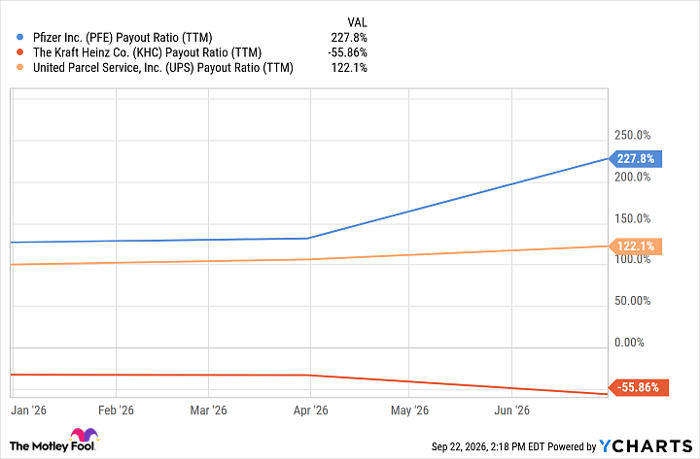
The payout ratio is often the default ratio many income investors look to when analyzing a dividend stock's risk. It tells investors how much of a company's earnings are being paid out in dividends. A ratio of more than 80% can signal trouble, and over 100% may indicate that it's unsustainable or that other factors are at play, such as an unusually poor quarter due to nonrecurring expenses.
PFE Payout Ratio (TTM) data by YCharts
None one of these payout ratios look great. Kraft's is in the negative as it posted a net loss recently due to significant impairment charges.
All of these companies are facing challenges and making changes to their operations to improve their financial situations, so it can be difficult to make a decision based on this metric alone. If there is an edge here, it goes to UPS, which is closest to 100%.
Which stock has the better free cash flow?
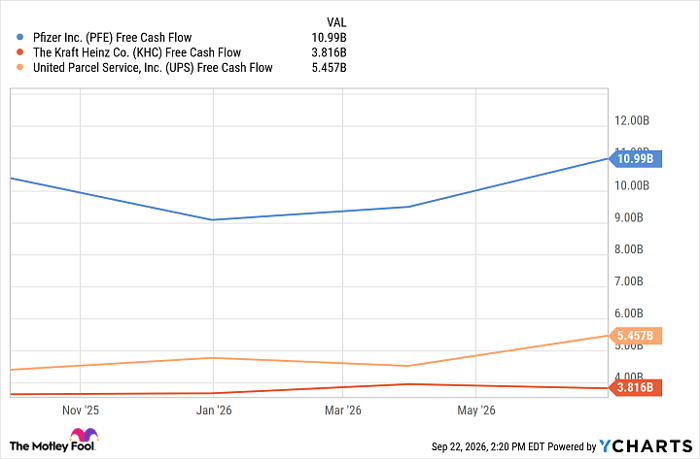
Free cash flow can sometimes be a better indicator of a company's ability to pay dividends, as it excludes the impact of non-cash items such as revaluation charges, impairment, and depreciation.
PFE Free Cash Flow data by YCharts
All three companies are generating positive free cash flow, which is encouraging. But it's important to put this into the context of how much dividends they are paying out.
Pfizer: It has paid out $9.8 billion in dividend payments over the trailing 12 months; thus, its free cash of nearly $11 billion puts it in a good position to continue making payments.
UPS: Its dividend payments have totaled $5.4 billion during the past 12 months. Its free cash flow is sufficient to cover the payouts, but there isn't a huge buffer here.
Kraft Heinz: Its dividend payments have totaled $1.9 billion over the past 12 months. Given its free cash flow of $3.8 billion, it has the largest buffer of the stocks listed here.
What are the big risks facing these stocks?
It's important to do a qualitative analysis of dividend stocks in addition to a quantitative one, as numbers may only tell part of the story.
Pfizer is adjusting to a post-COVID growth era, as it looks to develop new drugs to generate future growth, which is particularly crucial as it is also facing patent cliffs on multiple top drugs. The risk for investors is that the growth strategy does not go as planned, requiring more cash and potentially leading to pressure to reduce the dividend.
UPS has cut its business with Amazon by more than 50% as it looks to focus on improving its margins. It's been reducing its workforce as well as it gets leaner. The risk is that with global trade uncertainty and tariffs potentially weighing on its operations, it may also need to spend more cash to shore up its business. Investors may also worry about how strong the business will be with Amazon being a smaller customer.
Kraft faces no shortage of challenges on its own. As consumers are using GLP-1 drugs, which can curb appetites, there is concern about where its growth will come from in the future. It even contemplated splitting up its business. There are some massive question marks ahead for Kraft, which is why it may be the riskiest stock on this list.
Which of these dividend stocks is the best buy right now?
All of these three stocks carry risks, but the one I'd go with right now is Pfizer. The healthcare company has strong free cash flow, and it has been investing in its future growth and pipeline. While there is uncertainty ahead, even one big blockbuster drug could be a game changer for its business, and with its business still doing well, it may be an underrated buy.
UPS comes in at a close second, but tight free cash flow and trade uncertainty make it a slightly riskier option. Kraft, meanwhile, with its core business in trouble, it's hard to want to take a chance on it, even though its free cash flow is strong. The dividend may be safe for now, but it may not be in the long term.
Should you buy stock in Pfizer right now?
Before you buy stock in Pfizer, consider this:
The Motley Fool Stock Advisor analyst team just identified what they believe are the 10 best stocks for investors to buy now… and Pfizer wasn’t one of them. The 10 stocks that made the cut could produce monster returns in the coming years.
Consider when Netflix made this list on December 17, 2004... if you invested $1,000 at the time of our recommendation, you’d have $395,625!* Or when Nvidia made this list on April 15, 2005... if you invested $1,000 at the time of our recommendation, you’d have $1,397,147!*
Now, it’s worth noting Stock Advisor’s total average return is 951% — a market-crushing outperformance compared to 214% for the S&P 500. Don't miss the latest top 10 list, available with Stock Advisor, and join an investing community built by individual investors for individual investors.
See the 10 stocks »
*Stock Advisor returns as of September 23, 2026.
David Jagielski, CPA has no position in any of the stocks mentioned. The Motley Fool has positions in and recommends Amazon, Pfizer, and United Parcel Service. The Motley Fool recommends Kraft Heinz. The Motley Fool has a disclosure policy.
Recommended Articles


