


Why Did SanDisk Stock Surge 6%? Rosenblatt Initiates With Buy as AI Storage Demand Keeps Heating Up
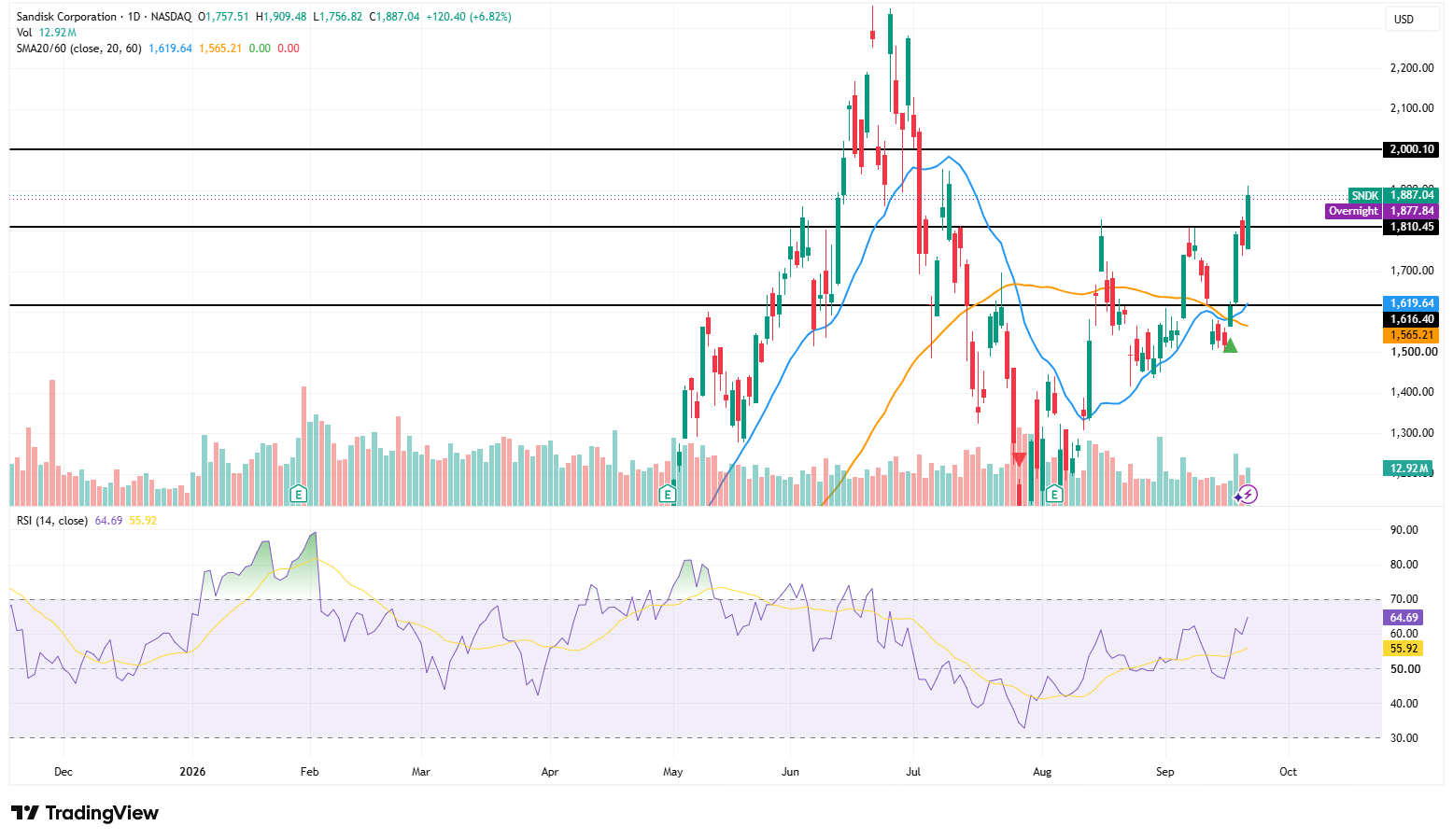
TradingKey - Rosenblatt Securities initiated coverage on SanDisk (SNDK) with a "Buy" rating and set a price target of $2,400. Driven by this, SanDisk closed up about 6.8% on Tuesday at $1,887.04.
Cassidy believes that the development of artificial intelligence is altering the demand structure for traditional NAND flash memory. In the past, NAND primarily served PCs, smartphones, and consumer electronics, with industry competition focusing more on increasing storage density and lowering unit costs. However, as AI models expand in scale and the volume of data generated by inference tasks grows continuously, data center requirements for storage products are shifting, with the importance of performance, capacity, durability, and supply stability rising significantly.
Under this trend, NAND is expected to further integrate from traditional storage components into AI infrastructure. Compared to standard consumer-grade storage, large-scale AI systems need to process far more data and perform continuous model training and inference, driving up demand for high-capacity, high-performance storage. Cassidy notes that this shift could elevate the value of NAND within the broader AI ecosystem, transforming it from a mere commodity focused solely on lowest cost.
SanDisk is currently advancing next-generation NAND technologies, including the BiCS8 and BiCS10 architectures co-developed with Japan's Kioxia. By increasing the number of vertically stacked storage cell layers, such technologies can deliver higher capacity within a limited footprint. Cassidy expects that with higher storage density and cost advantages, SanDisk is well-positioned to remain competitive in the AI data center storage market.
Regarding business expectations, Rosenblatt forecasts that SanDisk's data center revenue for fiscal year 2027, starting at the end of June 2026, will reach $21.7 billion and further increase to $28.6 billion in fiscal year 2028. Based on Cassidy's $2,400 price target, there remains an upside potential of approximately 30% compared to the stock price at the time the report was published.
In addition to growing AI demand, SanDisk's new supply collaboration model with customers is another reason analysts are bullish. It is reported that the company has signed multi-year agreements with eight major NAND customers, allowing them to lock in a specific volume of product supply and pricing in advance. As AI drives a rapid increase in NAND demand, such arrangements help enhance the company's visibility over future orders.
Cassidy believes that large-scale long-term agreements can cover a significant portion of SanDisk's NAND production capacity, thereby mitigating the supply-demand volatility that has frequently plagued the memory industry in the past. For the capital markets, if AI demand continues to rise and long-term contracts further strengthen order stability, SanDisk's business cycle may become smoother.
Source: TradingView
From a technical perspective, the stock price has comfortably cleared its 20-day moving average of $1,619.64 and 60-day moving average of $1,565.21, maintaining a bullish bias in the short-to-medium term. The $1,810 level has flipped from prior resistance into the primary support, with the next support located at $1,616–$1,620; a further breakdown would point attention to around $1,565.
To the upside, immediate resistance lies near $1,900, with $2,000 serving as a key psychological barrier. If the stock breaks above $2,000 on high volume at the close, it could extend toward the $2,100–$2,200 zone; however, if it fails to hold above $1,810, investors should be cautious of a failed breakout.
The RSI rose to 64.69, above its signal line of 55.92, indicating that upward momentum is strengthening, though it has not yet entered noticeably overbought territory.
Recommended Articles


