


Not Nvidia. Not Micron. Meet the AI Infrastructure Stock That Could Triple in Just 3 Years
Key Points
Oracle has a massive revenue backlog that will ensure stronger growth for the company over the next three years.
The company has found a smart way to reduce the pressure on its balance sheet while sustaining its aggressive data center build-out.
Oracle's accelerating earnings growth and attractive valuation indicate that the stock is poised for a big jump.
- 10 stocks we like better than Oracle ›
The artificial intelligence (AI) infrastructure boom has supercharged Nvidia and Micron Technology's growth in recent years, as both companies sell mission-critical chips deployed in AI data centers for model training and inference.
Not surprisingly, investments in Nvidia and Micron have been highly lucrative for investors. Importantly, both semiconductor stocks still have room for more upside, fueled by further growth in AI infrastructure investments.
Missed AI’s "Act 1"? Act 2 Could Be 15x Bigger. Most investors think they missed the AI boat because they didn't buy Nvidia in 2005. But according to our analysts, we’re only at the end of "Act 1"—the R&D phase. "Act 2" is the global rollout. Continue »
However, there is one AI infrastructure stock that has failed to capitalize on this fast-growing space despite its impressive numbers. Shares of Oracle (NYSE:ORCL) are down 52% over the past year. But a closer look at the company's latest quarterly report suggests investors may be underestimating its potential. Here's why.

Image source: The Motley Fool.
Oracle's incredible growth is going to send the stock on a bull run
Oracle released its fiscal 2027 first-quarter results (for the three months ended Aug. 31) on Sept. 10. The company's revenue increased 30% year over year to a record $19.3 billion. Additionally, the company's non-GAAP earnings per share rose 30% year over year to $1.92.
Analysts would have settled for $1.75 in earnings per share. However, it seems that the company's business model of asking customers to prepay for AI accelerator chips or to bring their own hardware is having a positive impact on its bottom line. Even Oracle's revenue exceeded the $19.14 billion consensus estimate, suggesting that it is converting its backlog into revenue at a solid pace now.
The good news for Oracle investors is that its revenue backlog continues to improve. The company's remaining performance obligation (RPO), which is the total value of unfulfilled contracts at the end of a quarter, increased by $209 billion from the year-ago quarter. The metric now stands at a massive $664 billion, paving the way for solid long-term growth in revenue and earnings.
Even better, Oracle notes that the conversion of RPO into revenue is poised to accelerate over the remainder of fiscal 2027. The company now expects to convert half of its RPO into revenue over the next three years, compared to the earlier estimate of 46%. So, Oracle is on track to generate $332 billion in revenue over the next three years, translating into an annual run rate of almost $111 billion.
That points to a significant improvement over Oracle's fiscal 2026 revenue of $67.4 billion. What's more, Oracle management's comments indicate that the stronger jump in revenue will also give its bottom line a nice boost. CFO Hilary Maxson noted on the latest earnings call that the "new RPO will not impact our capex or revenues until fiscal 2028 or beyond."
The company's bring-your-own-hardware/prepayment business model is therefore bearing fruit. This is also evident from Oracle's improving non-GAAP operating income, which increased 21% year over year in fiscal Q1 on a trailing-twelve-month basis. That was a significant improvement over the year-ago period's growth rate of 8%.
As such, I won't be surprised to see Oracle exceeding its guidance in fiscal 2027. The company anticipates a 34% year-over-year increase in revenue to $90 billion this fiscal year, while non-GAAP earnings are expected to increase by 18% to $8.10 per share. However, the fiscal Q1 performance clearly suggests that Oracle is on track to outperform that.
More importantly, Oracle's conversion of backlog into revenue will send the stock significantly higher over the next three years.
Here's how Oracle can become a multibagger
As Oracle's capital expenses taper off and backlog conversion accelerates, its bottom-line growth will also pick up. This explains why analysts are expecting a substantial step-up in earnings growth over the next couple of fiscal years.
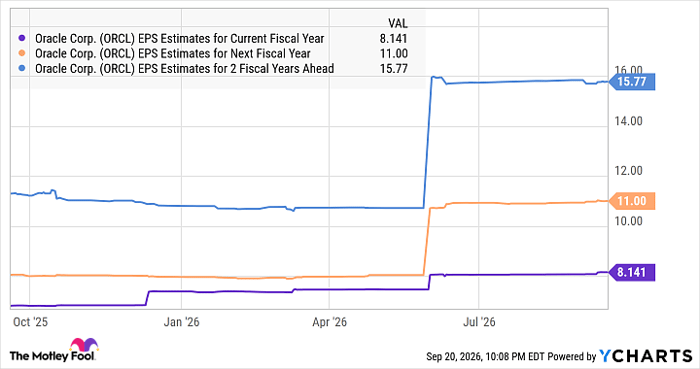
ORCL EPS Estimates for Current Fiscal Year data by YCharts
Oracle's earnings growth rate could double in fiscal 2028, as evident from the chart above, followed by a 43% increase in fiscal 2029. Oracle trades at 18 times forward earnings, lower than the tech-laden Nasdaq-100 index's forward earnings multiple of 24. A pick-up in earnings growth should be rewarded with a higher valuation.
Assuming Oracle trades at 30 times earnings after three years and its earnings per share reach $15.77 in fiscal 2029, the stock could jump to $473. That's over 3x where Oracle stock is right now. So, savvy investors can consider buying this beaten-down stock right away and holding it for the long run, considering its healthy upside potential.
Should you buy stock in Oracle right now?
Before you buy stock in Oracle, consider this:
The Motley Fool Stock Advisor analyst team just identified what they believe are the 10 best stocks for investors to buy now… and Oracle wasn’t one of them. The 10 stocks that made the cut could produce monster returns in the coming years.
Consider when Netflix made this list on December 17, 2004... if you invested $1,000 at the time of our recommendation, you’d have $387,158!* Or when Nvidia made this list on April 15, 2005... if you invested $1,000 at the time of our recommendation, you’d have $1,365,749!*
Now, it’s worth noting Stock Advisor’s total average return is 932% — a market-crushing outperformance compared to 211% for the S&P 500. Don't miss the latest top 10 list, available with Stock Advisor, and join an investing community built by individual investors for individual investors.
See the 10 stocks »
*Stock Advisor returns as of September 21, 2026.
Harsh Chauhan has no position in any of the stocks mentioned. The Motley Fool has positions in and recommends Micron Technology, Nvidia, and Oracle. The Motley Fool has a disclosure policy.
Recommended Articles


