


History Says This 1 Bear Market Move Is the Costliest Mistake Investors Can Make
Key Points
Over the past 150 years, the U.S. stock market has entered bear territory about every six years.
Stock market selloffs are a bad time to sell -- and a good time to buy.
Fidelity research found that missing out on the best five days of S&P 500 returns in 36 years could reduce a portfolio’s growth by 37%.
- These 10 stocks could mint the next wave of millionaires ›
The past few years have been good for stock market investors. The S&P 500 index (SNPINDEX: ^GSPC) has gained about 72% in the past five years. The tech-heavy Nasdaq-100 index has done even better, up about 93% in that time.
But good times in the stock market don't last forever. Stock market corrections (share price declines of 10% or more) or bear markets (declines of 20% or more) are inevitable. According to Fidelity research, over the past 150 years, U.S. stocks have entered a bear market about every six years on average.
Missed Nvidia in 2009? This Rare Signal Is Flashing Again. In 2009, a "Double Down" signal flashed for a little-known chipmaker called Nvidia. For the first time in years, that same "Total Conviction" signal is flashing for a company 1/100th the size of Nvidia. Continue »
Bear markets can be scary. When stock prices are plummeting, it might seem as if the world is on fire, everyone is panicking, and we're all going to lose money forever. Some investors might be tempted to sell stocks during a bear market or stop investing. But that's a mistake.
Let's look at historical evidence for why selling stocks during a bear market is often the wrong decision -- and what long-term investors should do instead.
Image source: Getty Images.
Biggest bear market mistake: Selling stocks (or pausing your investing)
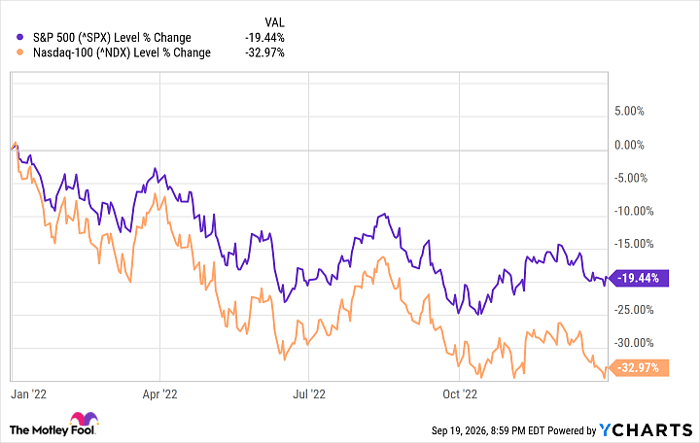
Bear markets happen. We had one in 2022, when the S&P 500 lost about 19%, and the Nasdaq-100 did even worse.
^SPX data by YCharts
It sounds counterintuitive, but when stocks are going through a sell-off, that's when you need to keep buying more. A bear market means that stocks are on sale at a 20% (or more) discount. Selling stocks when everyone else is selling is often a mistake. But buying more stocks when everyone else is selling -- and share prices are lower -- can help you lock in better long-term expected future returns.
If you invest via dollar-cost averaging (putting about the same amount of money into the stock market on a regular schedule), a bear market is ultimately good news for you. If you don't need your stock market money tomorrow and can leave it invested for five to 10 years (or longer), you should keep buying stocks every month according to your long-term plan.
The biggest risk of a bear market
The biggest risk of a bear market is not losing money -- it's missing out on future gains. Bear markets don't last forever. The stock market doesn't go to zero. The market has always recovered. Conflicts and crises come to an end. Good economic news comes along. A new trend, technology, or game-changing product gets investors excited again. Big money flows back into stocks because savvy investors want to own shares of those future profits.
Sometimes the market bounces back so fast that if you sell stocks during a bear market and then try to wait for the right time to get back in, you'll miss your chance to buy at a discount. Stocks will get more expensive again, faster than you can react. Stock market prices can go back up just as fast, or faster, than the speed of a bear market downturn.
Missing out on just a few higher-performing days in the stock market can cause you to miss out on massive wealth-building momentum. Fidelity research examined historic S&P 500 returns from 1988 to 2024. The study found that if an investor had invested $10,000 in the S&P 500 on Jan. 1, 1988, that investment would have grown to $522,576 by Dec. 31, 2024.
But if the investor had tried to time the market by moving money in and out of stocks, missing out on just the best five days of stock performance during those 36 years, the portfolio's value would've grown only to $330,000. That's a loss of about 37%.
What to do during a bear market instead of selling stocks
Selling stocks during a stock market sell-off can be a costly mistake. Most long-term investors are going to be better off by continuing to invest in stocks during bear markets -- especially when everyone else seems to be selling stocks and heading for the exits.
Buying low-cost index funds and continuing to invest regularly through all the everyday ups and downs of the stock market is often a good move. The Vanguard S&P 500 ETF (NYSEMKT: VOO) has delivered annualized returns of 15% since September 2010.
Taking an even longer-term view, the S&P 500 has delivered an average annual return of about 10% since 1928. Investing in VOO can help you earn those strong, wealth-generating gains through good times and bad, bear and bull markets. Long-term investors don't have to be afraid of bear markets. Just keep buying stocks according to your long-term plan.
Where to invest $1,000 right now
When our analyst team has a stock tip, it can pay to listen. After all, Stock Advisor’s total average return is 932%* — a market-crushing outperformance compared to 211% for the S&P 500.
They just revealed what they believe are the 10 best stocks for investors to buy right now, available when you join Stock Advisor.
See the stocks »
*Stock Advisor returns as of September 21, 2026.
Ben Gran has no position in any of the stocks mentioned. The Motley Fool has positions in and recommends Vanguard S&P 500 ETF. The Motley Fool has a disclosure policy.
Recommended Articles


