


The Stock Market Looks More Expensive Than Ever Before Based on Certain Measures, and Warren Buffett's Timeless Advice Has Never Been More Valuable
Key Points
Stock valuations are extremely high based on multiple valuation measures, including Warren Buffett's favorite.
There are good reasons valuations could be this high, but that doesn't mean there's less risk.
Focusing on Buffett's simple investment strategy can help you uncover opportunities in today's market.
- 10 stocks we like better than S&P 500 Index ›
Over the last four years, the S&P 500 (SNPINDEX: ^GSPC) and Nasdaq Composite (NASDAQINDEX: ^IXIC) have been practically unstoppable in their continued march higher. Despite a number of potentially dislocating events, investors have bought into stock price pullbacks, pushing the indexes to new all-time highs this year.
But as the bull market approaches its four-year anniversary, stocks, as a group, have never looked more expensive. Twenty-five years ago, as the dot-com bubble popped, Warren Buffett shared a simple metric he called "the best single measure of where valuations stand at any given moment." Today, that metric is hitting new record highs, indicating a severely overvalued stock market. Luckily, Buffett's timeless wisdom can also point investors toward market opportunities.
Missed AI’s "Act 1"? Act 2 Could Be 15x Bigger. Most investors think they missed the AI boat because they didn't buy Nvidia in 2005. But according to our analysts, we’re only at the end of "Act 1"—the R&D phase. "Act 2" is the global rollout. Continue »
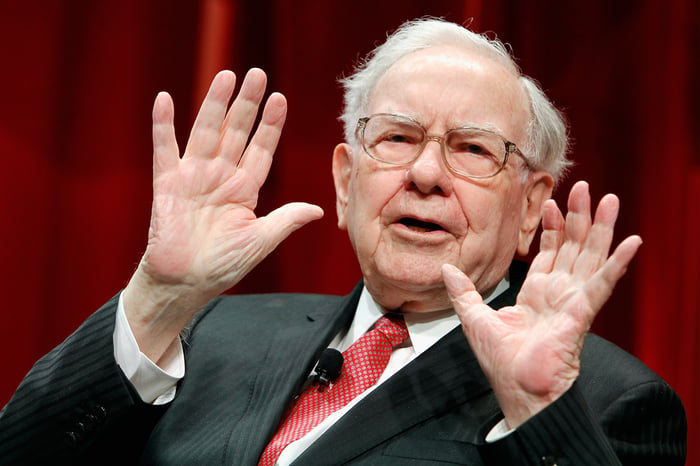
Image source: Getty Images.
How expensive is today's stock market?
Buffett's top metric for market valuations has come to be known as the Buffett indicator since he first published it in 2001. The calculation is simple: Take the total market cap of the Wilshire 5000 index, the broadest U.S. stock market index, and divide it by the U.S. GDP. Buffett warned, "If the ratio approaches 200% -- as it did in 1999 and a part of 2000 -- you are playing with fire."
Today, the ratio sits around 240%, the highest it's ever been.
It's not the only valuation indicator at or near all-time highs. Much has been written about the price-to-earnings (P/E) ratio and cyclically adjusted P/E ratio of the S&P 500. Both sit near levels last seen in the dot-com bubble. The equity risk premium is shrinking as well. Margin debt is also hitting new records and climbing fast.
But before investors start running for the hills, there are a few important factors to consider.
First, there are good reasons for U.S. stocks to have a higher market cap today as a percentage of U.S. GDP than in the past. Namely, companies, especially the largest U.S. companies, derive a larger percentage of their sales from international markets than in the past. FactSet Research analyst Jonas Svallin recently adjusted the Buffett indicator to account for the growing share of profits derived from international markets. That brought the metric down to 144%, which he says is still overvalued, but not "playing with fire."
Additionally, a strong earnings growth outlook supports very high valuations. Analysts expect the S&P 500 to produce average earnings growth of more than 26% per year over the next five years. In the meantime, corporate profits as a percentage of GDP have climbed significantly above their levels in 1999 and 2000, suggesting stock prices are justified.
That doesn't mean high valuations are without risk, though. Any shortfall in the market's lofty expectations could send stocks reeling. That's why investors should focus on a key piece of wisdom from Warren Buffett that works equally well whether stocks are expensive or cheap.
The timeless Buffett advice investors need for today's market
Buffett laid out Berkshire Hathaway's (NYSE: BRKA) (NYSE: BRKB) entire investment strategy in a single sentence in his 1986 letter to shareholders: "We simply attempt to be fearful when others are greedy and to be greedy only when others are fearful."
It's important to note that "the stock market" isn't just one thing; it's a massive collection of companies across different industries, and the market has put a value on each and every one of them. Some corners of the market will exhibit extreme greed, others will display characteristics of overly fearful investors. The key is to focus on the latter while avoiding the former.
Earlier this year, software stocks experienced a massive sell-off as fears arose that AI would render their products irrelevant over time. Investors heavily discounted today's earnings with expectations that earnings growth was unsustainable and that, eventually, many enterprise software companies would see their top lines shrink. While those fears have abated somewhat, software stocks, as a group, still look tremendously undervalued.
More recently, investors have started pushing down the valuations of some of the world's biggest cloud computing companies: Amazon, Microsoft, and Alphabet. Fears of an AI bubble, that these companies are overbuilding capacity, have created a great level of uncertainty in their future returns on their cash spending today. Buffett, for one, sees opportunity in these stocks, and he and Berkshire CEO Greg Abel have made a massive investment in Alphabet.
But not all cloud computing companies are created equal. Highly leveraged, undifferentiated, and unprofitable neocloud companies pose substantially greater risk but nonetheless tend to garner much higher valuations than hyperscalers.
Berkshire Hathaway's recent equity purchasing behavior points to how to effectively manage a portfolio in an increasingly expensive market. Managing risk becomes key, and that's seen in Berkshire's large cash position. But Berkshire has been able to make at least some stock purchases each quarter while waiting for a broader market pullback to create more meaningful investment opportunities.
Should you buy stock in S&P 500 Index right now?
Before you buy stock in S&P 500 Index, consider this:
The Motley Fool Stock Advisor analyst team just identified what they believe are the 10 best stocks for investors to buy now… and S&P 500 Index wasn’t one of them. The 10 stocks that made the cut could produce monster returns in the coming years.
Consider when Netflix made this list on December 17, 2004... if you invested $1,000 at the time of our recommendation, you’d have $387,158!* Or when Nvidia made this list on April 15, 2005... if you invested $1,000 at the time of our recommendation, you’d have $1,365,749!*
Now, it’s worth noting Stock Advisor’s total average return is 932% — a market-crushing outperformance compared to 211% for the S&P 500. Don't miss the latest top 10 list, available with Stock Advisor, and join an investing community built by individual investors for individual investors.
See the 10 stocks »
*Stock Advisor returns as of September 21, 2026.
Adam Levy has positions in Alphabet, Amazon, and Microsoft. The Motley Fool has positions in and recommends Alphabet, Amazon, Berkshire Hathaway, FactSet Research Systems, and Microsoft. The Motley Fool has a disclosure policy.
Recommended Articles


