


What History Tells Us When Markets React to Economic Alarm Bells
Key Points
Economic data helps determine market conditions.
That doesn't mean the market is very good at predicting what the economy will be doing in the near term.
Nor is the economy's direction a surefire bellwether for predicting what the markets will do in the near term.
- 10 stocks we like better than S&P 500 Index ›
When the economy's control panel starts to flash red warning lights, the market is usually already moving, pricing in the potential damage before the data confirms it, and then reversing course if the damage never arrives. That tendency will now be tested again. Wholesale prices rose 5.4% in the 12 months through August 2026, and crude oil rose above $100 per barrel on Sept. 15. To complicate matters further, on Sept. 16, the Federal Reserve hiked rates by 0.25%, its first hike since 2023.
These conditions are an uneasy mix for the S&P 500 (SNPINDEX: ^GSPC), the Nasdaq Composite (NASDAQINDEX: ^IXIC), and the Dow Jones Industrial Average (DJINDICES: ^DJI), all of which stand to struggle significantly if those rising prices and rising input costs lead to slimmer margins for businesses or lower demand for goods from consumers. But, as economist Paul Samuelson famously joked in 1966, stocks have predicted nine of the last five recessions. Let's untangle the lessons of history and try to extract some useful principles for thinking about what to expect next.
Missed AI’s "Act 1"? Act 2 Could Be 15x Bigger. Most investors think they missed the AI boat because they didn't buy Nvidia in 2005. But according to our analysts, we’re only at the end of "Act 1"—the R&D phase. "Act 2" is the global rollout. Continue »
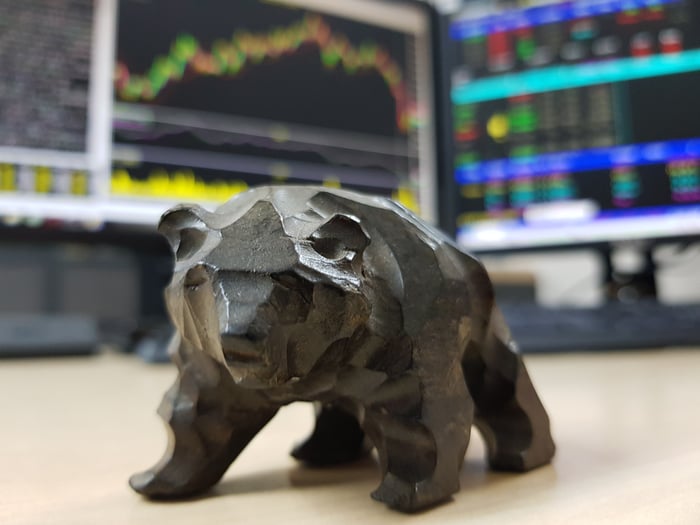
Image source: Getty Images.
Stocks declined by 25% in 2022, but the feared recession never happened
Investors rarely wait for bulletproof evidence before acting. People sell when they expect profits to shrink, so a typical recession affects share prices before it's reflected in the official statistics. At the same time, fundamentals often start to improve before an economic downturn is declared over, with share prices following a bit later.
On that note, the S&P 500 fell 25.4% between Jan. 3 and Oct. 12, 2022 in a brutal bear market caused in part by the Federal Reserve hiking rates to fight against inflation.
At that low, investors widely expected a recession in 2023. However, those fears proved unfounded, and the index went on to reach a new high on Jan. 19, 2024. Earnings slipped downwards for a few quarters, but never collapsed.
Don't take that to mean stock sell-offs are meaningless. A 2013 International Monetary Fund working paper found that stock price drops are significantly linked to the start of recessions in the G7 economies.
Should you buy when alarm bells ring?
Sometimes the market shrugs off trouble for a while only to collapse later.
The S&P 500 closed at a record on Oct. 9, 2007, two months before a long and difficult recession began. The National Bureau of Economic Research (NBER), which officially dates U.S. recessions, didn't confirm one had started until Dec. 1, 2008. The index then fell 56.8% by March 2009, and didn't reclaim its 2007 record until March 28, 2013, weeks after the Dow reclaimed its own. Similarly, the Nasdaq, still flattened by the dot-com bust, took until April 2015 to top its March 2000 record.
The market rarely predicts the future accurately on its first exposure to new data, and it often overreacts to both the upside and the downside.
Therefore, the one thing investors should not try to do is time the market. Whichever factors you think you're trying to plan around, the odds of the market reacting to them in a time frame that works for your investment are poor. Buying consistently in small doses over time is an advisable approach.
Should you buy stock in S&P 500 Index right now?
Before you buy stock in S&P 500 Index, consider this:
The Motley Fool Stock Advisor analyst team just identified what they believe are the 10 best stocks for investors to buy now… and S&P 500 Index wasn’t one of them. The 10 stocks that made the cut could produce monster returns in the coming years.
Consider when Netflix made this list on December 17, 2004... if you invested $1,000 at the time of our recommendation, you’d have $387,158!* Or when Nvidia made this list on April 15, 2005... if you invested $1,000 at the time of our recommendation, you’d have $1,365,749!*
Now, it’s worth noting Stock Advisor’s total average return is 932% — a market-crushing outperformance compared to 211% for the S&P 500. Don't miss the latest top 10 list, available with Stock Advisor, and join an investing community built by individual investors for individual investors.
See the 10 stocks »
*Stock Advisor returns as of September 20, 2026.
Alex Carchidi has no position in any of the stocks mentioned. The Motley Fool has no position in any of the stocks mentioned. The Motley Fool has a disclosure policy.
Recommended Articles


