


Gold price retraces as Fed hawks keep the US Dollar bid
- Gold slips from $4,383 as US Dollar extends post-Fed recovery.
- Fed officials reinforce tightening bias, capping Bullion’s rebound prospects.
- ADP, PMIs and Fed speakers shape Gold’s next move.
Gold price retreats on Monday, down over 0.6% following last week’s Federal Reserve (Fed) interest rate hike. That 25 bps hike initially pushed US bond yields higher, but the US Dollar Index (DXY) has recovered some ground on Monday despite Treasury yields falling in the back half. The XAU/USD trades at $4,350 on Monday after peaking at nearly $4,383.
XAU/USD retreats as renewed tightening expectations outweigh softer Treasury yields
The yellow metal feels the pressure at the beginning of the week, while market mood remains upbeat despite the Fed’s decision. The Buck remains supported by expectations of further tightening by the US central bank, which has regained some credibility after the decision due to the closer ties between Fed Chair Kevin Warsh and US President Donald Trump.
The US Dollar Index (DXY), which measures the performance of the US currency against the other six, is up 0.2% at 100.42.
Expectations of diplomatic progress between the US and Iran pushed Oil prices lower after US President Trump indicated he would be willing to meet with his Iranian counterpart, who is anticipated to attend the UN General Assembly this week.
Aside from this, US Treasury yields remained depressed, but Bullion has failed to rally despite its inverse correlation with US yields. Despite this, money markets seem confident that the Fed will increase rates toward the end of the year, with traders expecting at least 33 basis points of tightening.
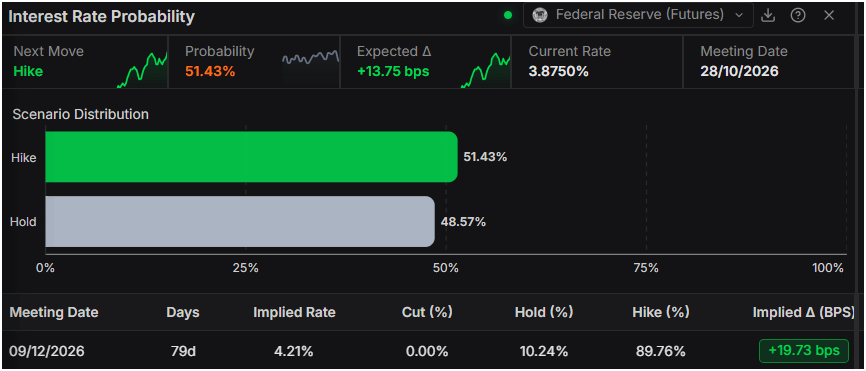
Federal Reserve officials unleashed
The St. Louis Fed President, Alberto Musalem, commented that “without further policy restraint, it is more likely inflation will remain substantially above 2% target in 18 months from now.” He added that further rate hikes are needed.
The Chicago Fed's Austan Goolsbee said that the Fed can’t ignore repeated and consistent supply shocks and that they must respond in a way that may cause economic hardship. He commented that the path to bringing inflation back to the 2% goal may not be painless.
On Sunday, the Minneapolis Fed President Neel Kashkari said that inflation is too high across all sectors of the US economy, not just Oil.
Given the backdrop and the hawkish tilt by most Fed officials, the Gold price should be capped on the upside. Nevertheless, rising geopolitical tensions and broad US Dollar weakness could prompt buyers to buy the yellow metal.
Ahead, the US economic docket will feature the ADP Employment Change 4-week average, speeches by Fed officials and S&P Global Flash PMIs.
XAU/USD technical analysis: Gold struggles at $4,400 aims toward the 100-day SMA
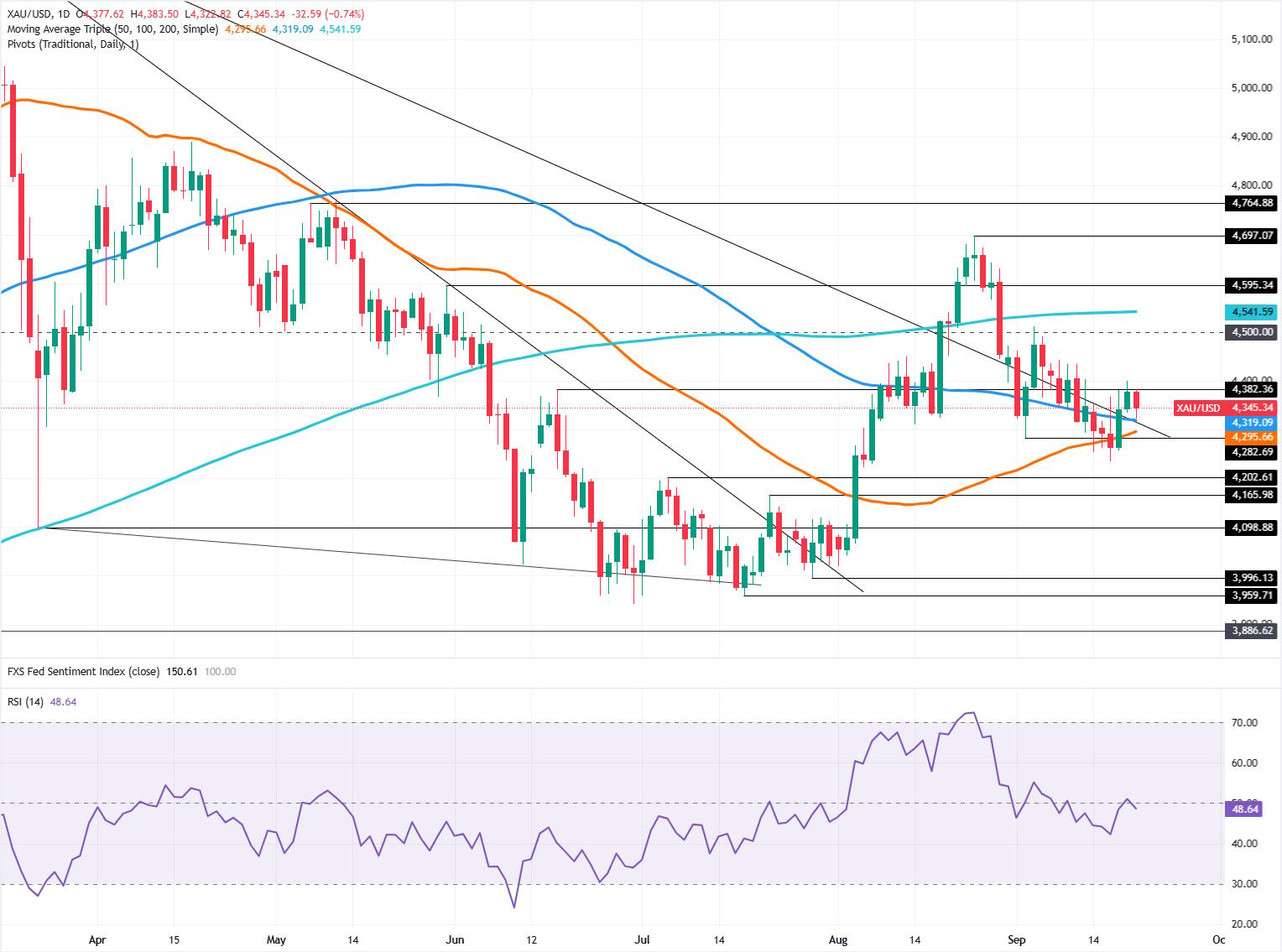
From a technical perspective, Gold is poised for further consolidation but slightly tilted to the downside. The Relative Strength Index (RSI) is aiming lower and has turned bearish. From a market structure standpoint, the successive series of lower lows and lower highs stays intact.
On the downside, XAU’s first support is the low of the day at $4,322. A breach of the latter will expose the 100-day Simple Moving Average (SMA) of $4,319, followed by the 50-day at $4,295. If those levels are taken out, the next demand zone is the $4,000 milestone.
If buyers moved in and reclaimed $4,400 on a daily basis, it opens the door for some range-trading within the $4,400 - $4,500 area. On further strength, the next stop is the 200-day SMA at $4,541.
Gold FAQs
Gold has played a key role in human’s history as it has been widely used as a store of value and medium of exchange. Currently, apart from its shine and usage for jewelry, the precious metal is widely seen as a safe-haven asset, meaning that it is considered a good investment during turbulent times. Gold is also widely seen as a hedge against inflation and against depreciating currencies as it doesn’t rely on any specific issuer or government.
Central banks are the biggest Gold holders. In their aim to support their currencies in turbulent times, central banks tend to diversify their reserves and buy Gold to improve the perceived strength of the economy and the currency. High Gold reserves can be a source of trust for a country’s solvency. Central banks added 1,136 tonnes of Gold worth around $70 billion to their reserves in 2022, according to data from the World Gold Council. This is the highest yearly purchase since records began. Central banks from emerging economies such as China, India and Turkey are quickly increasing their Gold reserves.
Gold has an inverse correlation with the US Dollar and US Treasuries, which are both major reserve and safe-haven assets. When the Dollar depreciates, Gold tends to rise, enabling investors and central banks to diversify their assets in turbulent times. Gold is also inversely correlated with risk assets. A rally in the stock market tends to weaken Gold price, while sell-offs in riskier markets tend to favor the precious metal.
The price can move due to a wide range of factors. Geopolitical instability or fears of a deep recession can quickly make Gold price escalate due to its safe-haven status. As a yield-less asset, Gold tends to rise with lower interest rates, while higher cost of money usually weighs down on the yellow metal. Still, most moves depend on how the US Dollar (USD) behaves as the asset is priced in dollars (XAU/USD). A strong Dollar tends to keep the price of Gold controlled, whereas a weaker Dollar is likely to push Gold prices up.
Recommended Articles


