


Realty Income or Agree Realty During a REIT Sell-Off?
Key Points
Realty Income is a net-lease REIT giant and has always been a bit of a dividend-growth tortoise.
Agree Realty is a smaller, faster-growing net-lease REIT, and higher rates could be a big near-term headwind.
- These 10 stocks could mint the next wave of millionaires ›
The average real estate investment trust (REIT) has fallen roughly 8% over the past three months, as of this writing. Realty Income (NYSE:O), the largest net-lease REIT, is down 14%, and Agree Realty (NYSE:ADC), a smaller, faster-growing peer, is off by 16%. The main driver of the sell-off is rising interest rates and bond yields. Dividend investors could find that this drawdown is opening up a long-term high-yield opportunity.
Why are Realty Income and Agree so unloved?
Realty Income and Agree are both net-lease REITs, meaning their tenants are responsible for most property-level operating costs. Very often, these REITs buy properties directly from companies that occupy them, then rent them right back under long-term leases, in what is known as a sale-leaseback transaction. These are usually financing arrangements for the seller, which gets to free up capital to invest in other things, like growing its business or shoring up its balance sheet.
Missed AI’s "Act 1"? Act 2 Could Be 15x Bigger. Most investors think they missed the AI boat because they didn't buy Nvidia in 2005. But according to our analysts, we’re only at the end of "Act 1"—the R&D phase. "Act 2" is the global rollout. Continue »

Image source: Getty Images.
Realty Income and Agree are basically making the spread between their borrowing costs and the rental income they generate. With bond yields and interest rates rising, these REITs will have to contend with a higher cost of capital. Meanwhile, long-term leases generally lock in rent hikes, but at levels that may seem low today, in a world facing elevated inflation. Profitability is under pressure, and investors are reacting accordingly, shifting into the guaranteed income stream offered by bonds, which now offer more compelling yields.
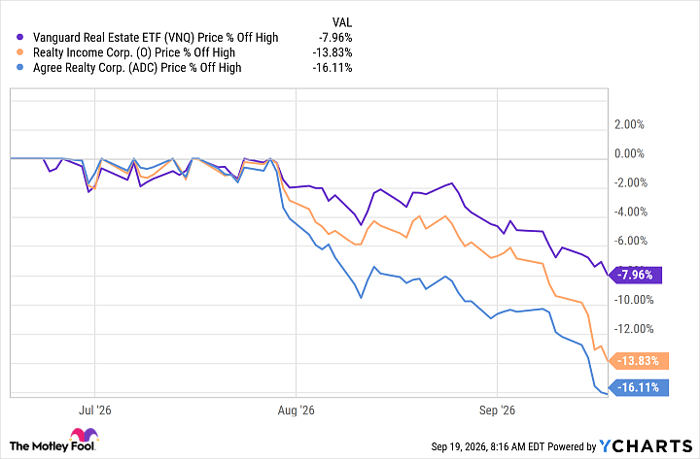
VNQ data by YCharts
Is Realty Income better than Agree, or vice versa?
From a near-term perspective, Realty Income is probably better positioned to navigate the current environment. It is the industry giant, with a market cap of $53 billion and a portfolio of over 15,500 properties. Its assets are spread over retail, industrial, and more unique property types, including casinos and data centers. It is also geographically diversified across North America and Europe.
As the net lease bellwether, sporting an investment-grade-rated balance sheet, Realty Income tends to have advantaged access to capital markets and a very low cost of capital. It has also been venturing into lending, which would benefit from rising yields, and institutional money management, which creates reliable fee income. It has long been a slow and steady tortoise, and that's not likely to change. With a 5.7% yield, even the most conservative investors should probably consider buying it. If the yield crosses 6%, the risk-reward balance would be heavily tilted toward reward for an income-focused dividend investor with a long time horizon.
Agree is a bit tricker, but for dividend growth investors it could still be compelling. The yield is currently around 4.7%, toward the high end of recent history. The REIT's market cap is roughly $8.5 billion, and it has a portfolio of about 2,800 properties. All of its properties are in the retail sector and located in the United States. It is a smaller REIT with a clear property preference and a focus on growth through acquisition.
Agree's growth has shown up most clearly in the dividend. The most recent dividend hike was 4% compared to the previous year. Realty Income's most recent dividend payment was up only 1% compared to the previous year. That's a big difference, with Agree likely to grow its dividend more quickly for years to come. However, in the near term, Agree is likely to be more affected by rising bond yields and interest rates, since its growth is heavily driven by acquisitions, which will be more expensive.
This too shall pass
So, for dividend growth investors, Agree is probably a good choice to keep an eye on. For investors who want a higher yield backed by a reliable business, Realty Income should probably win, noting it has increased its dividend annually for 31 years. But the really big story here is that property markets tend to adjust to market conditions over time. So history suggests that the profit pressures these two net-lease REITs are feeling today will eventually pass, either from a directional shift in rates or from property prices adjusting in a way that ensures Realty Income and Agree are well compensated for their capital. In other words, if you think in decades and not days, the REIT sell-off is the type of market reaction that could help you build a strong dividend foundation for your portfolio.
Where to invest $1,000 right now
When our analyst team has a stock tip, it can pay to listen. After all, Stock Advisor’s total average return is 932%* — a market-crushing outperformance compared to 211% for the S&P 500.
They just revealed what they believe are the 10 best stocks for investors to buy right now, available when you join Stock Advisor.
See the stocks »
*Stock Advisor returns as of September 20, 2026.
Reuben Gregg Brewer has positions in Realty Income. The Motley Fool has positions in and recommends Realty Income. The Motley Fool has a disclosure policy.
Recommended Articles


