


If a Stock Market Crash Is Coming, History Says This Is the Smartest Move You Can Make.
Key Points
The S&P 500 has climbed in the double digits over the past few years.
In recent times, investors have worried about economic headwinds and stocks’ valuations.
- 10 stocks we like better than S&P 500 Index ›
The S&P 500 has been advancing through a bull market for more than three years, with artificial intelligence (AI) stocks leading the way. Investors got excited about the game-changing nature of this technology and piled into potential winners early to maximize gains. And this proved to be a winning bet in many cases, considering the double- and triple-digit gains of many AI stocks, from Micron Technology to Nvidia.
But, in recent months, investors have become more cautious about AI and the general market, and this is amid various headwinds. These include the ongoing turmoil in Iran, higher prices in the U.S., and questions about the enormous levels of spending poured into the AI build-out. And just this week, the Federal Reserve increased interest rates for the first time in three years to tame inflation. Higher rates equal higher costs for consumers and for companies borrowing to expand, and that could be bad news for corporate earnings growth. At the same time, the overall stock market remains expensive, with valuations at a level they've only surpassed once before throughout history.
Missed AI’s "Act 1"? Act 2 Could Be 15x Bigger. Most investors think they missed the AI boat because they didn't buy Nvidia in 2005. But according to our analysts, we’re only at the end of "Act 1"—the R&D phase. "Act 2" is the global rollout. Continue »
All of these elements have prompted some investors to worry about a potential market crash ahead. It's impossible to predict when the next crash may come, but one thing is certain: Crashes are part of stock market cycles, so one eventually will take place -- even if it's far down the road.
What can you do to prepare? History offers us a valuable piece of advice. If a stock market crash is coming -- even well into the future -- this is the smartest move you can make.

Image source: Getty Images.
The S&P 500 bull market
So, first, let's take a look at the S&P 500's path so far over the past few years. As mentioned, they've been great ones for investors. From 2023 through 2025, the index climbed 78%, led by AI stocks. These players, tech giants that we know well, like Nvidia and Alphabet, are heavily weighted in the S&P 500, so moves they make set the pace for the entire index. These players have been early winners of the AI race, as they sell the products and services needed for AI development -- as a result, their revenue has exploded higher, and the stock prices followed.
This year, however, investors' concerns intensified about the pace and depth of spending on the AI infrastructure build-out. Top tech companies have committed more than $700 billion this year alone to the effort. Though demand continues to soar, investors still worry that the future revenue opportunity may not justify this level of investment.
Meanwhile, the other headwinds I mentioned above also weighed on investor sentiment, and all of this has made investors more hesitant, particularly regarding AI stocks. And with the S&P 500 Shiller CAPE ratio showing us that stocks are at one of their most expensive levels ever, investors have worried that declines -- and even a market crash -- may be on the way.
Looking at past crashes
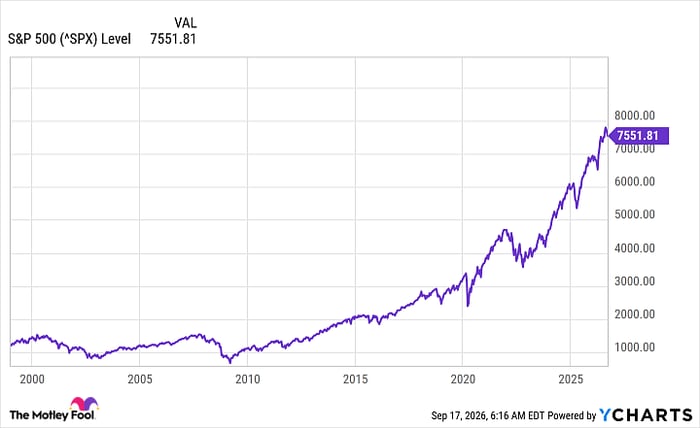
So, if a stock market crash is coming, what does history show us? The following chart spans the period of three crashes: the dot-com crash in 2000, the financial crisis of 2007-2008, and the coronavirus market crash in early 2020. As we can see, after each occasion, the S&P 500 went on to recover and post a significant gain in the years to come.
^SPX data by YCharts
This suggests that the smartest move you can make to prepare for a crash and during a crash is to hold onto quality stocks as they are very likely to recover. It's important to view investing as a long-term endeavor and resist focusing on short-term turbulence -- from dips and headwinds to market crashes. These negative moments are temporary, and history clearly shows us that the S&P 500, which is composed of market-leading companies, always goes on to gain.
So, if a crash is ahead, history offers us great advice: Hold onto great companies that have proven themselves over time -- they have what it takes to withstand the pressure of a crash and go on to deliver a win for shareholders.
Should you buy stock in S&P 500 Index right now?
Before you buy stock in S&P 500 Index, consider this:
The Motley Fool Stock Advisor analyst team just identified what they believe are the 10 best stocks for investors to buy now… and S&P 500 Index wasn’t one of them. The 10 stocks that made the cut could produce monster returns in the coming years.
Consider when Netflix made this list on December 17, 2004... if you invested $1,000 at the time of our recommendation, you’d have $387,158!* Or when Nvidia made this list on April 15, 2005... if you invested $1,000 at the time of our recommendation, you’d have $1,365,749!*
Now, it’s worth noting Stock Advisor’s total average return is 932% — a market-crushing outperformance compared to 211% for the S&P 500. Don't miss the latest top 10 list, available with Stock Advisor, and join an investing community built by individual investors for individual investors.
See the 10 stocks »
*Stock Advisor returns as of September 20, 2026.
Adria Cimino has no position in any of the stocks mentioned. The Motley Fool has positions in and recommends Alphabet, Micron Technology, and Nvidia. The Motley Fool has a disclosure policy.
Recommended Articles


