


Boeing's New MQ-25A Stingray Drone Costs $184 Million ... or Less
Key Points
The U.S. Navy awarded Boeing $552 million to build and deliver MQ-25A Stingray drones.
Part of the contract price will cover advance purchases of parts to build three additional Stingray drones.
The contract envisions a purchase price per drone 10% below initial estimates.
- 10 stocks we like better than Boeing ›
It's been nearly a decade since Boeing (NYSE: BA) won the Navy's competition to design a new drone that can launch from (and land back on) an aircraft carrier. The drone in question, the MQ-25A Stingray, isn't a fighter jet -- it actually carries no weapons at all. Instead, it's a drone refueling tanker, designed to keep piloted fighter jets gassed up so they can reach targets at greater distances.
Eight years after that award came down, Boeing finally completed its first test flight from a U.S. carrier earlier this year, launching, refueling its fighters, and landing back on deck. And yes, eight years seems like a long time to develop a weapons system, but it's not all bad news for Boeing.
Missed AI’s "Act 1"? Act 2 Could Be 15x Bigger. Most investors think they missed the AI boat because they didn't buy Nvidia in 2005. But according to our analysts, we’re only at the end of "Act 1"—the R&D phase. "Act 2" is the global rollout. Continue »
And not all bad news for the U.S. Navy, either.
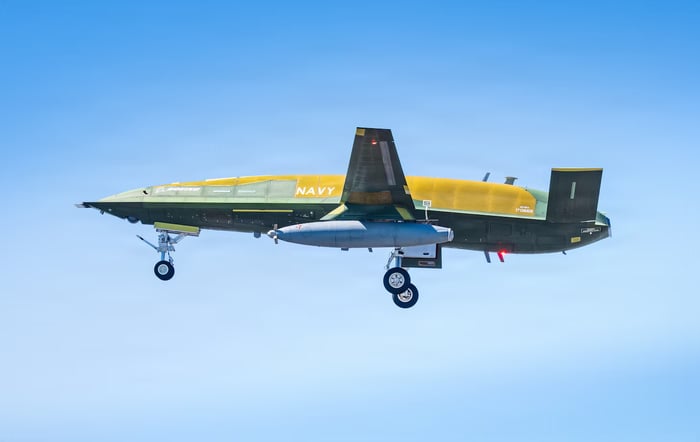
Image source: U.S. Navy.
Boeing's big Navy win
Boeing began its Stingray odyssey with an $805 million development contract awarded in 2018. The U.S. Government Accountability Office initially estimated the total program cost at $15.8 billion to build 76 refueling drones -- about $207 million each. More recently, it tweaked these figures to anticipate a total cost of $15.9 billion -- $209 million per Stingray drone.
And now here's where the news gets good.
On Monday, the Defense Department's daily digest of contract awards revealed that Boeing has been awarded a $552 million fixed-price contract to deliver three "Lot One" MQ-25A Stingray drones to the Navy. The funds will also pay for "advance acquisition of long-lead components for three low-rate initial production Lot Two aircraft for the Navy."
These are significant numbers.
The $552 million figure implies that, at most, the Navy will pay $184 million per Stingray -- much less than the initial estimate of $207 million. What's more, if even just some of the $552 million is used not to buy these first few aircraft, but to buy parts for the next three, then this further implies that the cost of the first three is less than $184 million per plane.
Translation: Boeing may not be coming in "on time and on budget" with its Stingray contract. Initial operating capability isn't expected before 2029. With the entire contract not due for completion before 2031, Boeing is actually several years late on delivery. That said, the Navy can hardly complain about the cost.
Because it looks as if Boeing will deliver its drones for more than a 10% discount from the advertised price!
What this means for Boeing
For Boeing, this is a case of bad news, good news.
Bad news: The Navy isn't paying quite as much per Stingray drone as Boeing expected. But good news: If Boeing can produce the Stingray for a price lower than it budgeted for, the Navy may decide it can buy even more of the drones. For that matter, developing a reputation as one of the rare defense contractors that can deliver a product under budget wouldn't be the worst thing that could happen to Boeing! It could actually help the company win more contracts.
And more contracts, run through a defense business that's profitable again, means more profit for Boeing -- even at lower prices.
Should you buy stock in Boeing right now?
Before you buy stock in Boeing, consider this:
The Motley Fool Stock Advisor analyst team just identified what they believe are the 10 best stocks for investors to buy now… and Boeing wasn’t one of them. The 10 stocks that made the cut could produce monster returns in the coming years.
Consider when Netflix made this list on December 17, 2004... if you invested $1,000 at the time of our recommendation, you’d have $387,158!* Or when Nvidia made this list on April 15, 2005... if you invested $1,000 at the time of our recommendation, you’d have $1,365,749!*
Now, it’s worth noting Stock Advisor’s total average return is 932% — a market-crushing outperformance compared to 211% for the S&P 500. Don't miss the latest top 10 list, available with Stock Advisor, and join an investing community built by individual investors for individual investors.
See the 10 stocks »
*Stock Advisor returns as of September 20, 2026.
Rich Smith has no position in any of the stocks mentioned. The Motley Fool has positions in and recommends Boeing. The Motley Fool has a disclosure policy.
Recommended Articles


