


3 Stocks Bound to Ignore The September Effect
Key Points
Nvidia and Broadcom see huge growth in the AI computing market.
Micron is thriving from a memory chip shortage.
- 10 stocks we like better than Nvidia ›
The September Effect is a well-known trend in the stock market. September is the only month in the year where the market averages a negative return (February is also technically negative, but it's nearly break-even). That's a noteworthy effect, and many investors choose to ignore the month of September for this reason.
However, October, November, and December have some of the best returns by month on average, so positioning your portfolio wisely in September to take advantage of a potential sell-off is prudent investing. Three stocks that I think are well worth buying now due to their potential to rise toward the end of the year are Nvidia (NASDAQ: NVDA), Broadcom (NASDAQ: AVGO), and Micron (NASDAQ: MU).
Missed Nvidia in 2009? This Rare Signal Is Flashing Again. In 2009, a "Double Down" signal flashed for a little-known chipmaker called Nvidia. For the first time in years, that same "Total Conviction" signal is flashing for a company 1/100th the size of Nvidia. Continue »
I'm a firm believer that these three will end the year on a high note, and they are great candidates to ignore the September Effect.

Image source: Getty Images.
The AI buildout isn't slowing
All three of these companies have one thing in common: They are thriving from the AI buildout. They are critical suppliers in this industry, and without them, AI wouldn't look the same.
Nvidia makes GPUs, which are broad-purpose computing units that have been widely deployed by every AI hyperscaler. Nvidia holds the largest market share in AI-accelerated computing units by far, and its dominance has led it to become the largest company in the world by market cap.
Broadcom is challenging Nvidia on the AI computing front by taking a different path. While Nvidia's GPUs excel in a variety of scenarios, sometimes a specialized computing unit makes the most sense from a financial standpoint. Many AI hyperscalers realize this, which is why they've partnered with Broadcom to design and produce custom AI chips. These offer advantages in some scenarios over Nvidia's GPUs and are rising in popularity.
Micron makes memory chips, which are a major component of computing units from Nvidia and Broadcom. While there are several suppliers in the memory chip space, the combined capacity is not enough to meet the demand that the data center buildout is generating. As a result, prices for memory chips have skyrocketed, and Micron and its peers are making a fortune from it. It be mid-2027 and into 2028 before more production capacity is up and running.
The AI buildout is far from over, and isn't slowing. Nvidia noted that the big five AI hyperscalers will spend nearly $800 billion on capital expenditures in 2026, with that figure expected to rise to $1.3 trillion in 2027. By the end of the decade, Nvidia expects worldwide annual capital expenditures to total $3 trillion to $4 trillion. If that pans out, there's a ton of growth ahead for these three, but the market isn't respecting that right now.
All three stocks are cheaply valued
These three companies all expect monster growth in 2027, so using those earnings projections is the best way to value the stocks.
Nvidia's fiscal year ends in January, while Broadcom's ends in October. So, a direct comparison isn't possible, but each of these trades at an attractive valuation.
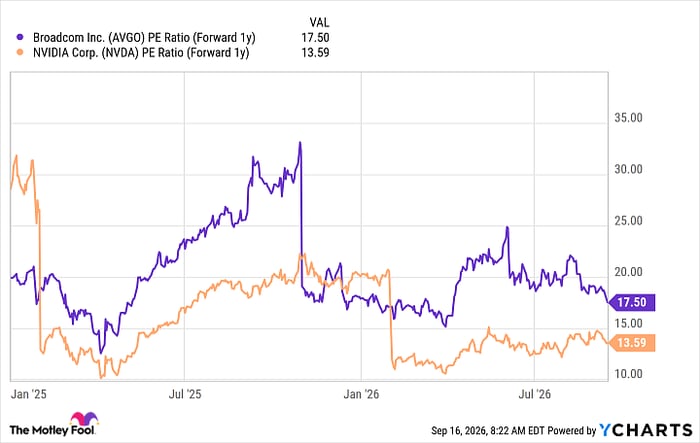
AVGO PE Ratio (Forward 1y) data by YCharts
At 14 times next year's earnings, Nvidia is an absolute steal. While Broadcom is a bit more expensive at 18 times 2027's earnings, it's still a solid buy.
Micron's fiscal year 2027 started in September. It's figure in this comparison is the least, trading at a mere 6 times FY 2027's earnings.
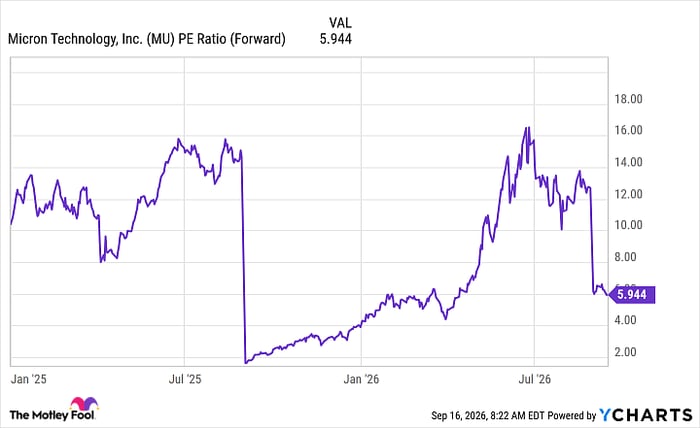
MU PE Ratio (Forward) data by YCharts
This lower price is a reflection of the market's skepticism of the long-term health of the memory chip market. Still, with Micron's management team noting that "tightness" in the memory chip market won't subside until 2028, I think there's still a lot of time left for Micron to soar.
Each of these stocks have bright futures ahead, so even if there is a September Effect this month and stocks drop, buying these three is a genius move.
Should you buy stock in Nvidia right now?
Before you buy stock in Nvidia, consider this:
The Motley Fool Stock Advisor analyst team just identified what they believe are the 10 best stocks for investors to buy now… and Nvidia wasn’t one of them. The 10 stocks that made the cut could produce monster returns in the coming years.
Consider when Netflix made this list on December 17, 2004... if you invested $1,000 at the time of our recommendation, you’d have $387,158!* Or when Nvidia made this list on April 15, 2005... if you invested $1,000 at the time of our recommendation, you’d have $1,365,749!*
Now, it’s worth noting Stock Advisor’s total average return is 932% — a market-crushing outperformance compared to 211% for the S&P 500. Don't miss the latest top 10 list, available with Stock Advisor, and join an investing community built by individual investors for individual investors.
See the 10 stocks »
*Stock Advisor returns as of September 20, 2026.
Keithen Drury has positions in Broadcom and Nvidia. The Motley Fool has positions in and recommends Broadcom, Micron Technology, and Nvidia. The Motley Fool has a disclosure policy.
Recommended Articles


