


Better Buy for Cautious Investors: Eli Lilly vs Costco
Key Points
Eli Lilly has generated explosive growth thanks to its weight loss drug portfolio.
Costco’s focus on bargain prices keeps customers loyal -- and membership renewal rates surpass 90%.
- 10 stocks we like better than Eli Lilly ›
Investors piled into growth stocks in recent years, particularly in the area of artificial intelligence (AI), and this movement offered the overall market enormous momentum. The S&P 500 soared into a bull market, and the famous benchmark reached multiple record highs amid this optimism.
The bull market continues, but today, investors are feeling more hesitant than they were earlier in this growth story. A series of headwinds has weighed on stock performance periodically -- from concerns about the general economic backdrop amid rising inflation to worries that companies may be spending too much on AI infrastructure development. Though S&P 500 earnings soared in the recent quarter, and demand for AI remains high, some investors today favor caution.
Missed AI’s "Act 1"? Act 2 Could Be 15x Bigger. Most investors think they missed the AI boat because they didn't buy Nvidia in 2005. But according to our analysts, we’re only at the end of "Act 1"—the R&D phase. "Act 2" is the global rollout. Continue »
And this brings me to the following question: If you're looking for a certain level of safety today, which stocks should you buy? Pharmaceutical players and some consumer-related names could be the answer as people rely on their products regardless of the economic situation. Two winners that come to mind are Eli Lilly (NYSE:LLY) and Costco Wholesale (NASDAQ:COST). They both make great additions to a portfolio looking for security. But if you could only buy one, which is the better buy right now? Let's find out.

Image source: Getty Images.
The case for Eli Lilly
Often, pharmaceutical companies don't exactly make headlines. They work in the background, producing medicines recognized by doctors and patients. But Eli Lilly has stood out in recent years thanks to a type of product that's on the general public's radar screen: the GLP-1 weight loss drug.
Lilly leads the market with about a 60% share in the U.S. as it sells Mounjaro and Zepbound. These products, the former approved for type 2 diabetes and the latter for weight loss, have driven revenue growth in recent years as patients rushed to get in on them. In the recent quarter, for example, Mounjaro and Zepbound generated more than $14 billion in revenue.
It's likely this growth will continue as the weight loss drug market is expected to reach nearly $100 billion by the end of the decade. And Lilly's latest approval, weight loss pill Foundayo, and its late-stage pipeline could keep it in the lead. On top of this, Lilly has a broad portfolio of products across treatment areas, so the company doesn't depend on just one specialty. All of this translates into a certain level of revenue throughout market environments.
The case for Costco
Costco offers shoppers fantastic deals on items they need most, from groceries to gas, and because of this, shoppers may rush here even more frequently when times are tough. The company is able to offer such prices because it doesn't need to generate high margins on these goods -- instead, Costco makes most of its profit through membership fees.
This is great for a number of reasons. First, as mentioned, it means the company doesn't have to rely on product markups -- something that may push away customers -- to drive profit growth. Second, membership fees are high-margin as the signing on of a new member doesn't cost the retailer much, just the production of a membership card. Finally, this business model offers investors visibility on revenue to come, particularly since Costco's membership renewal rates are high, topping 90% in the U.S. and Canada.
Finally, Costco is known for paying special dividends every few years, with the latest being $15 a share in 2024. Investors who like passive income may appreciate these payments, especially during uncertain market times.
Which stock is the better "cautious" buy now?
As I said earlier, both of these stocks make great additions to a portfolio, and they offer investors a certain degree of safety, even during a tough economy. But if you could only buy one right now, which is the best choice?
For this, let's take a quick look at valuation. Lilly and Costco have seen valuation come down over the past couple of years.
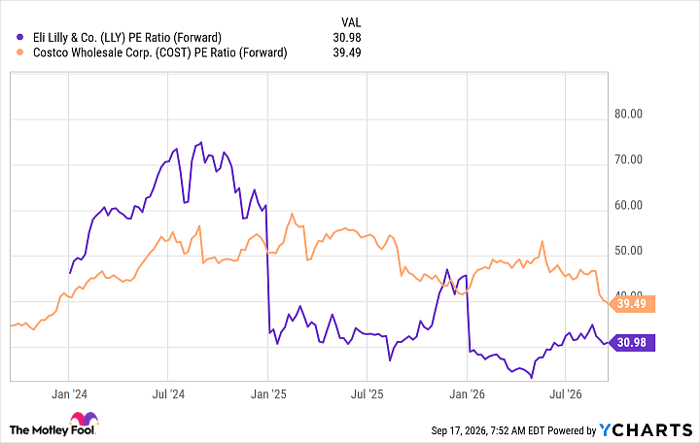
LLY PE Ratio (Forward) data by YCharts
But at about 39x forward earnings estimates, Costco represents an opportunity. It has generally traded above this level, while in recent times Lilly has traded around its current level. Both of these stocks are reasonably priced today and make great "safe" buys for the cautious investor -- if you could only buy one, though, I would go for Costco.
Should you buy stock in Eli Lilly right now?
Before you buy stock in Eli Lilly, consider this:
The Motley Fool Stock Advisor analyst team just identified what they believe are the 10 best stocks for investors to buy now… and Eli Lilly wasn’t one of them. The 10 stocks that made the cut could produce monster returns in the coming years.
Consider when Netflix made this list on December 17, 2004... if you invested $1,000 at the time of our recommendation, you’d have $406,141!* Or when Nvidia made this list on April 15, 2005... if you invested $1,000 at the time of our recommendation, you’d have $1,347,745!*
Now, it’s worth noting Stock Advisor’s total average return is 940% — a market-crushing outperformance compared to 211% for the S&P 500. Don't miss the latest top 10 list, available with Stock Advisor, and join an investing community built by individual investors for individual investors.
See the 10 stocks »
*Stock Advisor returns as of September 18, 2026.
Adria Cimino has no position in any of the stocks mentioned. The Motley Fool has positions in and recommends Costco Wholesale and Eli Lilly. The Motley Fool has a disclosure policy.
Recommended Articles


