


AMD Stock Breaks $524 as Helios Demand Puts $548 and $572 in Focus
TradingKey - AMD closes September 17 at $545.09, up 6.36% from its September 16th close of $512.50. This move confirms a breakout from $524.08, and comes with new resistance around $547.70. AMD's move higher is well deserved given its recent strategic wins with some of the largest cloud clients. Additionally, recent wins in the data center have been backed with production ramp of AMD's Helios rack-scale products. Lastly, recent commitments from cloud clients have been multi-year in nature.
Data Center Has Become AMD’s Main Growth Engine
From an overall financial perspective, Q2 was another strong quarter for AMD. Revenues increased 50% year over year to $11.54 billion, Non-GAAP gross margin improved to 56%, and Operating Income more than doubled to $3.09 billion. As a result, adjusted EPS more than doubled to $1.66 from the prior year quarter's $0.48. It is important to highlight the above results were reported by AMD and were not presented on a constant currency basis.
The Data Center segment generated approximately $6.7 billion for the quarter, a 107% increase year over year. This represents approximately 58% of the company’s total revenue. Operating income for the segment was approximately $2.1 billion.
This data is important, as it shows that AMD is moving beyond processors and graphics cards for gaming. With the growing interest and investment in AI, AMD is becoming a company that provides AI and data center infrastructure.
Q3 Guidance Points to Further Acceleration
The company expects revenue for the quarter to be between $12.7 billion and $13.3 billion. Non-GAAP gross margin is expected to be 56%.
At the company’s expected midpoint for the quarter, this represents approximately 41% year over year growth and approximately 13% growth from the previous quarter.
The company expects the same to be true for the Data Center processors, with the back half of 2026 seeing even more growth due to increasing demand for EPYC processors and the launch of Helios, along with other Data Center processors and products.
The demand for these products is fairly established. However, the company needs Helios to be successful along with other data center processors to reach revenue and fully satisfy customer demand.
Helios Is AMD’s Biggest Competitive Step Against Nvidia
AMD has announced their new platform, ‘Helios’, their first rack-scale AI computing platform.
AMD uses Instinct MI455X GPUs, 6th generation EPYC Venice CPUs, AMD Pensando networking products, AMD ROCm open software, and a design of networking at the rack level.
The creation of this system is designed to counter Nvidia’s dominant position in the AI accelerator market, as Nvidia has an advantage on the full-scale integration of systems with GPU’s, including the network, software, and other components.
AMD is now producing systems at the same level as Nvidia.
There are multiple features of the Helios platform that are meant to give AMD a competitive edge in the industry. AMD notes that Helios can deliver up to 30% better performance-per-dollar than competing systems.
Large Customers Provide Strong Visibility
In addition, Meta has announced a similar long-term relationship, covering up to 6 gigawatts of AMD’s Instinct GPUs. The first gigawatt is planned to be shipped by the end of 2026.
An agreement to deploy up to 6 gigawatts of AMD GPUs by OpenAI has shown progress on their side, with the first 1 gigawatt deployment of MI450 GPUs set to begin in the second half of 2026 and Helios infrastructure expected online beginning in Q4 2026.
Oracle plans an initial deployment of 50,000 MI450-series GPUs in an OCI supercluster beginning in calendar Q3 2026, while Microsoft is also deploying Helios at scale on Azure.
This matters since AMD’s AI focus is losing its connection to one big customer. The clientele is spreading to include several AI labs, clouds and sovereign data centers.
The same can be said for EPYC.
EPYC Remains an Important Advantage
EPYC processors are key to AMD’s AI strategy as well.
Fifth and sixth-gen EPYC processors give AMD a significant position in AI as they provide strong CPU cores for control, storage and networking, as well as other functions and Inference.
This also aids in the understanding of the company's data center revenues which are being driven by both EPYC processors and Instinct Accelerators.
Valuation Is the Main Financial Risk
As of September 17, AMD closed at $545.09 with a market cap of approximately $890 billion.
The stock is currently trading at around 49x forward earnings, according to analyst consensus.
That is pricey, though considerably less demanding than the trailing multiple.
The key risk is that AMD must now make good on the reported high customer commitments surrounding Helios, Meta, Anthropic, OpenAI and Oracle in order for strong earnings growth to materialize. Any delays in the supply, deployment, or adoption of ROCm would make the valuation tenuous.
Hyperscalers continue to develop custom silicon, so AMD cannot tacitly assume that merchant chip growth will encompass all AI/ML compute.
AMD Technical Analysis: $547.70 Is the Immediate Breakout Test
AMD closed at $545.09 on September 17, up from the $452.99 low. The stock has broken out above the $524.08 level, which roughly completes a $93 measured move. This breakout targets the next major hurdle at $571.87.
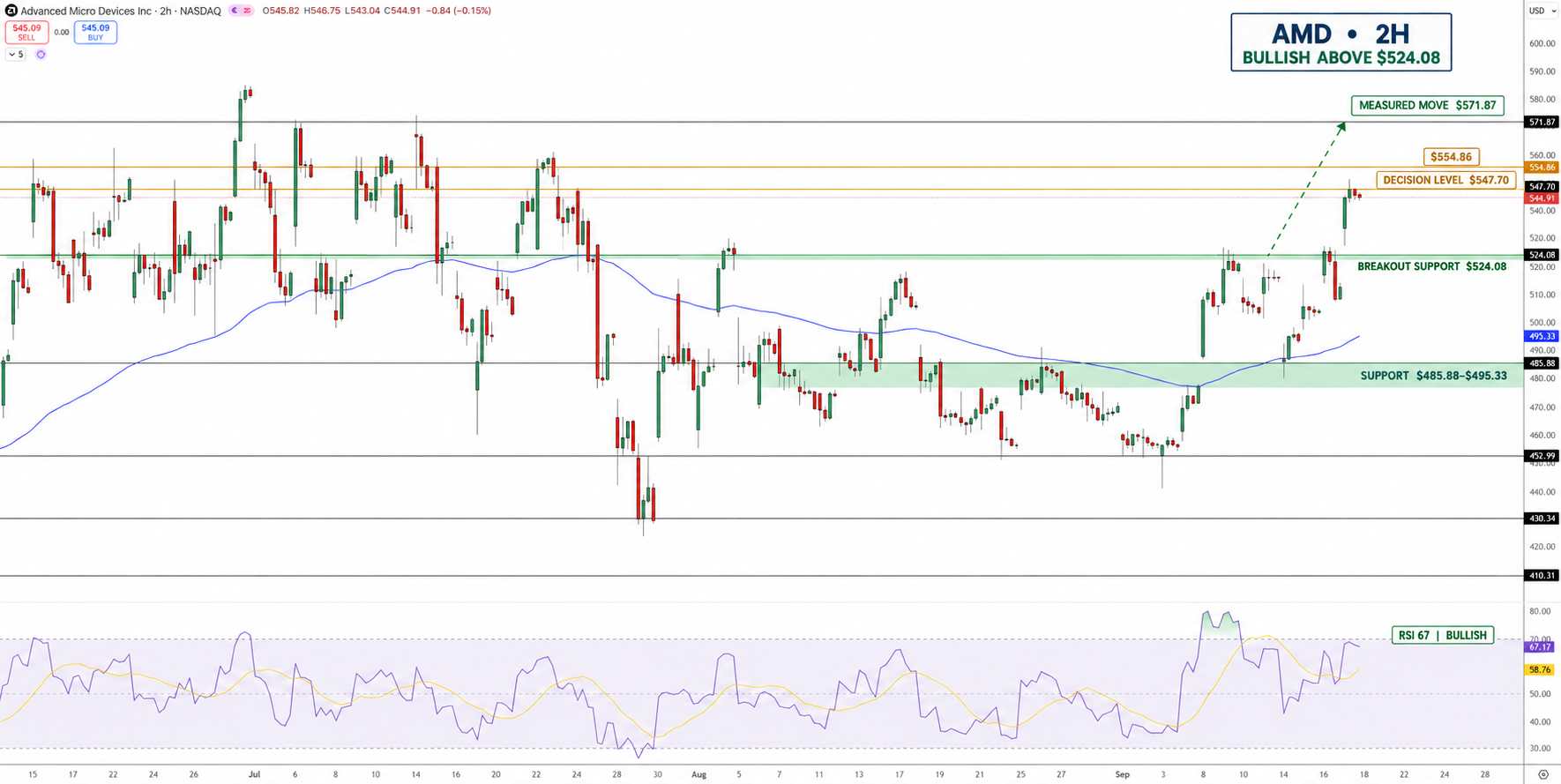
AMD Stock Price Chart - Source: Tradingview
The initial major obstacle to $547.70 is now resistance. Further upside would target $554.86.
RSI is at 67, above the signal line at 59, indicating bullish momentum approaching an overbought condition.
The $524.08 level is now the first major support level. Beneath that, the next support is at $495.33, with even stronger support located at $485.88.
Key Levels
• Recent Close: $545.09
• Breakout Support: $524.08
• Secondary Support: $495.33
• Major Structural Support: $485.88
• Immediate Resistance: $547.70
• Next Resistance: $554.86
• Measured Move Target: $571.87
• Relative Strength Index (RSI) is at roughly 67 and is bullish with a tendency to head towards overbought
Why is AMD stock in focus now?
Increased Data Center revenue, the start of major customer chips for AMD, and increased deployments of AI by large companies.
What level confirms further AMD upside?
Resistance lies at $547.70. If the stock price closes above this level, a move to $554.86 and $571.87 is probable. If support is tested, expect a retest to the downside towards $524.08.
Bottom Line
The fundamentals and the technicals of AMD bullish setup for September 18th remain intact. There are several catalysts that provide a bullish case for AMD, including the ramp of Helios, hyperscale customer deployments of AI, and the rapid growth of AMD's Data Center Segment. The major risks are more around competition from Nvidia and other chipmakers. From a purely technical analysis, I like AMD and think it has potential upside toward $554.86 and $571.87.
Recommended Articles


