


Tesla vs SpaceX: Which Is the Better Elon Musk-Backed Stock to Buy?
Key Points
Tesla is betting its future on robotaxis and robots.
SpaceX's reusable rockets could unlock significant future growth opportunities for the company.
- 10 stocks we like better than Space Exploration Technologies ›
Elon Musk is one of the most divisive public figures in the world, but one thing is certain: He heads two of the most ambitious companies in the world in Tesla (NASDAQ: TSLA) and Space Exploration Technologies (NASDAQ: SPCX). Musk sees both companies eventually changing the world, but for investors, the question is: Which stock looks like the better buy?
In my view, it's Tesla, but let's dip into both.
Missed AI’s "Act 1"? Act 2 Could Be 15x Bigger. Most investors think they missed the AI boat because they didn't buy Nvidia in 2005. But according to our analysts, we’re only at the end of "Act 1"—the R&D phase. "Act 2" is the global rollout. Continue »
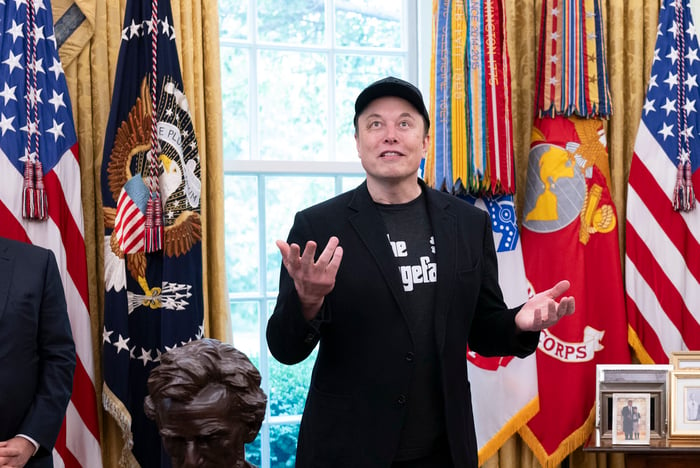
Image source: Official White House photo.
Tesla
Tesla is, of course, Musk's older company. The company is a leader in electric vehicles (EVs) and is also involved in the solar and stationary battery storage businesses.
Its core automotive business has had its share of troubles over the past couple of years. Musk's push into politics damaged the brand among some consumer groups, while the end of federal EV tax credits also hurt sales. At the same time, the combination of the end of CAFE (Corporate Average Fuel Economy) standard penalties in the U.S. and the loosening of European Union emissions regulations caused one of Tesla's biggest profit drivers, regulatory credit revenue, to fall off a cliff.
Tesla's EV business has also been facing increased competition in both the West and China. However, the company's auto segment did see a nice rebound last quarter, with auto revenue climbing 23% on a 25% jump in deliveries, and the worst appears to be behind it.
That said, Tesla's future is more about autonomous driving, robotaxis, and robotics. The company is set to introduce important safety and accident-avoidance features with its latest FSD (Full Self-Driving) software update, while it also recently rolled out its new Cybercab. While there are self-driving robotaxis today, Tesla's Cybercab, which uses a vision-only neural network and eschews expensive Lidar, promises to be a much cheaper option. Combined with its manufacturing capabilities, this development should greatly improve the business's economics relative to competitors.
Meanwhile, Musk believes Tesla's largest business will eventually be its Optimus robot. While he's warned there will be timing issues, as there is no supply chain for humanoid robots as of now, Musk has said Tesla will start shipping its Optimus robots to customers next year.
SpaceX
Musk's other public company is SpaceX, which IPO'd to much fanfare earlier this year. The company currently operates in three segments. Its most profitable segment is its Starlink satellite internet service. This is a nice recurring business that is growing quickly, and the company has talked about eventually entering voice and challenging wireless providers, although there are technical hurdles and/or significant capital expenditures that would come with that.
Its Space segment is its smallest, but perhaps its most important in the long term. This is home to its rocket launches, and the company's big future ambitions revolve around extending its reusable rockets to its larger Starship rockets. This could open the company up to putting data centers in space and a host of other future revenue opportunities. There are still technical obstacles to overcome, but the company is moving closer to its goal of recovering both stages of Starship's rocket for rapid reuse.
SpaceX's final segment is its artificial intelligence business. This has become its fastest-growing business as the company has found a big opportunity to sell scarce compute power for big profits. In fact, it just recently signed a $1.1 billion-per-month deal. SpaceX is acting more as a short-term compute arbitrageur, exploiting immediate capacity shortages, than as a cloud computing provider with long-term commitments. The short-term economics are better, but they are likely temporary.
Why Tesla is the better stock to buy now
I think it is a pretty sure bet that Musk will look to combine his two companies under one roof, with SpaceX eventually buying Tesla at a premium. Tesla's big bets on robotaxis and robots also feel a bit closer to reality than SpaceX's.
While SpaceX will grow more quickly, much of that will likely come from pretty empty-calorie revenue growth driven by the current scarcity of compute resources. As such, of the two Elon Musk stocks, Tesla is the one I'd rather own.
Should you buy stock in Space Exploration Technologies right now?
Before you buy stock in Space Exploration Technologies, consider this:
The Motley Fool Stock Advisor analyst team just identified what they believe are the 10 best stocks for investors to buy now… and Space Exploration Technologies wasn’t one of them. The 10 stocks that made the cut could produce monster returns in the coming years.
Consider when Netflix made this list on December 17, 2004... if you invested $1,000 at the time of our recommendation, you’d have $412,074!* Or when Nvidia made this list on April 15, 2005... if you invested $1,000 at the time of our recommendation, you’d have $1,314,319!*
Now, it’s worth noting Stock Advisor’s total average return is 932% — a market-crushing outperformance compared to 209% for the S&P 500. Don't miss the latest top 10 list, available with Stock Advisor, and join an investing community built by individual investors for individual investors.
See the 10 stocks »
*Stock Advisor returns as of September 18, 2026.
Geoffrey Seiler has no position in any of the stocks mentioned. The Motley Fool has positions in and recommends Tesla. The Motley Fool has a disclosure policy.
Recommended Articles


