


One Wall Street Analyst Just Said Tesla Stock Could Be Worth $840: Time to Buy?
Key Points
Morgan Stanley raised its Tesla bull case target price to $840, but investors need to read between the lines.
Tesla's Semi truck and full self-driving software could drive significant future revenue, but timelines are unclear.
Current valuation is high and depends on belief in Tesla's autonomous and robotics businesses.
- These 10 stocks could mint the next wave of millionaires ›
A Morgan Stanley analyst, Andrew Percoco, recently raised his bull-case target price for Tesla (NASDAQ: TSLA) from $820 to $840 while maintaining an equal-weight rating and a $400 price target in his base-case scenario. (The shares now trade for about $357.) Wall Street analysts often provide a range of price targets reflecting various outcomes, and investors shouldn't get too excited by one that nudges the target higher by 2.4% in the best-case scenario. Nevertheless, one reason for the update highlights the long-term potential of a part of Tesla that doesn't get enough attention.
The investment case for Tesla stock
Although the company is best known for its hardware products, including electric vehicles (EVs) and energy storage, its future lies in higher-margin recurring revenue from its physical solutions, namely robotaxis (including its dedicated robotaxi, Cybercab) and Optimus robots. To be clear, if you don't believe in these businesses, then you have no other reason to hold a stock trading at 200 times its estimated 2026 earnings.
Missed Nvidia in 2009? This Rare Signal Is Flashing Again. In 2009, a "Double Down" signal flashed for a little-known chipmaker called Nvidia. For the first time in years, that same "Total Conviction" signal is flashing for a company 1/100th the size of Nvidia. Continue »
However, Tesla's investment case is exciting and, on the transportation-as-a-service side, rests on the potential for recurring fare revenue from its own Cybercabs, its share of fare revenue from third-party operators, and full self-driving (FSD) software. Optimus will likely operate under a robot-as-a-service model, generating long-term recurring software revenue.
Yet, Tesla has another exciting business with significant revenue-growth potential: the Tesla Semi truck.
What Wall Street expects from the Tesla Semi
Tesla plans to make money from its Semi truck through a combination of hardware sales, charging services, and software subscription revenue. While the latter may be seen as akin to FSD revenue from passenger cars, it has much higher revenue per vehicle because trucks are driven many more miles. In fact, the key cost advantage of EVs really shines when you maximize the per-mile advantage by driving more.
That's why the Morgan Stanley update discusses the possibility of more than 80,000 autonomous Semi trucks on the road by 2040, each generating as much as $18,000 a month in FSD revenue. . It's a scenario that could lead to more than $17 billion in high-margin FSD revenue by 2040.
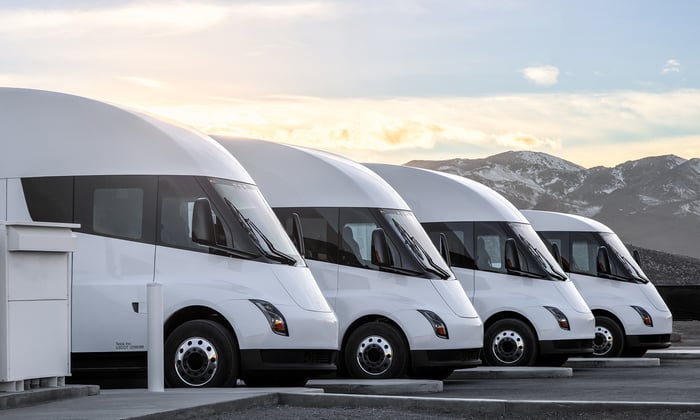
Image source: Tesla.
Although 80,000 trucks and 2040 are a long way off, the Wall Street outlook, according to Visible Alpha, calls for Semi units to rise from 4,000 in 2027 to 12,000 in 2028 as production ramps up. That growth will likely be driven by the Semis' lower cost per mile than that of a typical diesel truck (a point noted by the Morgan Stanley analyst), as demonstrated by a highly successful pilot with PepsiCo.
Where next for Tesla's Semi
Tesla Chief Executive Officer Elon Musk said on the last earnings call that "the total number of units of the Tesla Semi is still low and will continue to be a very small percentage," and that's why Tesla is focusing on developing v15 FSD for its Model 3, Model Y, and Cybercab/robotaxi fleet first. Musk said developing FSD for the Semi is "taking a bit of a backseat for the next six months." However, he also noted that "it will definitely be working next year and in time for the scale-up to high production of the Tesla Semi."

Image source: Getty Images.
To be clear, all of this assumes Tesla will overcome regulatory hurdles for passenger-car FSD, let alone Semi trucks, and that adoption rates for the Semi will grow. In addition, there's no guarantee Tesla Semi trucks will be driven as expected, and Morgan Stanley still has an equal-weight rating on the stock.
All told, investors should not view Semi in isolation when considering the benefits of developing FSD for the Cybercab/robotaxi fleet. Not least because it will strengthen investor confidence in the development of an autonomous Semi, which could become another significant source of recurring income. It's not a near-term earnings driver, but it is one to pencil in for long-term growth, provided Tesla's FSD ambitions progress as planned.
Don’t miss this second chance at a potentially lucrative opportunity
Ever feel like you missed the boat in buying the most successful stocks? Then you’ll want to hear this.
On rare occasions, our expert team of analysts issues a “Double Down” stock recommendation for companies that they think are about to pop. If you’re worried you’ve already missed your chance to invest, now is the best time to buy before it’s too late. And the numbers speak for themselves:
- Nvidia: if you invested $1,000 when we doubled down in 2009, you’d have $548,453!*
- Apple: if you invested $1,000 when we doubled down in 2008, you’d have $63,537!*
- Netflix: if you invested $1,000 when we doubled down in 2004, you’d have $433,160!*
Right now, we’re issuing “Double Down” alerts for three incredible companies, available when you join Stock Advisor, and there may not be another chance like this anytime soon.
See the 3 stocks »
*Stock Advisor returns as of September 16, 2026.
Lee Samaha has no position in any of the stocks mentioned. The Motley Fool has positions in and recommends Tesla. The Motley Fool has a disclosure policy.
Recommended Articles


