


Dara Khosrowshahi Just Delivered Fantastic News for Uber Stock Investors
Key Points
Uber operates the world's largest ride-hailing platform, and it's betting big on autonomous vehicles to eliminate the enormous cost of human drivers.
CEO Dara Khosrowshahi just outlined a plan to speed up the company's autonomous transition.
Uber stock is trading at a very attractive price right now, potentially opening the door to significant upside over the long term.
- 10 stocks we like better than Uber Technologies ›
Uber Technologies (NYSE: UBER) operates the world's largest ride-hailing platform, but its food delivery and commercial freight networks are also very competitive globally. The company is in the early stages of a major transformation as autonomous vehicles and robots complete a growing number of trips on its platform, which will significantly boost its revenue and earnings over the long term.
Uber released its operating results for the second quarter of 2026 (ended June 30) on Aug. 5. In his prepared remarks to shareholders, Chief Executive Officer Dara Khosrowshahi provided an update on the company's autonomous transition. Here's why investors might want to buy Uber stock on the back of his comments.
Missed Nvidia in 2009? This Rare Signal Is Flashing Again. In 2009, a "Double Down" signal flashed for a little-known chipmaker called Nvidia. For the first time in years, that same "Total Conviction" signal is flashing for a company 1/100th the size of Nvidia. Continue »

Image source: Getty Images.
Uber is betting big on autonomous vehicles
Developing a safe and capable self-driving car might not be the hardest part of succeeding in the autonomous industry. Companies also have to build a platform that customers can use to seamlessly request a ride, and it has to arrive in a timely fashion. Uber has already developed all of the necessary infrastructure to accomplish this, which is why dozens of companies have chosen to plug their autonomous cars and robots into its network.
This arrangement is a win for everyone involved. Uber's autonomous partners get access to its 208 million monthly active customers, so they don't have to build their own platforms from scratch. Uber, on the other hand, gets to keep its asset-light business model by simply taking a cut of every ride facilitated by its platform, without having to spend billions of dollars to develop its own self-driving cars.
Autonomous vehicles are already active on Uber in seven cities, but Khosrowshahi says that could more than double to 15 cities by the end of 2026. He also told shareholders that Uber will deploy around $10 billion over the next few years to help its partners bring their autonomous vehicles to market at scale. You might think that goes against the company's business model as a mere facilitator, but it's a very good idea, and I'll explain why.
During Q2, Uber had $58 billion in gross bookings, which represented the total dollar amount customers spent on its platform for every ride, food order, and commercial delivery. A whopping $25 billion of that total was paid to the platform's 10.2 million drivers, representing the company's single largest cost.
After accounting for other costs, like the money paid forward to restaurants for every food order, Uber was left with $14.2 billion in revenue. Then, after factoring in operating costs like marketing, the company was left with just $2.4 billion in generally accepted accounting principles (GAAP) profit.
In other words, Uber pockets a mere fraction of its gross bookings each quarter. If it can eliminate the enormous cost of human drivers, it will instantly grow its revenue and profit even if it doesn't acquire a single additional customer. Of course, some of that money will be paid to the operators of the autonomous vehicles in its network instead, but that expense will probably be far cheaper than human drivers in the long run. Plus, a self-driving car can work around the clock with minimal downtime, so it can also bring in a lot more money.
By funding some of its partners, Uber can speed up the autonomous transition so it can unlock those savings as soon as possible.
Uber's valuation leaves plenty of room for upside
Based on Uber's $55.2 billion in trailing 12-month revenue and its market capitalization of $153 billion as I write this, its stock is trading at a price-to-sales (P/S) ratio of just 2.8, which is a steep discount to its average of 4.1 since going public in 2019.
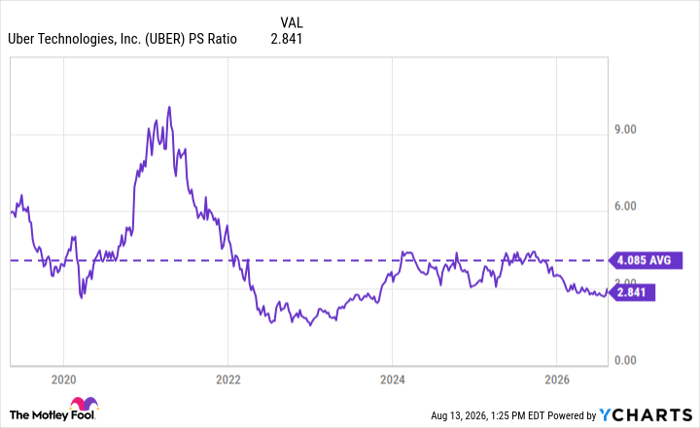
UBER PS Ratio data by YCharts.
Uber stock would have to climb by 46% just to match its average P/S ratio, and that doesn't even factor in any future revenue growth. The stock would also have to more than double to match the P/S ratio of the Nasdaq-100 index, which is currently 6.3. Simply put, Uber looks heavily undervalued right now, particularly compared to a basket of America's best technology stocks.
I think Uber is perfectly positioned to be one of the biggest winners of the autonomous driving boom. It's already working with some of the biggest names in the industry, including Alphabet's Waymo, which is completing over 500,000 paid autonomous trips across 11 U.S. cities every single week.
As a result, it might be time to stop thinking about Uber as a ride-hailing company, and start treating it as a potential leader in one of the most valuable technological revolutions of the future.
Should you buy stock in Uber Technologies right now?
Before you buy stock in Uber Technologies, consider this:
The Motley Fool Stock Advisor analyst team just identified what they believe are the 10 best stocks for investors to buy now… and Uber Technologies wasn’t one of them. The 10 stocks that made the cut could produce monster returns in the coming years.
Consider when Netflix made this list on December 17, 2004... if you invested $1,000 at the time of our recommendation, you’d have $421,511!* Or when Nvidia made this list on April 15, 2005... if you invested $1,000 at the time of our recommendation, you’d have $1,381,960!*
Now, it’s worth noting Stock Advisor’s total average return is 981% — a market-crushing outperformance compared to 216% for the S&P 500. Don't miss the latest top 10 list, available with Stock Advisor, and join an investing community built by individual investors for individual investors.
See the 10 stocks »
*Stock Advisor returns as of August 15, 2026.
Anthony Di Pizio has no position in any of the stocks mentioned. The Motley Fool has positions in and recommends Alphabet. The Motley Fool recommends Uber Technologies. The Motley Fool has a disclosure policy.
Recommended Articles


