


3 Obvious Reasons Warren Buffett's Berkshire Hathaway Owns Nearly 152 Million Shares in This Winning Financial Stock
Key Points
Investors have gotten used to seeing sustainable revenue and profit growth from American Express.
The combination of a premium brand and network effect solidifies this company’s wide economic moat.
Shares in the giant credit card company trade at a reasonable forward price-to-earnings ratio below 20.
- 10 stocks we like better than American Express ›
Warren Buffett started 2026 no longer the CEO of Berkshire Hathaway (NYSE: BRKA) (NYSE: BRKB). Despite taking a back seat, his fingerprints are all over the conglomerate's $353 billion public equity portfolio. This information is a potential gold mine for individual investors, who can look at these holdings to possibly find compelling opportunities.
One financial stock, which has produced a total return of 497% in the past decade (as of Aug. 12), is Berkshire Hathaway's second-largest holding. The business owns almost 152 million shares, a position initiated in 1991. Here are three reasons why Buffett appreciates this winning company.
Missed Nvidia in 2009? This Rare Signal Is Flashing Again. In 2009, a "Double Down" signal flashed for a little-known chipmaker called Nvidia. For the first time in years, that same "Total Conviction" signal is flashing for a company 1/100th the size of Nvidia. Continue »
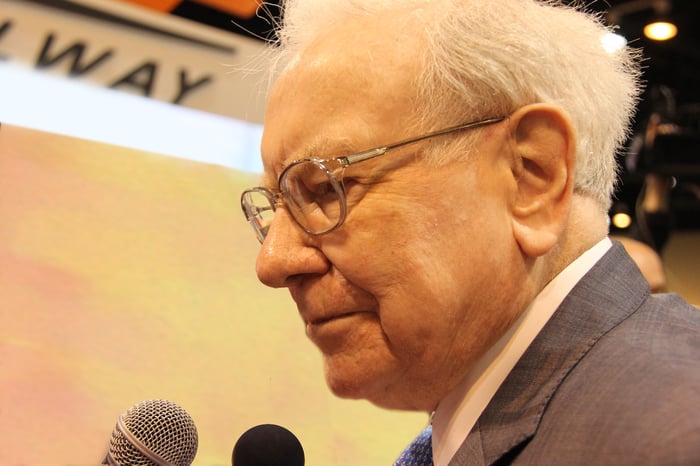
Warren Buffett. Image source: The Motley Fool.
Two characteristics support the wide moat
Close followers of Warren Buffett and Berkshire Hathaway know that American Express (NYSE: AXP) is the business in question. Perhaps one of the clearest reasons why it's a mainstay position is that the company possesses a wide economic moat. This is an important attribute that the Oracle of Omaha looks for, and it's a signal that you're dealing with a business that has staying power.
One of the traits supporting American Express's moat is its brand power. This single asset is perhaps the biggest contributor to the company's success. American Express positions its card products at the premium end of the market, defined by trust, prestige, and community.
"They have an emotional connection to our brand and the products and services we offer," CEO Stephen Squeri said in 2022 when discussing how customers view American Express. This attracts an affluent demographic that has a lower credit risk profile and higher spending power than the average consumer out there. For the business, this translates into industry-leading loss rates and consistent growth in average fee per card member over time.
In 2022, Buffett also highlighted how special this business is. "You can't create another American Express," he said in a Bloomberg interview.
The moat is strengthened by the presence of a network effect. American Express runs a closed-loop payment system that provides an improving value proposition with more active cards and merchant acceptance locations. Because this is an entrenched ecosystem that also taps various rewards partners, there's a competitive position here that's hard to disrupt.
Revenue and profit have grown in a durable manner
American Express has long been a financially sound enterprise. These are the types of businesses that Buffett favors. For instance, its net profit margin has averaged 13% in the past decade. This has allowed the leadership team to pay a dividend that has climbed 197% over that time. Stock buybacks are also a critical component of capital allocation, with the outstanding share count being reduced by 3% just in the past 12 months.
This company is able to grow its net revenue and income steadily. The formula is driven by new card members, greater payment volume, and higher membership fees.
Despite being considered a mature business, American Express isn't done growing. In fact, the leadership team adopts an upbeat view of what the future holds. In January, when the company reported fourth-quarter 2025 financial results, American Express gave investors explicit financial guidance. The outlook calls for at least 10% annualized revenue growth and mid-teens diluted earnings-per-share growth over the long term.
Don't forget about the valuation
"It's far better to buy a wonderful company at a fair price than a fair company at a wonderful price," Buffett wrote in Berkshire's 1989 shareholder letter. There might be no better way to describe American Express right now. Based on factors already discussed, like the brand, network effect, and financial gains, this is a wonderful company. That's not up for debate.
The stock's valuation, on the other hand, doesn't exactly provide investors with a once-in-a-lifetime opportunity. However, it's a reasonable setup. Shares trade at a forward price-to-earnings ratio of 19.4. It might be a good time for investors to follow Buffett's lead and own American Express.
Should you buy stock in American Express right now?
Before you buy stock in American Express, consider this:
The Motley Fool Stock Advisor analyst team just identified what they believe are the 10 best stocks for investors to buy now… and American Express wasn’t one of them. The 10 stocks that made the cut could produce monster returns in the coming years.
Consider when Netflix made this list on December 17, 2004... if you invested $1,000 at the time of our recommendation, you’d have $421,943!* Or when Nvidia made this list on April 15, 2005... if you invested $1,000 at the time of our recommendation, you’d have $1,382,819!*
Now, it’s worth noting Stock Advisor’s total average return is 983% — a market-crushing outperformance compared to 216% for the S&P 500. Don't miss the latest top 10 list, available with Stock Advisor, and join an investing community built by individual investors for individual investors.
See the 10 stocks »
*Stock Advisor returns as of August 14, 2026.
American Express is an advertising partner of Motley Fool Money. Neil Patel has no position in any of the stocks mentioned. The Motley Fool has positions in and recommends American Express and Berkshire Hathaway. The Motley Fool has a disclosure policy.
Recommended Articles


