


Former AMD Executive Patrick Moorhead Says Nvidia Is Copying Intel’s Past Strategy to Suppress AMD
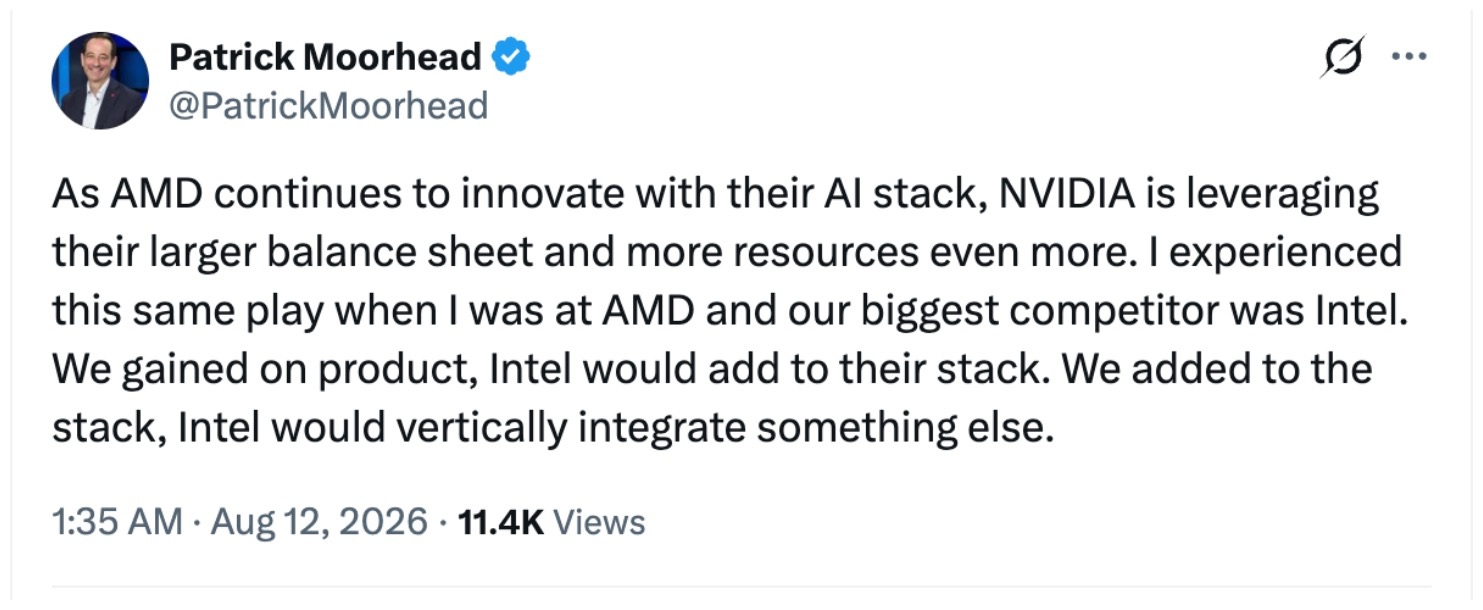
TradingKey - On August 11, Eastern Time, Patrick Moorhead, former executive at AMD (AMD), founder, and chief analyst of Moor Insights & Strategy, recalled on social media that whenever AMD made technological progress, Intel (INTC) would expand its own product lineup. Having personally experienced the long-term competition between the two companies, he now believes the same strategy is playing out again in the AI field, except with Nvidia (NVDA) as the main player.
 [Source: X]
Moorhead spent 11 years at AMD. According to his recollection, AMD won for 4 years and Intel won for 7 years during that period. Based on this experience, he believes Nvidia is leveraging its vast financial strength and resources to adopt Intel's competitive strategy from those years.
Today, Nvidia's technological moat is even deeper than Intel's back then. Beyond GPU hardware and the CUDA ecosystem, Nvidia has also partnered with institutions such as BlackRock (BLK) and Goldman Sachs (GS) to leverage over $500 billion in third-party capital to provide clients with AI infrastructure financing support. This means competition has extended from the technological level to the capital level, and this capital advantage, in turn, further reinforces Nvidia's lock-in effect on customers.
However, AI customers are unwilling to be locked in by a single supplier. Moorhead believes the market will inevitably seek alternatives, giving AMD a window of opportunity to catch up.
AMD's response is the Helios platform, which integrates 72 MI455X accelerators, EPYC processors, and 31TB of HBM4 memory. AMD executives expect the product to generate billions of dollars in revenue.
On the customer front, Anthropic has committed to deploying 2 gigawatts of Helios computing power, with the first 1 gigawatt scheduled to go live in the first half of 2027; OpenAI, Meta (META), and others are also on the customer list.
Progress has also been made on the software ecosystem front. AMD disclosed that Anthropic migrated its large model to the ROCm platform in just one weekend, with the MI355 chip tested in practice, indicating that CUDA's ecosystem advantage is facing challenges.
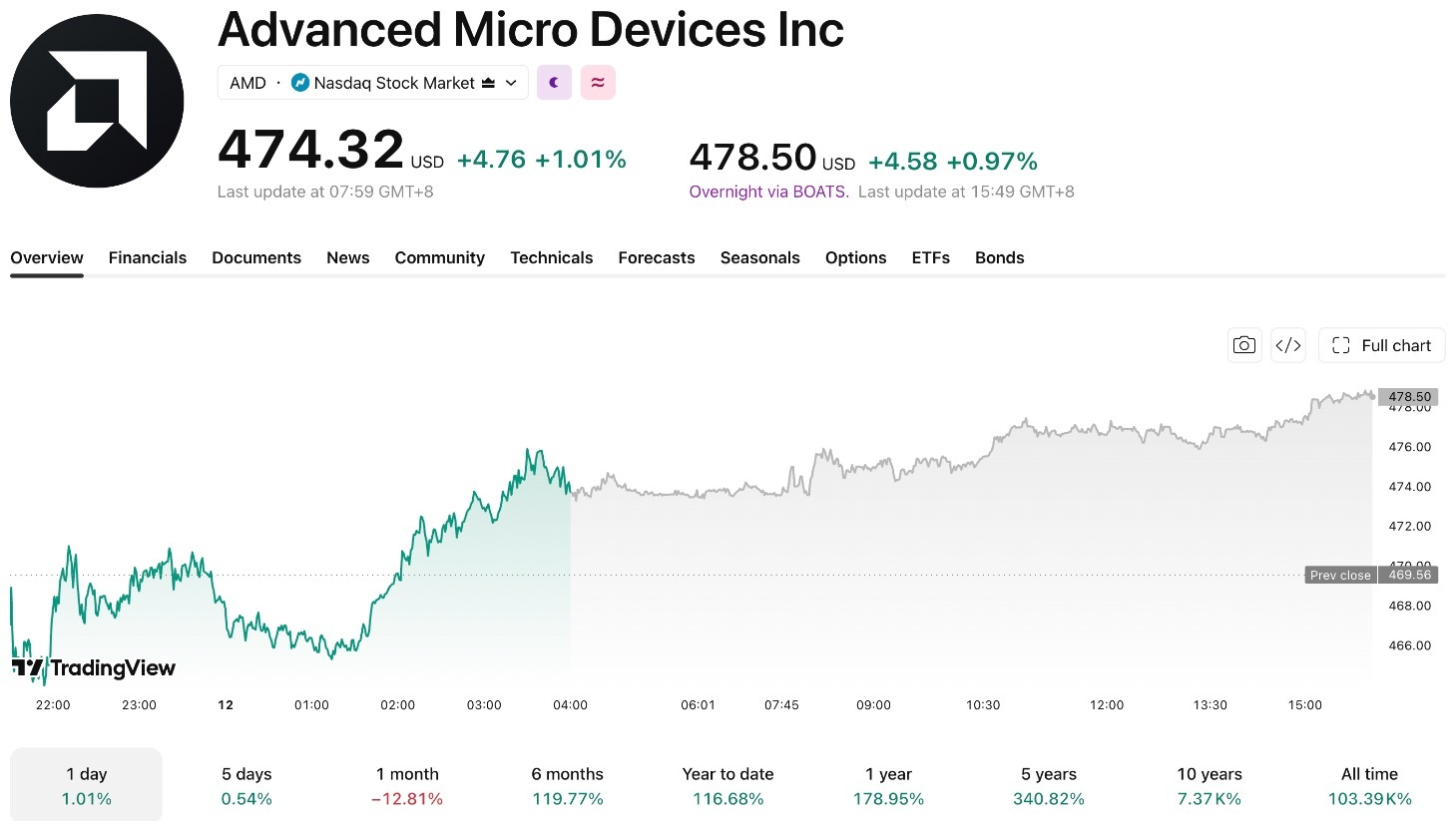
AMD stock closed up 1% on Tuesday at $474.32. Morningstar assigned a fair value estimate of $530 on the same day, representing about 12% upside, while maintaining a "3-star" rating and a "Hold" recommendation.
[Source: TradingView]
Intel's historical precedent shows that failing in either manufacturing process or chip design could shake a company's foundation. AMD currently relies on TSMC (TSM) for foundry manufacturing and continues to enhance its design capabilities. However, facing Nvidia's comprehensive advantages in capital and ecosystem, whether AMD can repeat its historical comeback against Intel in the CPU market remains to be seen.
Recommended Articles


