


Opinion: The Best AI Memory Stock to Buy Isn't Micron or Sandisk -- It's This Korean Giant
Key Points
Advanced DRAM and NAND flash solutions are becoming a bottleneck within the AI chip stack.
Micron and Sandisk are two of the best-known producers of AI memory chips.
A rival from Korea holds more market share than Micron and Sandisk, and is trading at an attractive valuation right now.
- 10 stocks we like better than SK Hynix ›
The artificial intelligence (AI) memory supercycle has transformed semiconductor investing, fueled by explosive demand for high-bandwidth memory (HBM) and advanced DRAM to power hyperscalers' training clusters, inference deployments, and data center expansion.
Surging demand for graphics processing units (GPUs) and expanding agentic AI workloads are tightening memory chip supply -- driving higher average selling prices and record profits for manufacturers.
Missed Nvidia in 2009? This Rare Signal Is Flashing Again. In 2009, a "Double Down" signal flashed for a little-known chipmaker called Nvidia. For the first time in years, that same "Total Conviction" signal is flashing for a company 1/100th the size of Nvidia. Continue »
Micron Technology (NASDAQ: MU) and Sandisk (NASDAQ: SNDK) have emerged as two popular plays in the AI memory boom. As of Aug. 6, Micron stock has gained roughly 715% over the past year and about 212% year-to-date. Sandisk has posted even more dramatic gains, nearing 3,000% returns over the last 12 months and roughly 439% so far in 2026.
With that said, I think a stronger opportunity may be hiding in plain sight with South Korean rival SK Hynix (NASDAQ: SKHY). Let's dig into why.

Image source: Getty Images.
Market leadership beyond Micron and Sandisk
Micron designs and manufactures DRAM and has growing exposure to HBM for AI accelerators. Sandisk focuses primarily on NAND flash and solid-state drives (SSDs), also found in AI compute systems. Both companies compete directly in the high-growth memory market that defines the ongoing capex supercycle.
According to market data from IDC, however, SK Hynix holds a clearer edge in the very markets where its peers operate. SK Hynix ranks first in HBM market share in Q1 2026 with a commanding 56.4% portion. In addition, the company is second to Samsung (OTC: SSNLF) in DRAM and NAND flash revenue market share.
Micron held about 22% of DRAM and 14% of NAND, while Sandisk also captured roughly 14% of NAND. SK Hynix's dominant HBM position arguably makes it more central to the AI infrastructure build-out than either of its better-known U.S. counterparts.
Record results were met with a sharp pullback
SK Hynix's second-quarter financial results underscored the company's operational strengths. Revenue reached 79.3 trillion Korean Won, equivalent to approximately $55 billion USD. Operating profit hit 60.54 trillion Won, for a 76% margin. Management said that prices for both DRAM and NAND rose sharply quarter over quarter, with high-value products including HBM, AI-server DRAM, and enterprise SSDs driving the company's expansion.
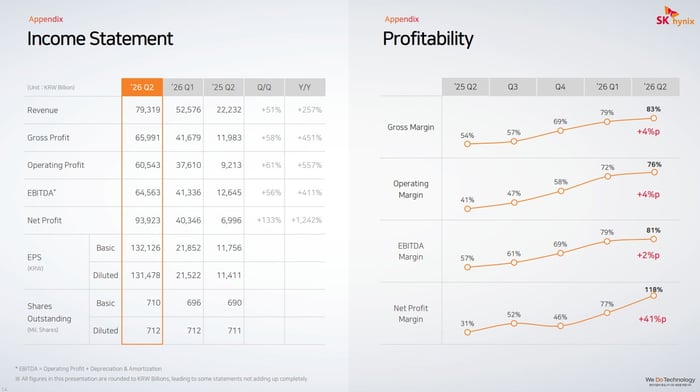
Image source: SK Hynix Investor Relations.
Nevertheless, SK Hynix stock met a harsh sell-off as the company missed elevated consensus estimates that had called for even higher revenue and operating profit. Moreover, fears around the memory cycle peaking and concerns over new Chinese capacity added to the decline.
SK Hynix's valuation profile makes the dip attractive
SK Hynix trades at a forward price-to-earnings (P/E) multiple of 5.5. This is within the same range as Sandisk, which sports a forward P/E ratio of 5.9. Micron is more elevated at 12.0x forward earnings.
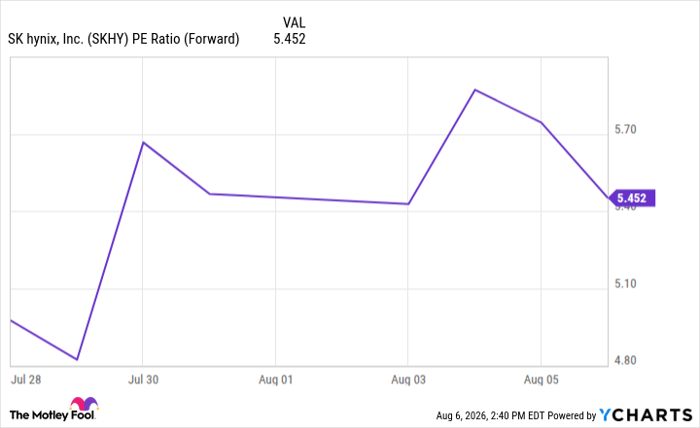
SKHY PE Ratio (Forward) data by YCharts.
With industry-leading HBM share, expanding long-term customer agreements, and secular tailwinds from sustained AI infrastructure demand, SK Hynix stands in a strong position to convert the memory supercycle into durable earnings growth.
I think the discount reflects temporary sentiment rather than a flaw in SK Hynix's underlying fundamentals. The recent sell-off, driven more by lofty expectations than operational weakness and matching broad tech sales on that day, creates an opportunity to buy the dip in one of the purest beneficiaries of AI-driven memory demand.
Should you buy stock in SK Hynix right now?
Before you buy stock in SK Hynix, consider this:
The Motley Fool Stock Advisor analyst team just identified what they believe are the 10 best stocks for investors to buy now… and SK Hynix wasn’t one of them. The 10 stocks that made the cut could produce monster returns in the coming years.
Consider when Netflix made this list on December 17, 2004... if you invested $1,000 at the time of our recommendation, you’d have $399,832!* Or when Nvidia made this list on April 15, 2005... if you invested $1,000 at the time of our recommendation, you’d have $1,374,595!*
Now, it’s worth noting Stock Advisor’s total average return is 968% — a market-crushing outperformance compared to 215% for the S&P 500. Don't miss the latest top 10 list, available with Stock Advisor, and join an investing community built by individual investors for individual investors.
See the 10 stocks »
*Stock Advisor returns as of August 9, 2026.
Adam Spatacco has no position in any of the stocks mentioned. The Motley Fool has positions in and recommends Micron Technology. The Motley Fool has a disclosure policy.
Recommended Articles


