


The Timeline to Sweeping Social Security Benefits Cuts Is Likely Being Accelerated by 3 of President Donald Trump's Policies
Key Points
Social Security's Old-Age and Survivors Insurance trust fund, which pays retired workers and survivor beneficiaries, is forecast to exhaust its asset reserves by the fourth quarter of 2032.
Two of Donald Trump's policies are fattening Social Security's annual cost-of-living adjustments (COLAs) -- but larger payouts come at a potentially steep cost to the program.
Additionally, President Trump's flagship tax and spending law is weighing on Social Security's primary source of funding.
- The $23,760 Social Security bonus most retirees completely overlook ›
For the better part of the last nine decades, Social Security has played a foundational role for retirees. Annual surveys by national pollster Gallup show that up to 90% of retirees rely on their monthly payout, in some capacity, to make ends meet.
But the financial outlook for this vital program has been deteriorating since the mid-1980s. The annually released Social Security Board of Trustees Report is forecasting a $29.3 trillion unfunded obligation through the year 2100.
Missed Nvidia in 2009? This Rare Signal Is Flashing Again. In 2009, a "Double Down" signal flashed for a little-known chipmaker called Nvidia. For the first time in years, that same "Total Conviction" signal is flashing for a company 1/100th the size of Nvidia. Continue »
Worse yet, the Old-Age and Survivors Insurance trust fund (OASI), which doles out monthly benefits to retired workers and survivors of deceased workers, is projected to exhaust its asset reserves by the fourth quarter of 2032. Once this excess income collected since inception is gone, sweeping benefit cuts of up to 22% are expected.

President Trump's policies have shifted Social Security's solvency needle in the wrong direction. Image source: Official White House Photo by Daniel Torok.
Although Social Security is in no danger of going bankrupt or halting benefits, a potential 22% benefit haircut is no walk in the park. While ongoing demographic shifts are primarily to blame for Social Security's shortcomings, three of President Donald Trump's policies are also playing a role in accelerating the timeline for broad-based benefit cuts.
The Iran war and sweeping global tariffs are leading to outsize Social Security "Trump bumps"
Social Security's Board of Trustees consider several factors when examining the financial outlook for America's leading retirement program, including the annual cost-of-living adjustment (COLA).
Social Security's COLA is essentially a raise given to recipients that's designed to offset the effects of inflation (rising prices). For instance, if the cost for a large basket of goods and services regularly purchased by seniors rises by 3% from one year to the next, Social Security benefits would need to climb by a commensurate percentage to avoid a loss of buying power.
When the Trustees formulate their projections, they're based on modest annual COLAs. However, thanks to two of President Trump's policies, Social Security's COLAs are being inflated.
For starters, the president introduced sweeping global tariffs and higher reciprocal tariffs on dozens of countries in April 2025. Although the U.S. Supreme Court ultimately invalidated these tariffs in February 2026, they boosted prices in the goods sector last year, resulting in a Social Security "Trump bump." In other words, Social Security's 2.8% COLA for 2026 was a bit higher due to Trump's tariffs.
The latest set of tariffs from President Trump took effect on Friday for more than 80 countries, covering virtually all U.S. imports.
-- PBS News (@NewsHour) July 24, 2026
They replace another set of tariffs, launched on what Trump called "liberation day," that the Supreme Court struck down earlier this year.
Liz... pic.twitter.com/MKethHhrfN
Last month, the Trump administration announced a new round of tariffs, ranging from 10% to 12.5%, on more than 80 countries. Adding duties to unfinished imported goods can increase production costs that lift prices for consumers.
In addition to tariffs boosting Social Security's COLA, the Trump-led Iran war should result in a sizable Trump bump in 2027. Not long after military operations against Iran began, the latter closed the Strait of Hormuz to virtually all commercial vessels. This resulted in the largest energy supply disruption in modern history and sent prices at the fuel pump soaring.
Price increases since start of the Iran war...
-- Charlie Bilello (@charliebilello) July 25, 2026
Sulfur: +146%
European Natural Gas: +98%
Heating Oil: +63%
Jet Fuel: +54%
Diesel: +40%
Gasoline: +38%
Brent Crude Oil: +35%
WTI Crude Oil: +35%
Rice: +35%
Diammonium Phosphate: +26%
Cotton: +22%
Palm Oil: +17%
Wheat: +15% pic.twitter.com/SMUk1ZAJOy
According to The Senior Citizens League, a nonpartisan senior advocacy group, Social Security's 2027 COLA is pacing 3.8%. Meanwhile, independent Social Security and Medicare policy analyst Mary Johnson is projecting a 3.7% COLA next year. Both estimates are well above the modest COLA figure the Trustees take into consideration when formulating their outlooks.
While outsize Social Security raises can put a smile on the faces of the program's more than 71 million traditional beneficiaries, they also threaten to drain the OASI's asset reserves even faster. The bigger the Social Security Trump bump, the more likely it is that the timeline to sweeping benefit cuts shifts forward.
Image source: Getty Images.
The "Big, Beautiful Bill's" tax breaks come at a steep cost to Social Security
But there's more to this story than just the president's tariffs and the Iran war. The highly touted "Big, Beautiful Bill," or BBB, is also shifting Social Security's solvency needle in the wrong direction.
For some taxpayers, the BBB has enabled them to keep more of their income. Though far from a complete list, Donald Trump's flagship tax and spending law provides:
- Senior tax deduction: Qualifying seniors aged 65 and above will receive an extra $6,000 standard deduction (or $12,000 if married and filing jointly) from calendar years 2025 through 2028.
- No tax on tips: From tax years 2025 through 2028, eligible workers can receive a dollar-for-dollar deduction of up to $25,000 on reported tip income.
- No tax on overtime: Additionally, eligible single filers can deduct up to $12,500 of their overtime pay (or $25,000 if filing jointly) from tax years 2025 through 2028.
However, there's a price to be paid by Social Security for these temporary tax cuts.
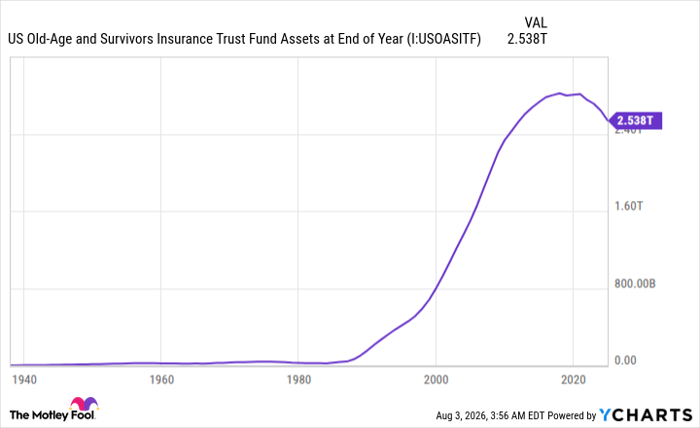
The big, beautiful bill is accelerating the timeline to the depletion of the OASI's asset reserves. US Old-Age and Survivors Insurance Trust Fund Assets at End of Year data by YCharts.
America's top retirement program has three income sources:
- The 12.4% payroll tax on earned income (wages and salaries, but not investment income) up to $184,500 in 2026.
- Interest income earned on the OASI's and Disability Insurance trust fund's asset reserves, which are invested in special-issue, interest-bearing government bonds, as required by law.
- The taxation of Social Security benefits.
The payroll tax accounted for more than 91% of the income Social Security collected in 2025. Through at least 2028, Trump's flagship tax and spending law is shrinking the pool of earned income subject to the payroll tax.
In August 2025, in response to a request from Sen. Ron Wyden (D-OR), the Social Security Administration's Office of the Actuary (OACT) published a 10-year projection of the effects of the big, beautiful bill on Social Security. The OACT analysis estimated that the president's law would increase program costs by $168.6 billion from 2025 through 2034 and shorten the timeline to the depletion of the OASI's asset reserves by three months.
Between Social Security's outsize Trump bumps and the big, beautiful bill, the program's financial outlook has gone from bad to worse.
The $23,760 Social Security bonus most retirees completely overlook
If you're like most Americans, you're a few years (or more) behind on your retirement savings. But a handful of little-known "Social Security secrets" could help ensure a boost in your retirement income.
One easy trick could pay you as much as $23,760 more... each year! Once you learn how to maximize your Social Security benefits, we think you could retire confidently with the peace of mind we're all after. Join Stock Advisor to learn more about these strategies.
View the "Social Security secrets" »
The Motley Fool has a disclosure policy.
Recommended Articles


