


3 Robotics and Automation Stocks to Buy in August
Key Points
Rockwell Automation is a highly profitable industrial automation leader that should benefit from AI-driven factory modernization.
Ouster is a LiDAR and perception technology company giving investors exposure to the “eyes” of robotics.
Symbotic is a fast-growing warehouse automation company backed by Walmart.
- 10 stocks we like better than Rockwell Automation ›
As breakthroughs in artificial intelligence (AI) models and chip technology evolve, robotics and automation are expanding from single-task machinery to intelligent, general-purpose systems. These advancements are expected to drive strong adoption across factories, manufacturing, food service, and healthcare settings.
According to research published by Future Market Insights, the industrial robotics market could grow from $65 billion this year to nearly $344 billion by 2036, representing an 18% compound annual growth rate (CAGR). With such strong growth projected in the coming decade, here are three robotics and automation stocks investors can consider buying in August.
Where to invest $1,000 right now? Our analyst team just revealed what they believe are the 10 best stocks to buy right now, when you join Stock Advisor. See the stocks »
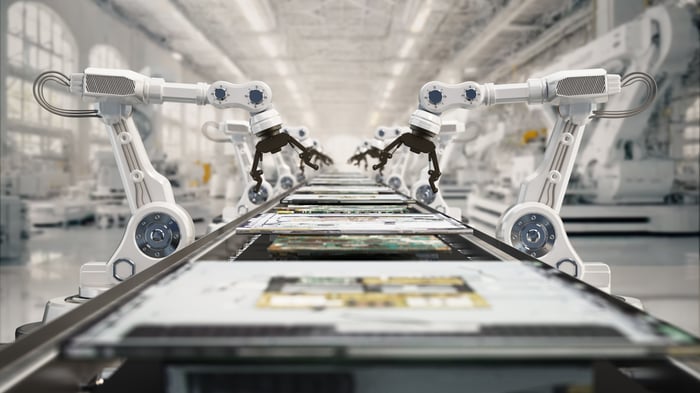
Image source: Getty Images.
Rockwell's Control Systems create sticky customer relationships
When it comes to industrial automation, Rockwell Automation (NYSE: ROK) is one of the biggest in the world. The company develops the "brains" of robotics, including drives, sensors, motion controls, and related software that tell robots how and when to move and what to do next. So while a factory owner could swap out old robotic arms for newer models, Rockwell's systems remain in place.
Rockwell stands out thanks to its dominant 50% market share of programmable logic controllers (through its subsidiary Allen-Bradley) in North America, giving it a robust competitive advantage as Western manufacturers look to reshore and modernize industrial automation processes. On top of this, once its architecture is in place, many factory operators don't want to switch or retrain it, and the switching costs become prohibitive.
The company has a stellar track record and boasts gross margins of 49%, while operating margins hover around 22%, making it a highly profitable company that should benefit from the tailwinds of growing AI and automation. In the second quarter, the company reported $2.2 billion in sales, up 9%, while generally accepted accounting principles (GAAP) earnings per share (EPS) rose 40% to $3.10.
Rockwell is building on its position and is looking toward the nuclear energy market next. It was recently selected by Aalo Atomics as the control platform provider for its Aalo-X test reactor, which is part of the U.S. Department of Energy's pilot program to accelerate the development of advanced nuclear technologies. This move also positions it to be a key player in the long-term growth of small modular reactor (SMR) technologies.
Ouster manufactures the "eyes" of automation
For investors seeking growth, Ouster (NASDAQ: OUST) is a robotics stock on the rise. If Rockwell provides the brains, then Ouster provides the eyes for robotics. The company develops digital 3D LiDAR (light detection and ranging) hardware and spatial perception software, with sensors built on a custom silicon chip architecture.
Its technology enables spatial navigation and mapping, letting mobile robots navigate complex environments, including warehouses, crop fields, or tunnels, without needing to use light or global positioning systems. Unlike many peers that went all-in on self-driving vehicles, Ouster has diversified into industrial machinery and infrastructure.
In Q1, Ouster's revenue surged 49% to $48.6 million, while its gross profit jumped 55% to $20.8 million. The company's advantage comes from its digital chip architecture, and its recent quarter saw stellar profit margins of 43%. To be sure, the company did post a net loss of $17.4 million and recently raised $200 million by issuing 3.6 million shares of common stock, so investors must balance its rapid growth against its ongoing investments in automation technologies and the possible dilution of their ownership stake.
Looking ahead, Ouster aims to become a full-stack, high-margin physical AI perception platform by unifying stereo camera vision, 3D digital LiDAR, and edge perception software. If it succeeds, it could lock in customers across robotics and smart infrastructure and improve recurring revenue as it works toward profitability.
Symbotic is a Walmart-backed automation play in distribution centers
Symbotic (NASDAQ: SYM) is another growing company developing AI-powered supply chain technology for automating warehouse systems. The company builds autonomous systems to help automate processes across the supply chain for retailers, including robots that operate in three dimensions. It also helps redesign traditional distribution infrastructure, enabling customers to manage higher inventory levels without increasing their physical footprint.
The company is deeply integrated into Walmart, its biggest single customer and an investor in Symbotic stock. Walmart owns 15 million Class A shares in Symbotic, giving it roughly an 11% ownership stake in the company. Walmart has a vested interest in Symbotic and is actively deploying its end-to-end system in all 42 of its U.S. regional distribution centers.
Through the first half of Symbotic's fiscal year ended March 28, revenue surged 26% to $1.3 billion, while net income flipped from a loss of $26.7 million last year to a profit of $22.8 million.
Of course, investing in Symbotic comes with risks. For example, the company expects to spend $20 million to $25 million per quarter as it rolls out its next-generation systems, which are expected to significantly shorten installation assembly times.
Looking ahead, Symbotic plans to introduce prototype products targeting e-commerce fulfillment (SyMicro), automated pickup and delivery (APD), and cold-storage environments. For investors looking for exposure to warehouse automation backed by a retail giant, Symbotic is an intriguing growth stock to scoop up now.
Should you buy stock in Rockwell Automation right now?
Before you buy stock in Rockwell Automation, consider this:
The Motley Fool Stock Advisor analyst team just identified what they believe are the 10 best stocks for investors to buy now… and Rockwell Automation wasn’t one of them. The 10 stocks that made the cut could produce monster returns in the coming years.
Consider when Netflix made this list on December 17, 2004... if you invested $1,000 at the time of our recommendation, you’d have $395,463!* Or when Nvidia made this list on April 15, 2005... if you invested $1,000 at the time of our recommendation, you’d have $1,268,290!*
Now, it’s worth noting Stock Advisor’s total average return is 927% — a market-crushing outperformance compared to 211% for the S&P 500. Don't miss the latest top 10 list, available with Stock Advisor, and join an investing community built by individual investors for individual investors.
See the 10 stocks »
*Stock Advisor returns as of August 5, 2026.
Courtney Carlsen has no position in any of the stocks mentioned. The Motley Fool has positions in and recommends Symbotic and Walmart. The Motley Fool recommends Rockwell Automation. The Motley Fool has a disclosure policy.
Recommended Articles


