


TradingKey Daily Market Brief: Gold Falls Below $4,000, TSMC’s Strong Earnings Fail to Stop AI Trade Cooling, Chip Stocks Sold Off

Tracking Market Trends
TradingKey - On July 16, Eastern Time, the three major US stock indexes closed down collectively. Although US economic data performed robustly and the start of the Q2 earnings season was generally better than expected, a continued sell-off in chip and AI hardware stocks dragged the Nasdaq and S&P 500 lower. Concerns about high valuations in AI trades, the return cycles of corporate capital expenditures, and the excessive previous gains in the semiconductor sector continued to escalate.
At the close, the Dow Jones Industrial Average fell 0.20% to 52,558.27 points; the S&P 500 Index declined 0.51% to 7,533.77 points; the Nasdaq Composite Index fell 1.47% to 25,881.95 points.
In terms of sectors and individual stocks, tech stocks were the core drag on the indexes. The Philadelphia Semiconductor Index tumbled 4.29%, weakening for the second consecutive trading day. Nvidia ( NVDA) fell 2.4%, TSMC ADR ( TSM) fell 2.32%, Micron Technology ( MU) fell 5.65%, SanDisk ( SNDK) plummeted 12.63%, AMD fell 5.33%, Intel ( INTC) fell 5.84%, Marvell Technology ( MRVL) fell 8.71%. Stocks related to storage, AI hardware, and semiconductor equipment became the main focus of the day's sell-off, indicating that divergence within the core AI theme is still widening.
In commodities, crude oil prices edged down slightly but remained near a one-month high. WTI crude ( USOIL) closed down 0.85% at $79.57; Brent crude ( UKOIL) closed down 0.26% at $84.85. Gold ( XAUUSD) fell sharply, with spot gold falling 2.06% to $3,976.28, closing below $4,000, and at one point touching its lowest level since early July.
Market News
TSMC reports record Q2 profit as AI chip demand remains strong. TSMC released its second-quarter financial results, with net profit rising 77% year-on-year to NT$706.6 billion (approximately $22 billion), significantly beating market expectations and hitting a record quarterly high. As the core contract chipmaker for companies like Nvidia and Apple, TSMC continues to benefit from the growing demand for AI processors and advanced manufacturing nodes.
U.S. economic data remains resilient. U.S. retail sales grew by 0.2% in June, largely matching market expectations and indicating that consumer spending remains supportive. For the week ended July 11, initial jobless claims fell to 208,000, lower than market expectations, reflecting a still relatively robust labor market. Solid consumer and employment data help support expectations of an economic soft landing, but also make it more difficult for the Fed to quickly pivot to easing.
U.S.-Iran conflict continues to disrupt energy markets. The U.S. and Iran continued to exchange fire on Thursday, with the conflict largely shattering the previous temporary ceasefire. Although crude oil prices retreated slightly on the day, Brent and WTI remained near recent highs. The market is particularly focused on the risks facing two energy corridors: restricted passage through the Strait of Hormuz, and Iran's demand for the Houthis to prepare to close the Bab el-Mandeb Strait, the entrance to the Red Sea, if necessary. If both shipping lanes are disrupted simultaneously, global tanker shipping, insurance costs, and energy supply chain pressures could all rise further.
Fed officials signal caution. Federal Reserve Vice Chair Jefferson stated that he currently supports keeping interest rates steady, but does not rule out another rate hike if inflation does not ease soon. He emphasized that the Fed must still adhere to its 2% inflation target, warning that recent rises in energy prices, tariffs, and AI investment demand could all pose new upward pressures on inflation. These remarks suggest that, although this week's CPI and PPI data cooled somewhat, rising oil prices mean the market still cannot fully rule out the risk of another rate hike this year.
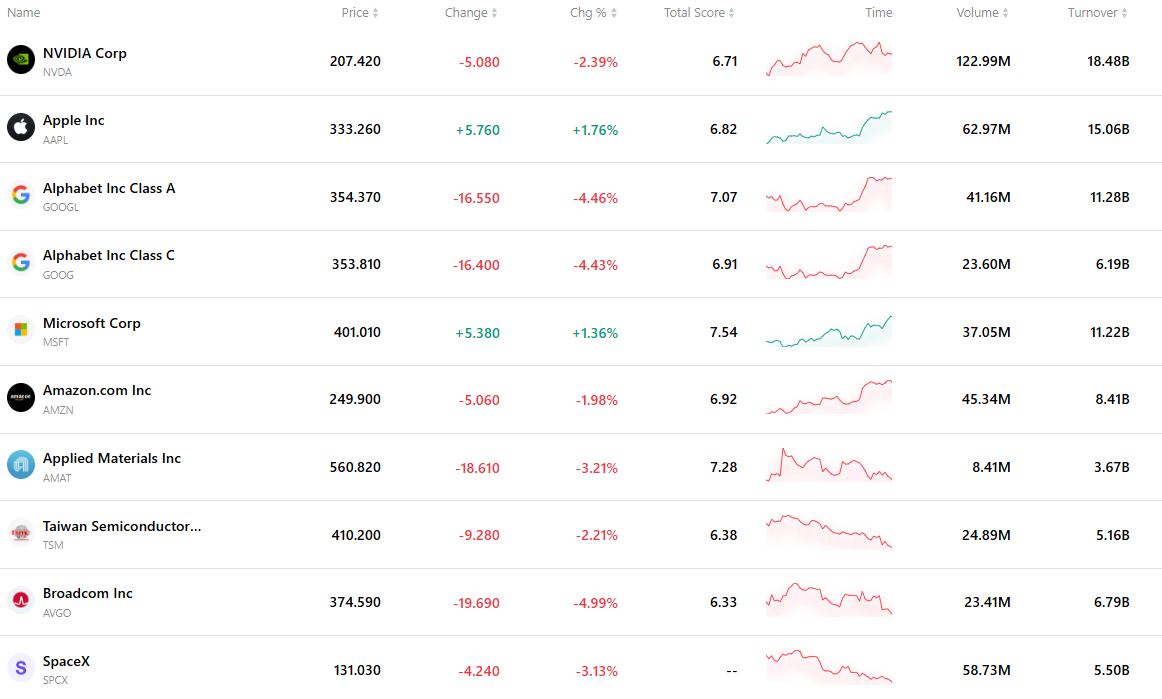
Top 10 Most Active Stocks
The table below lists the ten most actively traded stocks in the market recently. Backed by massive trading volumes and excellent liquidity, these assets have become key benchmarks for tracking global market dynamics.
Read more
* The content presented above, whether from a third party or not, is considered as general advice only. This article should not be construed as containing investment advice, investment recommendations, an offer of or solicitation for any transactions in financial instruments.


