


Investing $500 per Month in This ETF Could Set You Up for Life, According to History
Key Points
If you're committed to owning stocks for the long haul, simpler is usually better.
Index funds also don't create the temptation to buy low and sell high -- a strategy that often does more harm than good.
Even if you can't save $500 per month, saving something sooner is better than tucking away bigger amounts of money later.
- 10 stocks we like better than SPDR S&P 500 ETF Trust ›
Warren Buffett was right when he said, "There seems to be some perverse human characteristic that likes to make easy things difficult." Too many investors are constantly hunting for the next great growth stock, only to suffer avoidable setbacks by owning the wrong risky stocks. These people could do at least as well -- if not better -- with a simpler approach. That's investing a modest amount of money in the same boring exchange-traded fund (or ETF) the whole time you're growing your nest egg.
Here's the math, and a visualization of it.
Where to invest $1,000 right now? Our analyst team just revealed what they believe are the 10 best stocks to buy right now, when you join Stock Advisor. See the stocks »

Image source: Getty Images.
Slow and steady wins the race
The ETF in question is the SPDR S&P 500 ETF Trust (NYSEMKT: SPY), although the Vanguard S&P 500 ETF (NYSEMKT: VOO) would do just as well. Both are built to mirror the performance of the S&P 500 (SNPINDEX: ^GSPC), which has logged an average annual gain of just over 10% since 1957. Some years were better. Other years were (much) worse. But the historical average is reliable enough to use as a projection of the index's future performance.
So how much would you need to invest in one of these simple index funds to amass, say, $1 million -- or more -- over the course of 30 years? As the graphic below illustrates, tucking away just $500 per month in an investment that gains an average of 10% per year would leave you with just over $1.1 million in 30 years.
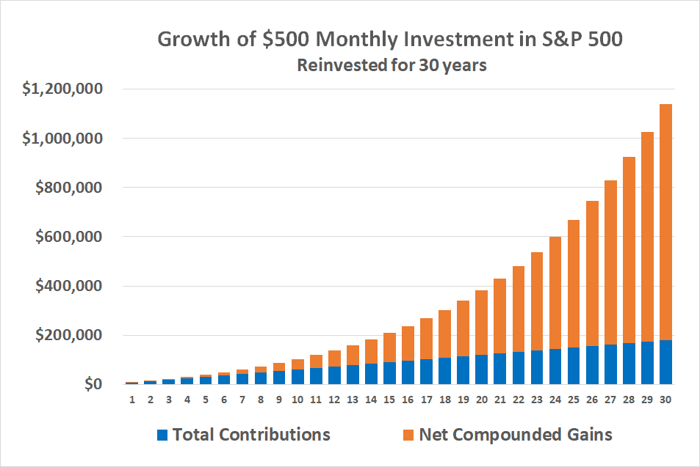
Data source: Calculator.net. Chart by author.
Notice that most of the net gain materialized in just the last third of the 30-year stretch. That's when the power of compound interest really kicks in, driving exponential growth on all the gains made up until that point.
Something is better than nothing, and sooner is better than later
Granted, $1.1 million won't be worth as much 30 years from now as it is today. In today's dollars, it would be worth only $548,000, or about half of that projected amount. That's still not bad, but it's a far cry from being "set up" for life. You'd still need to watch your spending very carefully with a nest egg of that size, leaving little to no room for monetary missteps.
Just don't forget that your disposable/investable income will also grow in step with inflation over the next three decades. You're also likely to receive pay raises stemming from experience-based career advancement. This, of course, means you'll have a good chance of ending the 30-year time frame with measurably more than $1.1 million.
The bigger takeaway, however, is this: Start saving as soon as you possibly can. Even if you can't invest $500 per month, even half that amount is enough to make a difference. Time does most of the heavy lifting here, so you want to give every dollar you can as much time as you can to do that work.
This might put things in perspective: Earning 10% annually on a $1.00 investment would equal $2.59 in 10 years, and $6.73 in 20 years. After 30 years, though, that $1.00 would be worth $17.45.
Should you buy stock in SPDR S&P 500 ETF Trust right now?
Before you buy stock in SPDR S&P 500 ETF Trust, consider this:
The Motley Fool Stock Advisor analyst team just identified what they believe are the 10 best stocks for investors to buy now… and SPDR S&P 500 ETF Trust wasn’t one of them. The 10 stocks that made the cut could produce monster returns in the coming years.
Consider when Netflix made this list on December 17, 2004... if you invested $1,000 at the time of our recommendation, you’d have $379,662!* Or when Nvidia made this list on April 15, 2005... if you invested $1,000 at the time of our recommendation, you’d have $1,206,116!*
Now, it’s worth noting Stock Advisor’s total average return is 886% — a market-crushing outperformance compared to 206% for the S&P 500. Don't miss the latest top 10 list, available with Stock Advisor, and join an investing community built by individual investors for individual investors.
See the 10 stocks »
*Stock Advisor returns as of July 28, 2026.
James Brumley has no position in any of the stocks mentioned. The Motley Fool has positions in and recommends Vanguard S&P 500 ETF. The Motley Fool has a disclosure policy.
Recommended Articles


