


Should You Forget Big Banks and Bet on Fintech Instead?
Key Points
Big banks like JPMorgan can deliver steady earnings growth.
A fintech disruptor like Nu Holdings is growing quickly, but comes with a riskier business model.
The better stock to buy depends on your personal investing goals.
- 10 stocks we like better than JPMorgan Chase ›
The internet, smartphones, and digital payments have made a once-stodgy industry -- banking -- much more competitive in the 21st century. New financial technology (fintech) players like Nu Holdings (NYSE: NU) have built consumer banking businesses entirely on smartphones. At the same time, legacy giants like JPMorgan Chase (NYSE: JPM) continue to generate gobs of profits through highly diversified financial services offerings.
What is the best buy for your portfolio today: big banks or fintech disrupters? The answer may depend on who you are as an investor.
Where to invest $1,000 right now? Our analyst team just revealed what they believe are the 10 best stocks to buy right now, when you join Stock Advisor. See the stocks »
Big bank reliability
The big banks like JPMorgan have sticky relationships with customers, ranging from individuals to some of the world's largest corporations. Customers flock to big banks for their branding, their balance sheets, and the variety of services they offer.
With diversified revenue streams, JPMorgan has been consistently profitable for the last 10 years, generating a record net income of nearly $65 billion over the last 12 months. This stems from its offerings in commercial banking, investment banking, consumer banking (through the Chase brand), and asset management for wealthier clients.
As the global economy grows, so should JPMorgan's lending and banking services. The more deposits it houses on its balance sheet -- total assets grew to $3.7 trillion last quarter -- the better able the bank is to make loans and other investments. For example, last year the company committed $1.5 trillion to making loans and direct investments over the next 10 years in sectors relevant to U.S. national security.
JPMorgan trades at a price-to-earnings ratio (P/E) of about 15, with a dividend yield of 1.7%. It is not as cheap as it has been historically, but I believe its investors will see slow, steady gains and solid dividend income.
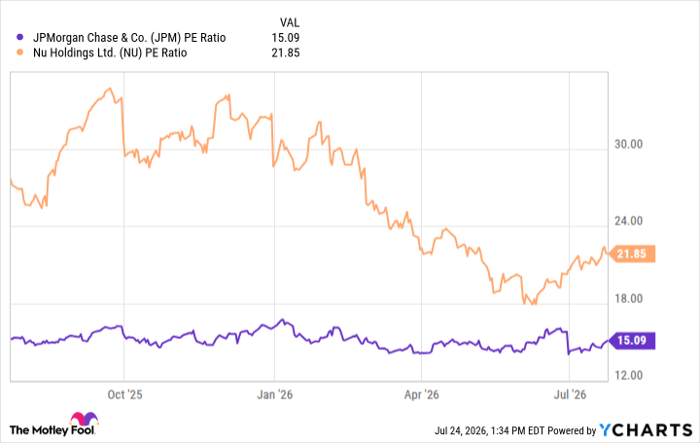
JPM PE Ratio data by YCharts
Growing fintech revenues
On the other end of the banking spectrum are fintech disruptors such as Nu Holdings, which operates the Nu Bank brand. It is an entirely digital banking application that has quickly grown into a leadership position in Latin American countries such as Mexico, Brazil, and Colombia, with plans to enter the U.S. market in the near future once it obtains a banking license.
Nu Bank is much smaller than a big bank like JPMorgan, with $42 billion in deposits at the end of last quarter. However, the business is growing quickly, with 135 million banking customers, having been founded only in 2013. In the last three years, its revenue has increased by 170%, a much faster growth rate than JPMorgan's cumulative growth of 31%.
From a business model standpoint, Nu Bank is less diversified than JPMorgan, depending heavily on consumer credit card spending and on personal loans to Brazilians and Mexicans, making it a riskier investment. At the same time, it trades at a P/E ratio of 22, which is not overly expensive but slightly higher than what one sees looking at the big banks.

Image source: Getty Images.
Which is the better buy?
An older investor seeking dividend income and steady earnings may favor JPMorgan over fintech disruptors such as Nu Holdings. On the other hand, investors who want to take a little more risk may favor a growth stock like Nu Holdings or other fintech players such as SoFi Technologies. Nu Bank is nowhere near the household name that JPMorgan is, but it is a smaller company with a strong track record of growth that could deliver multibagger gains.
For my money, an investor with a decade-long time horizon will do better owning Nu Holdings stock. It trades at a P/E ratio only slightly higher than JPMorgan's and is growing rapidly. Even though it has a shorter history as a bank (it is hard to compete with the hundred-plus years of brand building at JPMorgan Chase), this risk is more than offset by its growth potential.
Should you buy stock in JPMorgan Chase right now?
Before you buy stock in JPMorgan Chase, consider this:
The Motley Fool Stock Advisor analyst team just identified what they believe are the 10 best stocks for investors to buy now… and JPMorgan Chase wasn’t one of them. The 10 stocks that made the cut could produce monster returns in the coming years.
Consider when Netflix made this list on December 17, 2004... if you invested $1,000 at the time of our recommendation, you’d have $379,662!* Or when Nvidia made this list on April 15, 2005... if you invested $1,000 at the time of our recommendation, you’d have $1,206,116!*
Now, it’s worth noting Stock Advisor’s total average return is 886% — a market-crushing outperformance compared to 206% for the S&P 500. Don't miss the latest top 10 list, available with Stock Advisor, and join an investing community built by individual investors for individual investors.
See the 10 stocks »
*Stock Advisor returns as of July 28, 2026.
JPMorgan Chase is an advertising partner of Motley Fool Money. Brett Schafer has positions in Nu Holdings. The Motley Fool has positions in and recommends JPMorgan Chase and Nu Holdings. The Motley Fool has a disclosure policy.
Recommended Articles


