


Alphabet Just Delivered a Piece of AI-Related News That Sent Its Stock Tumbling. Should You Buy the Dip, or Run for the Hills?
Key Points
Alphabet's Google Search and Google Cloud businesses delivered strong growth in the second quarter of 2026, driven by artificial intelligence (AI).
The company just raised its capital expenditures forecast for 2026 as it races to build more AI data centers, which made investors nervous.
Alphabet stock is down 20% from its recent all-time high and looks cheap on the surface, but I'm not in a hurry to buy it.
- 10 stocks we like better than Alphabet ›
Alphabet (NASDAQ: GOOG)(NASDAQ: GOOGL) released its operating results for the second quarter of 2026 (ended June 30) after the market closed on Wednesday. Once again, artificial intelligence (AI) fueled strong revenue growth in important businesses like Google Search and Google Cloud.
However, Alphabet said it plans to spend even more on AI data centers during 2026 than originally expected, which made investors uneasy. These capital expenditures (capex) could seriously hurt the company's earnings power over the next few years, and thus lead to sluggish returns in its stock.
Where to invest $1,000 right now? Our analyst team just revealed what they believe are the 10 best stocks to buy right now, when you join Stock Advisor. See the stocks »
Alphabet stock immediately fell by around 7% following the release of the Q2 report, and it's now down 20% from its recent all-time high. Could this be the ultimate buying opportunity for long-term investors?
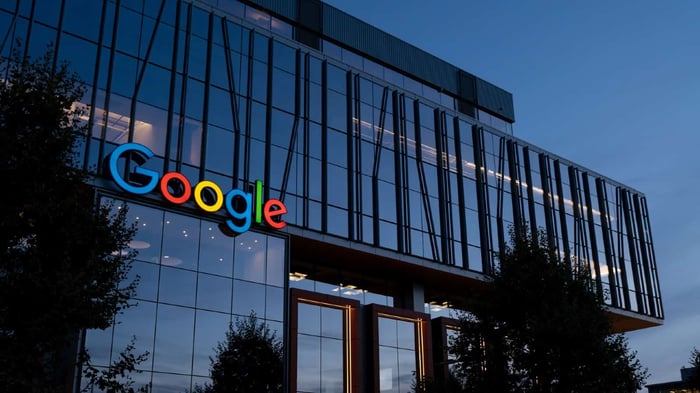
Image source: Alphabet.
Another strong quarter for Google Search and Google Cloud
Google Search's advertising business is Alphabet's largest source of revenue. The company has infused AI-powered features into the search engine to fight off the competitive threat from chatbots like OpenAI's ChatGPT, and the strategy is working.
First, AI Overviews use text, images, and links to third-party sources to provide AI-generated answers to queries in Google Search. They appear above the traditional search results, so users no longer have to dig through web pages to find the information they need. Then there is AI Mode, which opens a chatbot-style interface where users can expand on their original query by asking follow-up questions. AI Mode already has 1 billion monthly active users, despite only launching globally last October.
Alphabet said these features are driving increased search usage overall. This is great news because it means users are seeing more ads, and the company is making more money. On that note, Google Search generated a record $63.3 billion in revenue during Q2, up 17% from the year-ago period.
Google Cloud also had a very strong quarter. The cloud platform operates data centers all over the world that house thousands of specialized AI chips, and it rents the computing power to other businesses. It also offers a platform called Gemini Enterprise, where businesses can turn that computing capacity into finished AI chatbots, agents, and other applications. Alphabet says 90% of the Fortune 100 companies are using it already.
Google Cloud has consistently been the fastest-growing piece of Alphabet's business over the last couple of years, purely because of demand for AI-related services. Its revenue surged by 82% during Q2, to $24.8 billion.
Alphabet raised its capital expenditures forecast
While Google Cloud is already growing at a blistering pace, it had a staggering $514 billion order backlog as of June 30, a $50 billion increase from the first quarter of 2026 just three months earlier. Most of that backlog was from AI customers who were waiting for more data center capacity to come online. In order to meet their needs, Alphabet has to spend a truckload of money to build more infrastructure.
When discussing the company's Q2 operating results, management said capex was on track to come in somewhere between $195 billion and $205 billion during 2026. That forecast was revised higher from $180 billion to $190 billion in management's previous update, and it followed $91 billion in spending last year.
Data centers and chips usually have a useful life of several years, so Alphabet doesn't account for these costs up front. Instead, it depreciates the infrastructure over time, which means these enormous capex sums could erode Alphabet's profits for years to come. That won't be a problem if AI computing capacity and enterprise tools remain in high demand, but that isn't a guarantee.
That's why investors wince every time a hyperscaler like Alphabet ramps up its capex plans even further. Every misallocated dollar today could reduce the company's earnings and dent its stock price for a very long time.
Alphabet stock looks cheap, so should investors buy the dip?
On the surface, Alphabet's Q2 earnings soared by 294% year over year to $9.11 per share. But that's only because the company experienced a staggering $98 billion increase in the value of its investment holdings in companies like Anthropic and Space Exploration Technologies, which had nothing to do with its operating performance.
If we exclude those gains and also factor in Alphabet's capex, the company actually generated negative free cash flow of $5.8 billion during Q2.
Alphabet stock is trading at a much lower price-to-earnings (P/E) ratio than the Nasdaq-100 index (24.3 versus 33.4), suggesting it's cheaper than a basket of its big-tech peers. However, the stock might be far more expensive than it appears at face value after accounting for investment gains and capex, as demonstrated above.
I'm not saying Alphabet is a bad investment. It's a brilliant company with loads of long-term potential. But as an investor who doesn't already own it, I plan to wait on the sidelines for some of the dust to settle. If management adopts a more cautious approach to capex over the next couple of quarters, I might consider buying the stock.
Should you buy stock in Alphabet right now?
Before you buy stock in Alphabet, consider this:
The Motley Fool Stock Advisor analyst team just identified what they believe are the 10 best stocks for investors to buy now… and Alphabet wasn’t one of them. The 10 stocks that made the cut could produce monster returns in the coming years.
Consider when Netflix made this list on December 17, 2004... if you invested $1,000 at the time of our recommendation, you’d have $377,990!* Or when Nvidia made this list on April 15, 2005... if you invested $1,000 at the time of our recommendation, you’d have $1,269,518!*
Now, it’s worth noting Stock Advisor’s total average return is 896% — a market-crushing outperformance compared to 206% for the S&P 500. Don't miss the latest top 10 list, available with Stock Advisor, and join an investing community built by individual investors for individual investors.
See the 10 stocks »
*Stock Advisor returns as of July 26, 2026.
Anthony Di Pizio has no position in any of the stocks mentioned. The Motley Fool has positions in and recommends Alphabet. The Motley Fool has a disclosure policy.
Recommended Articles


